Showing posts with label Canada. Show all posts

Sunday, February 24, 2019

Resources for Black History Month in Canada

Barely squeaking it in before the end of February, I have just updated the LINKS page of www.kellymorrissey.com to include the resource links that Irene Moore Davis gave to attendees of her presentation to TESL Windsor, "Creative Strategies to Teach Black History in ESL Settings."


Hopefully we will all remember that they are there when February rolls around again in 2020. Or perhaps we won't limit ourselves to only covering African Canadian history one month of the year!

Do you have any good resources to add to that list?

Monday, November 19, 2018

Striving to Include Aboriginal Perspectives

The seniors voted to study Canada, among two other themes. Never has this class really delved deeply into the topic of Aboriginal perspectives. Yes, at Thanksgiving, I posted THIS VIDEO to give them something to think about and us something to talk more about. But--with their permission--I wanted to try to do more than that.

We started the unit by brainstorming what we THINK we already know about the indigenous peoples of Turtle Island, on which most of us are settlers or descendants of settlers. Could we even say, perhaps, occupiers? The brainstorming session revealed that we think of native people in the past tense. So we talked about that and about the five or six most common stereotypes to come out of Hollywood and mass media.

Since I have a multilevel class and since the previous week's material had been quite challenging for some, I decided that a nice overview and starting point would be Joan Acosta's Best of the Reader - Canada's Aboriginal People. 

I've extended the content with the Heritage Minute about Chanie Wenjack and Gord Downie's short film The Secret Path.

Trying to find a suitable film created by an Inuit, First Nations or Metis individual on NFB.ca proved daunting. There are too many for me to preview them all! I chose to show To Wake Up the Nakota Language. We also used Our Home on Native Land interactive territory map.

I think a good final project might be for us to create a poster for the lobby acknowledging that our school is on land that is the traditional territory of the Attawandaron, Anishaabeg, and Haudenosaunee peoples.

As we work our way through this material, I provide opportunities for discussion and for deeper processing of the language we encounter as we read and listen.

You can find more helpful resources, especially for higher levels, on my LINKS page under Indigenous Perspectives / Reconciliation. If you know of other resources that should be listed there, please let me know.

How about you? How do you try to incorporate indigenous perspectives and the topic of reconciliation in your teaching?


#PBLA P.S. Check out the many powerful comments on my penultimate post.

Sunday, October 8, 2017

Get More Bang for Your Lesson Planning Buck

One thing that I love about the principles of Back to the Well is that both teacher and student get something out of it. If you're interested in what the students get out of it, you can read a whole whack of posts on this blog under the category label of 'Back to the Well.' You can also read A Year of Slow in the Spring 2015 issue of Contact, an article I co-wrote with John Sivell, recently retired from Brock University's Department of Applied Linguistics.

What I want to talk about today is one of the reasons it is teacher-friendly, namely that it increases the ROI of my lesson planning time and energy.

This week the seniors, for example, were studying The Battle of Vimy Ridge. This topic was being explored in response to their request for more lessons about Canada. They also have requested more field trips, and I thought that studying an historic event like the victory at Vimy would be a great way to prepare for a trip to Jackson Park, where they will encounter many war memorials and monuments.

I invested my time in the creation of a short text about the battle. It is a simplified combination of two texts I found on the Internet. It was not easy for me to get the story down to five short paragraphs with pictures. It took the better part of an evening.

But now that we have it, there are so many ways we are able to milk this text for many types of linguistic affordances. Here is how our week played out in a class. (It is for the most part a listening/speaking course.)

Monday we did a KWL warm-up followed by my pre-teaching new vocabulary and introduction to the text. We did choral repetition, which they repeatedly ask me for. I threw out some discussion questions to give them their daily dose of oral practice and to up the student talk time.
Tuesday they read the text again individually and for a partner. After break I circulated some trench image cards that I had been able to download for free from the Internet over the weekend. In groups of 2-3, students had to ask one another, "What's happening?" The lower level students were able to participate easily since pictures were of familiar activities (a soldier is cutting his friend's hair in the trench; a soldier is eating bread in the trench; the soldiers are washing their feet in the trench).
trench image cards - soldiers in the trenches engaged in daily activities

Wednesday I distributed one trench image card to each student and gave them 15 minutes of dictionary time. Next I gave them ten minutes to practice telling a partner about a photo card. Finally I had each student come to the front of the class to tell about his/her card. NB: I took all cards away from students so that they would give their full attention to the person at the front of the room instead of nervously continuing to look at their translators, study their card, etc., in preparation for their turn. As each student came up, I held up his/her assigned photo card for all to see.

Thursday before the break we went back into the text with two discussion questions and two vocabulary exercises:
1) When we studied Confederation, we learned that Canada's birthday is July 1, 1867. So then what did Brigadier-General Ross mean when he said that at Vimy he had seen 'the birth of a nation?'
2) Can you think of a historic event that contributed to a sense of nationhood for your first country? What is it? (Not all compatriots will agree.)
3) Choose 3-5 useful words or chunks from the text and use them in new sentences.
4) Choose one interesting word from the text and look up its synonyms. Can any of the synonyms be substituted for the original word? Discuss your answer with a classmate.

Higher level students tackled all four items while lower level students skipped the abstract discussion questions and did the vocabulary study.

After break was a dictation with short, simple sentences on this now very familiar topic. For example: The trenches were cold, muddy, and full of rats. Soldiers could get trench foot. German prisoners helped carry out the wounded. And so forth.

After taking up the dictation, I then had them do another activity with the same sentences. Students got into small groups and I gave each group of 3-4 students one die.

On the board I wrote, "Start with the first sentence. Take turns rolling the die. According to your roll of the die, do one of the following:
1 - Read the sentence.
2 - Change positive to negative / negative to positive.
3 - Change the tense of the sentence.
4 - Make a question that the sentence answers.
5 - Change one word in the sentence to a synonym that works as well as the original word.
6 - Say "Really?" and then the sentence with surprised, questioning intonation."

Friday we had to postpone the field trip due to rain. Instead students used Flipgrid for the first time. I enticed them to give it a try by offering them a video tour of my apartment that I had created on the weekend. Each student recorded an introduction under that thread and then moved on to reflections on the week's learning. I wish there was a quick and easy way to convert the URL of our grid to a QR code for inclusion in their portfolios.
Seniors can use Flipgrid!

In short, not only does going 'Back to the Well' allow students' brains to make more neural connections with the lexis, but it frees up many evenings for a teacher who wants a life outside of eternal lesson preparation.

Sunday, October 1, 2017

Google Slides for Quick and Dirty Desktop Publishing

I am so OVER using a word processor to quickly create newsletters, Language Experience Approach (LEA) books with literacy students, and multi-page worksheets for my classes. Thanks to Tony Vincent and his Classy Graphics course that I took over the summer, I now turn to Google Drawing for one-page worksheets, handouts or posters. Google Slides can be used in the exact same way when you need a document to have several pages.

To use Google Slides to create a series of worksheets or a booklet, you simply change the page settings to 8.5" x 11" or to whatever your page dimensions need to be. One reason I love using these tools in the Google suite of tools is that I no longer find myself searching through a bunch of (not very intuitive) menus to find the setting I'm looking for. I'm tired of fighting with Word over headers and footers that need to start after the cover and inside front cover, or which need to be different section to section. I'm a smart person who has taken MANY classes, and after twenty years, the software should NOT still be giving me headaches. The interface in the suite of Google tools is easy to learn to use. It's more intuitive than a word processor and makes editing or making small and large changes to layout a breeze.

A few features that I enjoy in Google Slides and Google Drawing include the following:

  • Images stay where I put them. I can easily resize using handles.
  • Double clicking an image allows me to CROP IT IN PLACE! (Be still, my heart.)
  • Columns of text stay where I put them, do not run onto the next page when my back is turned!
  • I don't find myself needing to turn on REVEAL CODES to see why my document's content is 'acting up.'
  • All my creations reside on my Google Drive, available to me from any computer hooked to the internet. No more carrying around a flash drive!
  • I can easily share with my colleagues and with you.
  • By embedding the document in my website, any improvements I make to the original on my Google Drive automatically feed through to the one on my website!!! (This is so time-saving since I am a tweaker.)
This week I used Google Slides to create a variety of activities to enrich an upcoming field trip to Jackson Park / Queen Elizabeth II Gardens that my multilevel seniors class has requested. 

If you teach LINC in Windsor's downtown core (or just want to see a booklet that was created in Google Slides), you can download this activity pack for use with your own class. With Bloom's Taxonomy in mind, I provided at least one activity for each level of this pedagogical hierarchy. This week I will show my students the choices and allow each student to choose the task with which he/she feels most comfortable and which promises to boost his/her engagement and challenge language use the most. All of this ties into the theme of Canada and Canadian history, which got a large number of votes during our recent needs assessment.

How do you use Google Docs, Sites, Drive, Drawing, Slides and other tools in the suite with your classes? If you don't yet, are you tempted to try?

Sunday, July 2, 2017

A Canadian History Resource for CLB 4 and Higher

Do you--or do your students--sometimes find history to be boring?

My class was anything but bored when we undertook the gargantuan task of studying the history of Canada beginning with the early migrations of the people we now refer to as First Nations and Inuit and ending at Confederation. We certainly could have kept going, but we were worn out!

The class was a multi-level seniors class, a group that loves to take things slowly and really delve deeply into the subject matter, not just memorize key dates for a test.

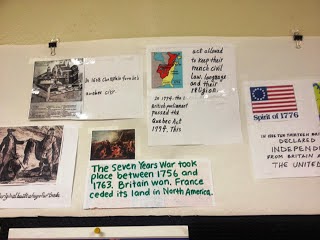
With their goals in mind, we decided to create a timeline. Each student took responsibility for one or two events, never racing ahead to historical events not yet covered in class. The timeline started out with a cluster of pictures at the far left end followed by a vast expanse of blank paper. Week by week, the learners sourced images, wrote captions, and decided where on the butcher paper to place their contributions.

Using tiny 3M Command® Hooks and equally tiny bulldog clips, we hung our very long timeline on the classroom wall near the ceiling. This allowed us to review what we'd learned in prior lessons while building on that knowledge as we inched our way through the decades. The photos you see here were snapped much later--after the project was concluded and the timeline was about to be rolled up and put away.

We took this series of units, which included reading a little book about Laura Secord, at our own pace. None of the seniors was in any hurry to pass an exam. They wanted the opportunity to acquire the related language and concepts--the knowledge.

For me the most fascinating chapter in our journey back in time was the unit we did on L'anse aux Meadows. I've shared about that on this blog before (December 2014), but I think it's worth sharing again now that I have a few more readers.

The centrepiece of our lesson was a rather long documentary about the national historic site L'anse aux Meadows. I found it fascinating. If you would like to watch the video and then take the Ted Ed lesson that I designed to accompany the video, you can do that HERE.

If you want to download the little quiz my students completed while watching the video, you can find it on my website www.kellymorrissey.com under FREE - Settlement Themes - Canada.

If this blog post inspires you in any way, I hope you'll leave a comment.

Cheers!

Sunday, April 9, 2017

Canada with CLB 1L

I don't usually teach "Canada and Citizenship" at the literacy level. However, this time around I, without giving it much thought, used an off-the-shelf pictorial needs assessment document instead of the usual one that I have customized for my learners. The one I got from a resource on Tutela.ca includes Canada as an option; of course that was the students' top pick.

Somehow, as a result of a mix of desperation and serendipity, I found a way to make the lessons come to life.

For the first week's module, we made a little six-page reader with the basics. I projected the book with blank lines up on the board and elicited the language, helping with grammar. Then students copied our sentences under the pictures in their own booklets.

This was the last time this group used primary penmanship lines. Our next module we graduated to regular lined sheets without the middle dotted guideline. They were pleased.

For week two, we took a little break from the map of Canada in order to incorporate a real-world task, map skills. This was done for the sake of an artefact for their portfolios and turned out to be an engaging module heavy on kinaesthetic means of learning; we turned the classroom into the streets and avenues of downtown Windsor. Students became fluent in giving and receiving directions to a few key landmarks around the core.
Back to the bigger map of Canada, learners made posters to help them remember which industries and foods are produced in each region.
We also started practicing offering, accepting, and declining food--a useful language function as newcomers make their first friends in Canada.


After days and days of practice with the rather large set of new terms, we made a video of our "Touring Canada through Food" party. The final test was closer to CLB 2 than 1, and all the class veterans aced it! Thirteen questions with NO images to support. They rocked it.

To finish off the theme, we picked out tourist post cards for one another, wrote little messages on them, addressed them to one another (for real), and asked the kind teacher to mail them.

A typical message went something like this:
Dear Ali,
Today I visited Niagara Falls. It is beautiful.
Your friend, Marwan.
Perhaps not this weekend, but very soon I will try to get the materials and checklists/rubrics for PBLA assessment onto my website for you to download and use.

Meanwhile, I have just uploaded other free materials for teaching housing HERE. Scroll down to "A Crack in the Tub."

I hope you're enjoying your teaching week. I sure enjoyed mine!

Sunday, December 27, 2015

Still Seeking Non-Traditional Families

Two families have volunteered so far for my project to put together some LINC classroom materials that reflect the full diversity of Canadian families: one child-free by choice couple and one same sex couple who love their doggies!

I would like to have four or five families before I put the booklet together. Since I do not yet have any transgendered individuals nor any children yet in the selection of families, it sure would be nice to find families that reflect those facets of our beautiful Canadian society so we can introduce those individuals' faces and stories to our newcomer English language learners.

If you live in Canada and would like to volunteer for this project, please contact me. Helping is easy. All I need are a couple of high-definition photos of your family doing whatever it is they do--like engaging in a favourite hobby or relaxing together on the weekend. I also would appreciate a short blurb about the family. Whether you mention what it is that makes your family different from the gender binary heteronormative stereotype is entirely up to you.

If you're not up for having your picture seen or your family portrayed, you can still help by printing out and posting my flyer on a bulletin board at your workplace, church, mosque, synagogue, community centre, university, etc.

The flyer can be downloaded from HERE.

Thank you so much! I hope you're enjoying your winter break, if you get one.

Monday, May 11, 2015

This is an LGBTQ+ Positive Space

 Cisgender. Cissexism. Pansexual. Last week I learned a few new words and updated my knowledge of others.

On Tuesday, I sat in one of those nice, cushy board room chairs around a table with a dozen other front-line settlement sector workers to educate myself on the barriers commonly faced by LGBTQ+ newcomers. The all-day workshop was part of the Positive Spaces Initiative, whose website I encourage you to visit if you want to learn more.

When it was my turn, I answered the three questions on the facilitator's Power Point slide: my name, the pronouns I would like used when others refer to me in the third person, and any hopes or fears I had going into the workshop. Gosh golly, I'd never thought about it before. Everyone has always referred to me as "she/her," but not because I'd asked them to. I'd be just as happy in Iranian culture, where everyone has always been "Ou," or in Sweden, where they've just introduced a new pronoun that liberates people from the binary he OR she construct.

Why do you suppose we were each asked to give our preferred pronouns, Erin asked. We sat and blinked at her. It's so that whenever there is someone in the group whose preferred pronoun isn't obvious will not feel singled out in having to request that.  I knew then I was going to like the presentation and presenter.

I've long felt strongly about making my classroom a safe space where I am an enthusiastic ambassador for the Canadian values of tolerance and multi-culturalism, where newcomers of all religions or none can sit side by side to learn the language of respectfully disagreeing.

For the literacy students, it could be a while before they sit in a level three class and learn "I see your point," "in my opinion," and "as I was saying,...." Nevertheless, it's not too early for me to begin to introduce some socio-cultural realities of their new Canadian lives.

In our unit on the family, I stand at the whiteboard with my markers in hand as we brainstorm together the meaning of "family." Inevitably they begin to shout out "mama," "daddy," "children." Sometimes they have enough language before the unit begins to add "grandmother" or other extended family. Because we are only in the warm-up stage, I rely on my artistic ability to convey concepts.

I draw a couple with no children and ask, "What about this? Can this be a family?" They begin to debate, turning toward each other with their conflicting yeses and nos.

"How about this one? Is this a family?" I point to the two fathers with a child.  Next I've sketched two mothers with three kids.

When their YES NO debates have died down and all that remains is the pregnant pause of their curiosity, I do not answer. I stare back at them with an amused smile and let the tension build just two degrees more.

"In Canada," I explain with a sense of pride in being able to welcome them to such a wonderful society, "THIS can be a family. And THIS can be a family. And THIS can also be a family."

If any student seems dubious, I may erase stick figures to make way for Google images. We see wedding cakes topped by two tuxedoed male figures. We see a Gay couple kissing while a priest stands close by. There are flowers. The rice is flying. I search out an image of Kathleen Wynne, premier of our province, flanked by her same-sex partner at a public ceremony.

The point at which any remaining vestige of confusion on faces melts away is when I remind them of the reason most of them feel safe here. Here we can live side by side, Christians and Muslims and all. Many of them have come here fleeing chaos, persecution, violence triggered by intolerance. When I bring this up, they get it. They smile. "Yes," they say. "In Canada, no problem."

To be honest, they usually have only one real concern or question. With their very limited language, they manage to pantomime their most pressing question: how on earth do same-sex couples have babies? Fortunately, I am a very gifted mime. There are many ways, and I present a three-second skit for each. The turkey baster always gets a laugh. And then it's over. Next topic. No big deal.

And that is the classroom atmosphere against which I had my first classroom coming out last year. It went well, but could have gone even better.

And that is why I was so excited when OCASI started the Positive Spaces Initiative, providing me and settlement sector professionals all around Ontario with starter kits and workshops if we would like to start the process of assessing our agencies to determine areas of strength and areas with room for improvement. The goal is for LGBTQ+ newcomers to be able to access services while being afforded the same level of dignity and respect as anyone else--and without having to leave a part of themselves at the door.

A table at the back of the board room was covered in posters, stickers, bookmarks and postcards. At some point in our eight hours together, Erin admonished us to give careful thought to it before putting a rainbow up declaring a space saf(er) and not to do so unless we were ready to commit to creating a space where instances of homophobia and transphobia would not go unchallenged. It would be better to put nothing up than to put up a sign of safety that didn't accurately reflect the way the clients would be received, supported, respectfully treated.

"Maybe your agency isn't ready to embrace LGBTQ+ Positive Space policies and practices, but in your own cubicle you can put up a sticker."

I feel my agency is ready because we did the self-assessment and have begun addressing weak areas while building on and celebrating areas of strength. Three of us were sponsored to attend the workshop. And I'm very happy to say that when I returned to work and explained to colleagues what my workshop had been about, the vast majority asked for a poster in order to declare their classrooms Positive Spaces. I can't wait to see what happens next.

Monday, December 1, 2014

L'Anse aux Meadows

When the students making up my multi-level seniors' class asked that I teach Canadian history, it surprised some of my colleagues to learn that I wasn't limiting our studies to preparedness for citizenship test questions. Rather, we hung a long piece of butcher paper along the wall near the ceiling and, week by week, created a collage depicting all the major and some minor Canadian historical events and explorations--starting with the two (hypothesized) major migrations across what is now the Bering Strait and ending with Confederation.

One of the most interesting illustrations on the timeline, which a student found and printed on computer lab day, shows the Norse explorers meeting and trading with the native Beothuk.

If you ever get a group of students as knowledge-hungry as my seniors and want to share with them the wonders of the internationally renown historic site L'Anse aux Meadows in Newfoundland, I highly recommend this 29-minute documentary entitled The Vinland Mystery.


In my Free Resources for Settlement Themes - Canada and Citizenship section, you can download a worksheet that gets students to pay attention to a few key points of the film. Because the language is very high, I did three things to scaffold the task:
  • Provided students with the exact time markers at which they should start listening for the answer to each question.
  • Made the answers multiple choice.
  • Supplied illustrations with some of the multiple choice options. 

FAVOURITE TECHNIQUE ALERT!

Another activity students seemed to really enjoy was the "two article technique," which I employed using two of the three articles on Vikings free for download from Bogglesworld.

How:

Divide the class into two groups, A and B. Each group is given a different graded article on the same topic and 10-15 minutes in which to digest it. Each A student is then paired with a B; they teach each other the content of their respective articles (paraphrasing, no paper). Warn students that they will be tested on the peer taught material and remind them that communication is the shared responsibility of speaker and listener. Don't forget to supply them with any needed language to accomplish this, such as, "Did you say....?" "How do you spell that?" "Can you explain that in different words?" If you're worried that one student might get shorted by being paired with a classmate who isn't able to teach the material very well, you could set up queues facing each other whereby the As are stationary and, after 3-5 minutes, the Bs move one seat to their right. Depending on how much time you have, you can thus allow each student to be taught the same article a few times--each time by a different peer. Or you could set it up in teaching teams. Oh, my...the possibilities are endless, aren't they?

If you like any of these ideas or end up using anything here, I would love to hear about it.