Looking over my posts from February in order to prepare the end-of-month summary newsletter, I noticed that I have not been creating very much. There was only one freebie that month. NB: If you subscribe to the newsletter, you know about all the freebies, even ones I only announce on Twitter but do not blog about. One week in February, I listened instead of talking.
You might think this lull means that things are slowing down here at Joy of ESL, but actually this is just the fallow time before the growing season. I am currently taking another of Tony Vincent's online classes, and this one is a doozy. The course is called Classy Videos. I am hoping to learn how to create good videos--both for ESL students and for my fellow teachers. Last week's assignment was to practice good narration. Here is what I created for that.
The assignment for this week is to create a tutorial video. The intended audience is YOU. I hope I can realize my vision and that it proves valuable to someone somewhere. Stay tuned for the addition of a Facebook page and YouTube channel.
Because the course is cognitively taxing and time-consuming, you can expect things to remain a bit low-key here on the blog for a few more weeks.
Here are the results of the survey so far:
What do readers value most in an activity pack?
Lots of images
Picture-word matching activity
Spelling activity
Cloze or gap-fill
Sentence unscramble
Peer survey or dialogue (zero votes)
Which types of blog posts do readers find most engaging?
Updates from the PBLA battlefield
Links to others' ideas
Personal stories
Classroom techniques
Announcements of freebies
Finally, I looked at reasons why someone might not subscribe to the newsletter. One reader said s/he reads the blog weekly and therefore does not need a summary. I should mention that some links to others' tools / ideas and some freebies do not get mentioned on the blog. However, if you are on Twitter, you will probably catch them there. Once I get the Facebook page up and running, everything will be there, too.
What are you up to these days? Is spring finally arriving in your neck of the woods?
Anyone who knows me probably knows I have a keen interest in methods such as Dogme and other materials-light approaches. You might also know that I recently joined a Facebook group called Global Innovative Language Teachers, led by Dr. Gianfranco Conti. Well, the other day a member of the group posted a comment in which she expressed appreciation for a graphic organizer she had gotten from one of Dr. Conti's books and which had proven very useful for her language class. Others seemed interested, so (with his permission) I recreated it in Google Drawing--first in A4 for all the European teachers in the group, and then in 8.5" by 11" for those of us in the U.S. and Canada.
You can find it on the FREE - BLANK TEMPLATES page of my website. If you have a Google account, you can click the name of the worksheet to be taken to the master, copy it over to your own Google Drive, and edit for your purposes. If you like it as is, just click the image to download the PDF.
Anyway! I showed it to my morning (seniors) class and they were keen to take it for a test drive. I introduced the form this week, but didn't introduce it on Monday. First we talked about our recent student-teacher conferences that ended our fall/winter term on January 26th. Many people told me that seniors cannot learn the same way young people can. They want even MORE reviewing than I have been giving them. (I admit that over time, I tend to drift away from some good practices and have to be reminded.) They said that as seniors, they learn three new words Monday and forget two on Tuesday.
So I decided it was time for a trip back to our easel chart--where each page full of topical lexical items represents one module we've covered in the past. I flipped back to the very beginning of the pad of paper and asked the first student to choose one useful word* from the sheet. I asked a new student who was brand new to our class and whose English is more developed than most in the room, to be my secretary--writing each word on the white board as I flipped pages. She was great--a good speller with lovely large handwriting.
I flipped to the second page and had the student next to the first one choose a word. Thus we took turns and ended up with about 20 previously studied words on the white board.
"Now take out a piece of paper. You can do this with a partner or on your own, as you wish. I want you to write a short story and incorporate as many of these unrelated words as you can." As usual, I advised Ss with lower writing benchmarks to try to incorporate 4-5 words, while higher level writers could try to incorporate almost all of them. And then I sat down with my tablet and pen to work on the same task while they did it.
We ended up with some really wonderful stories, and I was amazed at my students' creativity. (They have asked me to focus on L/S, so I rarely get to find out if they are creative writers; some really are!) I came around to check papers and point out errors that needed correcting before they shared their stories aloud.
In a subsequent lesson that week, I introduced the Connectigram. I filled in one as an exemplar and projected it. After talking about the whys and wherefores of my use of these connectors, the students took turns trying to put together their sentences. Students discovered that "while" and "since" both have temporal connotations as well as definitions that refer to to causal or logical relationships.
Remembering Conti's admonition to provide students not only with practice on focused processing but also with thorough processing, and recalling that he considered "odd man out" activities to be helpful with this, I created a multiple choice worksheet to complement the Connectigram.
By this time we were at the end of Thursday, as we did some work on our beginning-of-term needs assessment along the way. Friday morning we took up the answers to the quiz, and debated the answers until everyone was satisfied. I then asked the students to take out their stories from earlier in the week and select a few sentences or passages to re-write using their new connector words. This was the point at which I really got to see who understood and who did not. One student had even used "whereas" in place of the temporal "while." See? This is why we have to go Back to the Well. They cannot finish the trial-and-error process without time to test out hypotheses and have them checked.
We finished by watching the three-minute film from the National Film Board's Canada Vignettes, The Log Driver's Waltz. We ran out of time, but Monday we will try to talk about the plot of the little film using some of our new words. Can you say something about the plot using "nevertheless?"
I ended the week feeling very good about how the class had gone. We had successfully (I hope) integrated two new and very different types of students into a class whose chemistry had been cemented for months if not years. We now have equal numbers of Mandarin speakers and students who speak another language, meaning I can now give my Mandarin speakers a partner every week with whom they cannot fall back on their L1 to communicate. The best part was that my prep was minimal. I hope you can make use of these resources--the way I created them or customized. *I use the term word to mean unit of meaning, whether it be an idiom, phrasal verb or other lexical chunk.
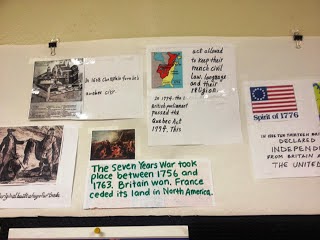
When the students making up my multi-level seniors' class asked that I teach Canadian history, it surprised some of my colleagues to learn that I wasn't limiting our studies to preparedness for citizenship test questions. Rather, we hung a long piece of butcher paper along the wall near the ceiling and, week by week, created a collage depicting all the major and some minor Canadian historical events and explorations--starting with the two (hypothesized) major migrations across what is now the Bering Strait and ending with Confederation.
One of the most interesting illustrations on the timeline, which a student found and printed on computer lab day, shows the Norse explorers meeting and trading with the native Beothuk.
In my Free Resources for Settlement Themes - Canada and Citizenship section, you can download a worksheet that gets students to pay attention to a few key points of the film. Because the language is very high, I did three things to scaffold the task:
Provided students with the exact time markers at which they should start listening for the answer to each question.
Made the answers multiple choice.
Supplied illustrations with some of the multiple choice options.
Divide the class into two groups, A and B. Each group is given a different graded article on the same topic and 10-15 minutes in which to digest it. Each A student is then paired with a B; they teach each other the content of their respective articles (paraphrasing, no paper). Warn students that they will be tested on the peer taught material and remind them that communication is the shared responsibility of speaker and listener. Don't forget to supply them with any needed language to accomplish this, such as, "Did you say....?" "How do you spell that?" "Can you explain that in different words?"
If you're worried that one student might get shorted by being paired with a classmate who isn't able to teach the material very well, you could set up queues facing each other whereby the As are stationary and, after 3-5 minutes, the Bs move one seat to their right. Depending on how much time you have, you can thus allow each student to be taught the same article a few times--each time by a different peer. Or you could set it up in teaching teams. Oh, my...the possibilities are endless, aren't they?
If you like any of these ideas or end up using anything here, I would love to hear about it.
This short animated video (click to go to page then scroll down to view) is, I think, an amazing tool to help our newcomer students understand what the flu vaccine is, how it is made, how safe it is, and why those who opt to get it must get a new shot annually. The film doesn't just debunk common myths (such as that the shot can give you the flu), but provides the science behind that--illustrated with charming and captivating cartoon images.
In my multi-level seniors' class, we first used a lesson plan and materials from LINC 1-4 Classroom Activities before viewing the video. One fun activity involved turning down the sound and having students attempt to reconstruct the language. Next time I'll probably have them do this in groups, or perhaps as a dicto-gloss.