Showing posts with label professional development. Show all posts

Wednesday, December 11, 2019

My TESL Ontario Conference Experience

Ah, lovely Toronto. In the summer of 2009, I impulsively quit a job that had turned hellish under a psycho supervisor and ran off to CCLCS to get my OCELT, draining my savings account to do so. During those first seven weeks lodged in a dorm with six very young women on Bloor Street, a seven week break, and second seven-week term lodged in a so-called homestay for international students in the Italian / Portuguese neighbourhood that required me to ride a bus up and down Dufferin to the subway, I learned my way around what I will always think of as one of the world's most beautiful cities.

A colleague and I shared a taxi from Billy Bishop and soon I was tucking myself under clean white sheets and a puffy duvet with alarm set for 5:30. I've always liked to have a slow, leisurely breakfast and still be first in line for my attendee's package. I already had two floor plans printed out, one for each day, with workshop names and arrows to help me jump quickly to my second choice should the first one fill up before I got a seat. Oddly, that measure proved entirely unnecessary this year.

Of course I could not miss U of T's Jennifer Burton and Yuliya Desyatova's Learning English with PBLA: What LINC Students Say. I must admit I did not know how this would turn out because I wasn't sure a satisfaction type of survey could capture the circus that PBLA is in reality, wasn't sure students across Canada were picking up on the failings since they might not know why PBLA was dreamt up in the first place.

But because these two researchers had the forethought to provide students with an open comment box after each question and because Jennifer took the time to sift through them and find the commonalities, we can see that students ARE indeed picking up on the same things that make us want to hang our heads in shame for what this profession is becoming, or leave it altogether.

We already know what those common threads are. We live them daily. But here are some slide snippets anyway:


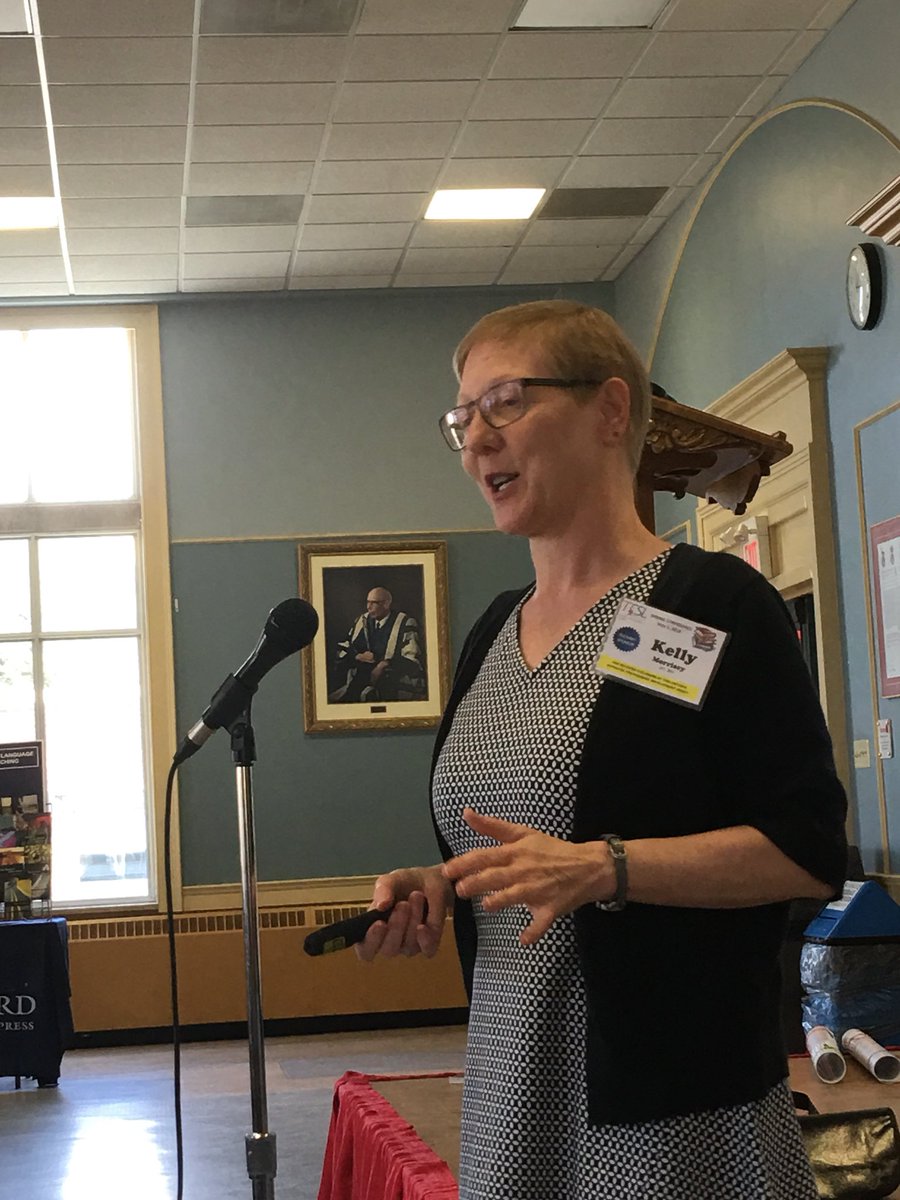
At the end, during the Q and A, Karen Alexander stood up and spoke her truth bravely. Peers encouraged her to attend the next morning's panel discussion and say what she had said once more, this time into a microphone. She did, and I'm proud of her for doing so. She said to me Thursday night when we were both seated at Trios what many of us concluded long ago: a field dominated by men would never have stood for this treatment, this nonsense, nor with being loaded down with a stressful load of extra work without pay.

At 9:50 I attended Recognizing and Accommodating Alternately Abled Students, Part 1 with Eliza Garland of ISANS. She is an occupational therapist and goldmine of information and insights to help us better understand Universal Design for Learning and how it can benefit not only our many students with undiagnosed learning disabilities, but the rest of the students as well--hence the name. This was one of the most valuable workshops I've attended ten years of conferences, and I look forward to seeing her slides posted on the website for all to peruse. From Eliza I learned about proprioception, sensory seekers and avoiders. I think what I gained from her session is even going to make me a better First Day School teacher, as some of the kids in my Quaker Meeting are very wiggly!

At 11:20 I joined Marijke Wertheim's Teaching without a Net because not since Ken Lackman's C.A.T., a framework for dogme has there been a dogme-focused session at this conference. Since I am a huge dogme believer, I could not miss this session. Marijke did an excellent job of bringing dogme to life, and I wish I could have stayed for the full two hours. Alas, I had to slip out for...

Yuliya was back at it in the same room at 12:40 with more research results in Leading and administrating PBLA: "Champagne on water wage." Here are a couple of slides I found to be most telling:

I liked that Yuliya put these quotes up without the "Learner," "Teacher," and "Admin" labels on them and had us first GUESS who we thought each quote had come from. I love the acknowledgment that a teacher can produce a beautiful binder without it being a reflection of learning.

This is a fantastic revelation. There is a negative correlation between length of time implementing PBLA and feeling the increased teacher workload is justified. Yes! I know many teachers AND a couple of leads who started out with an open mind and one who even started out as a cheerleader but who now say, "It looked good on paper" while shaking their heads.


One slide I thought was very telling was the one demonstrating that the closer one is to the frontline, the less optimism that person reported having toward PBLA. In other words, top admin feels the best about it, teachers themselves the worst, with lead teachers in between the two.

And Yuliya's recommendation? Make it optional. I love her list of advantages of making PBLA optional:

After a quick washroom break where I encountered a Joy of ESL fan who said she hoped to see me at the reception shortly, I ran off to Tapping the potential of conversation circles for integration by Tehreem Nathaniel, which was lovely and gave me lots of ideas. What a breath of fresh air it is to be in PBLA-free workshops! I was VERY satisfied to find at least one non-PBLA workshop in each time slot.

The reception catering was some of the best to date! I loved the artistic dessert. Sparks winner Susan Webb looked so cute in her dress and footwear, I thought. The next day she had on day-glo green Eiffel Tower earrings and an artsy dress that picked up on that colour. Suddenly, Susan, I feel I could almost forgive you for being on the PBLA bandwagon, as wobbly and small as that may be. One day, my sister, you may look back and see the error of your ways. Until then, keep rocking those unique outfits! (OMG, can you so totally tell that I have no more Fs to give?) And no, there is no alcohol and no THC in my system in this moment. This is all just Goddess Kali having her way with me.


Friday morning I discovered that the steel-cut oatmeal is better at Trios Bistro than at Hemispheres at the DoubleTree (did you know they changed their logo years ago because everyone thought the two entwined tree symbols looked like two entwined female symbols?), and they give you lots of fresh berries with it. But the absolute best steel-cut oatmeal in the conference hotel circuit is still Sheraton. They let you have nuts AND dried fruit AND fresh berries instead of making you choose just one.

In hopes of giving support to Karen Alexander, I sat down in the room where the panel discussion was to take place but was careful to sit close to the door since I would need to slip out for part two of Alternately Abled students. Yvonne Ferrer mentioned giving money to PBLA and caring about refugees in almost the same breath, and I wanted to follow her to the parking lot to ask her if she had read this article or understood that foisting born-of-a-colonial mindset 32-tests-a-term PBLA on newly arrived people from war-torn areas who don't yet know how to find their name in the stack of binders or hold a pencil is anathema to best practices in work with refugees and those with PTSD.

Sigh.

Knowing Karen would be great at the mic, I slipped out and made it to part II: Recognizing and Accommodating Alternatively Abled Students, which was as good as part I had been. Can't wait to synthesize my notes and share what I learned with my team.

I briefly sat down in Anne Hajer's PBLA Portfolio: ESL Literacy Considerations, but thought better of it. I sometimes have executive function / prefrontal cortex lapses when I'm tired, hungry, and/or emotionally aroused, so I thought it best to leave dear Anne in peace and spare her one of my angry outbursts. Instead I dashed out to Dundas station, bought three tickets (one for returning to Billy Bishop later), and headed out to Kensington to try the restaurant with the most rave reviews for vegan options on Tripadvisor.com : Hibiscus! 

Anyway, you cannot visit Toronto without wandering up and down the feast for the eyes that Kensington Market area is with its murals and whimsical tin shapes welded onto the window bars of Queen Annes painted in a riot of bright colours. You just cannot.

Hibiscus was quiet and clean with built in bookcases housing interesting poetry collections and glazed ceramic pieces. I had and a cup of the sweet potato chickpea soup and a savoury crepe with pear slices and pecans in it. The fresh cilantro on top of the soup made me sigh with appreciation.

I didn't quite make it back in time for my next session, but I'm glad I went ahead and slipped in late anyway because An Innovative and Easy Approach to Corpus Analysis was fascinating, inspiring, and left me wanting to get her slides so I can fill in what I missed. It also made me want to teach EAP. Julia Williams of the U of Waterloo was a very good presenter! If I were an engineering grad student faced with writing my papers in a language I hadn't spoken as a child, I would want Julia there by my side. I wish I had snippets of her slides to show you. Here's hoping she posts them!

After a light dinner and even lighter flirting with someone seated at the bar, I got my bag out of safekeeping and used my last subway ticket to get to Union Station where I somehow managed to find the hotel with the flags and thus the free shuttle back to Billy Bishop.

So long for now, Toronto. For me you will always be the crazy frugal Italian house mother at my homestay who locked up peanut butter and toilet paper, murals and head shops in Kensington, Honest Eds, stopping on Queen St West to sniff Johnny Fluevogs, lunches at the Queen Mum, being sold a dime for $2.75 by a panhandler who tricked me into thinking it was a subway token, Martine my TESL prof with her elegant ballet dancer body, the sudoku puzzle in the free Metro newspaper that helped me pass the time en route to my suburban practicum, indie movies on nights when assignments were not due the next day, and learning how to walk a labyrinth.

Monday, August 5, 2019

Open Thread - Summer Miscellany

I love that you guys feel comfortable enough here to ask for what you want. A comment came in from a reader:

Hi Kelly, 
I just had an idea. I'm wondering what you think of setting up an open summer "forum-like thread" on your blog . People could discuss whatever they like, including PBLA (let's face it, probably PBLA). Just a summer miscellany. I see it as a place that would be easy to find (no need to search through all the other topics and posts to see what people have to say). What do you think? 
Interested in what people are thinking/experiencing/discovering about PBLA
That's easy enough! Feel free, everyone, to pull up a Muskoka chair and share what's on your mind lately.


Saturday, June 1, 2019

On the Horizon

Back in early spring I was feeling the burgeoning potential of the greening world around me. I was in a new relationship and feeling excited. I had an idea for a new project, too--something bigger than I've taken on before.

The relationship has ended, I'm sorry to say, but one of the benefits of dating a compulsive analyzer and sensitive communicator is that now I'm participating in a very helpful post-mortem.

The project, I'm happy to say, has not shrivelled on the vine. Rather, it just this morning entered a phase more concrete than conceptualization. My project partner met with me under the maple boughs on my lower deck landing overlooking a small tributary to the Detroit River. The person who graced my humble abode with her presence is a bit of a legend in these parts, and I'm still feeling high from her visit.

Also of interest to us all is a new book coming from Steve Smith and Gianfranco Conti on teaching listening. This blog post is a small teaser.

What is on your horizon this week?

Monday, October 22, 2018

Limbo

I was very pleased to be asked by my local TESL affiliate to present at their fall PD event this past Saturday. It was fun, and I got a bit more mileage out of some slides that I had put A LOT of time and energy into creating--slides that had only been shown twice before.
TESL Windsor Fall PD Event
As happens at so many of our PD events these days, the subject of PBLA came up. "Cover Less, Uncover More: the Transformative Power of Slowing Down" was the title of my talk. (I offer apologies to the late great Leo van Lier, whose words I've borrowed.) How can I possibly slow down, one attendee wanted to know, when my manager is breathing down my neck to do one module after another and get those artifacts into the students' binders? Had I not got us back on topic, might the entire 90 minutes have been swallowed up by venting and commiserating among frustrated and disillusioned educators?

The annual TESL Ontario Conference is right around the corner, and for the first time in nine years, I'm not going. I'll miss breakfast at The Senator and hopping on the subway to get to whichever restaurant I've decided to try that year. I'll miss wandering up and down Queen Street West, stopping to smell the Johnny Fluevogs. But when I look at the conference program and see workshop after workshop after workshop on PBLA, my heart sinks. I miss the field as it once was and wonder what is to come for our profession.

It's absolutely wonderful that Yuliya Desyatova is doing her PhD research on the impact of PBLA, but what will become of that? Will anyone listen? Will they care? Is there a light at the end of this tunnel? Speaking of that, I hope those who are attending the conference will attend her presentation. I certainly would support her in that way if I could go.
Seen on Queen St. West
In more ways than one, I feel I'm in limbo. Even my presentation felt a bit stale to me. I'm ready for something different. The conference used to offer that. Ken Lackman was always there with something to get my gears turning, like his C.A.T.: a Framework for Dogme. There were so many good workshops that I would lament not being able to clone myself in order to be in three places at once! I would return from Toronto on fire to try new things with my learners.

I'm sorry this isn't much of a blog post today, but I'm not feeling it.

How about you? Where are you at now?

Monday, October 1, 2018

Our Teacher Training

This morning my attention was drawn to a tweet by @GeoffreyJordan asking teacher trainers to read and respond to five questions at the bottom of this blog post.

The problem, Jordan says, is that the most prominent teacher trainers seem to be paying too little attention to the questions "what are we doing?" and "is what we're doing effective?"

He goes on to cite research supporting the importance of implicit as opposed to explicit learning. I'm thinking he means language being taken up as a result of buckets of comprehensible input as opposed to months of grammar lessons from a coursebook.

It's always interesting to me to follow these debates in global and British circles of English as a second (or additional) language teachers since almost all of these educators do teach from a coursebook. We settlement English teachers in Canada do not, as a rule--though many of us find useful coursebooks on Amazon Marketplace or at conferences when we steal away to browse the publishers' displays. Pages from those squirreled away books might end up being useful on occasion, but our mandate is to sculpt a syllabus where topics are drawn from regular needs assessments, objectives are task-based, and the approach is communicative.

Let's fast forward to the five questions at the end of Jordan's blog post and see if we can answer them from the perspective of teachers reflecting on our own training. How were we taught to teach? How might our trainers answer the five questions?

Q1. How did our trainers transmit their views of the English language to us?
Q2. How do we think people learn a second language? How was language learning explained to us?
Q3. What types of syllabus did our trainers discuss with us? Which type was recommended to us?
Q4. What materials did our trainers recommend?
Q5. What methodological principles did our trainers discuss with us? Recommend to us?

Okay, so I'll get the ball rolling and others can chime in using the comment box below.

A1. My principle trainer went to great lengths to maintain a poker face and not reveal her biases, if any, as we undertook a survey of the most prominent SLA theories. I got a distinct feeling, however, that she agreed with Chomsky on the existence of a universal grammar and looked down on Krashen and the Krashenites. It was made clear, however, that I was to survey the literature and draw my own conclusions. One of the essay questions on our final exam dealt with this very thing. Which theory did I believe and how would that inform my teaching? I remember responding that I didn't feel able to conclude that one theory was 100% valid and the others rubbish. I said I would use an eclectic approach and hope that something might hit the mark.

A2. It was explained to me that L1 acquisition is different from L2 acquisition in that there is a window of plasticity that ends at around the age of puberty. If you don't get to the child with the L2 exposure by that age, then the child will never achieve native fluency. That's what I was taught. I do NOT recall getting a lot of information about any of the comprehensible input streams. That I've had to find out about on my own.

A3. We read a book about syllabus design and discussed it in class then took a quiz on it, I think. I remember it was a slender little green and black book, but that is all I remember. I kept the book and referred back to it after landing my teaching job, but I could not tell you right now any of the contents. We were taught how to build a unit / module backward from the objectives by doing task analysis. That's what I've had to know how to do. Everything in LINC (Language Instruction for Newcomers to Canada) starts with the needs assessment. Every semester is different.

A4. My trainer brought in a variety of books for us to examine and discuss--some more communicative in their approach than others. I remember seeing the Azar grammar books at one end of the spectrum, Grammar Dimensions, and a few others. We were tasked with choosing one to use in a class and defend our answer. With our trainer's heavy emphasis on communicative methods, most of us concluded that Azar made a nice supplement for assigning grammar homework, but that it wasn't appropriate for daily use. In the end, we all knew we would have to make each lesson and the materials from scratch.

A5. My trainer really drove home the obsolescence of the grammar-translation method while ensuring we understood the Canadian Language Benchmarks. My training (beyond the bachelor's degree) consisted of around 360 classroom hours. Half of those were theory and half practical. We learned how to create a PPP lesson plan and how to divide the allotted time among the three stages: presentation, practice, production. We learned how to let students learn inductively or deductively--what each of those lessons might look like. We learned how to create and conduct listening, speaking, reading and writing lessons that follow one another and how to assess using a rubric. When it comes to assessment, I learned some principles that are very important in assessment creation, such as face value.

I'm so glad that Geoff Jordan has raised these questions because the area where I feel my training and teaching has been most lacking is the area of effectiveness and the link between current / emerging SLA research and my practice. I feel as if I've sort of been thrown to the wolves. It's up to me to sift through all the journals, books, and articles and figure out what is likely to give my students the biggest SLA bang for their buck (time spent in class).

I have purchased MANY books with my own money and have read them with highlighter in hand and tried then to apply some of the ideas in my practice. These include but are not limited to:

  • Teaching Unplugged by Luke Meddings and Scott Thornbury
  • Uncovering Grammar by Scott Thornbury
  • Teaching Lexically by Hugh Dellar and Andrew Walkley
  • The Language Teacher Toolkit by Steve Smith and Gianfranco Conti
  • Input-Based Incremental Vocabulary Instruction by Joe Barcroft
  • Fluency through TPR Storytelling by Blaine Ray

Yes, blog readers, I owe you a lot of book reviews!

In all of my reading of both the books above and countless scholarly articles, I have one question in mind: what really works? What is the most effective way for my students to acquire second language in the time we have together, and how can I help them?

I also spend a lot of time reading about and listening to podcasts about cognitive theory in general and how it informs teaching of any subject. For example, I'm following the Learning Scientists and have begun to share their principles with my morning class as well as employ such things as spaced practice and interleaving in my teaching.

Thanks, Geoff Jordan, for bringing this up!

NB: This is blog post #2 of 2 today. Scroll down for the first one.

Sunday, June 17, 2018

The Summer Project

Blogger is still not behaving for me. Things seemed to go out of kilter during that whole GDPR compliance frenzy a couple of weeks ago. I'm not sure there's a connection. In any case, I no longer receive an email when someone comments on the blog. I've gone back into settings twice to ensure the right boxes are ticked, but I don't think it's working still. That means I have to remember to log in and check the comments section of the dashboard to know if any comments are pending approval or require a response. I will try to do that ever few days.

I don't have a blog post today and am not planning to blog weekly over the summer. I feel a need to do self care in the form of purposefully not thinking about lesson plans, professional development, or PBLA.

That being said, there are some projects still the works, goals left over from this school term, ones that I have not yet met. Because their completion affects all of you, I want to come back here and to the website to get them finished. Also there are a couple of guest blog posts pending from others. I'm just waiting to receive them. As soon as I do, I'll post them.

The main project is basically to work on the "Canadian Experiment" page of www.kellymorrissey.com. Lately several people have either shared something very valuable to us all in the comments or have told me something during back channel conversations that I think should be shared publicly with all of you. So I need to gather up all these bits and pieces and put them over on that page of the website.  I'm also hoping soon to be able to include an update from Yuliya on her PhD-level research project.


My mom, who is 87, is visiting me now from Little Rock, Arkansas. She arrived today; we spent the whole day getting caught up on each other's news. We have a lot of fun together. She's only here for ten days, so we will be packing a lot into each day. As soon as I have a breather, though, I will be working on the objective mentioned above.

How about you? Are you off for the summer? Working? Going to use some of your summer for PD or PBLA or lesson planning? Or the contrary? I would love to know what is happening with you.

Monday, May 14, 2018

Dreaming

A few weeks ago I had occasion to drive from Windsor through Kitchener-Waterloo on my way to the U.S. Whenever I pass through the area, I always stop in the Canadian city I first called home after immigrating in 1999: Waterloo. I don't have friends in the area anymore, but I still like to have a vegetarian meal at the Jane Bond and take in an art house film at my old haunt, the Princess Cinema.

It was dark when I arrived in Waterloo, but I recognized my old workplace: the Equitable Life Insurance Company of Canada. For five years I was a systems specialist. In that role, I wore many hats--from being a one-woman software support hotline to quality control of data files. I taught myself to code in VBA and created custom solutions for my team. I really enjoyed creating GUIs (Graphic User Interfaces) that were dummy-proof. Using my little apps, it was impossible to make a mistake or wrong decision. The programs I wrote shoehorned the user into right decisions. I didn't have any formal I.T. education, yet they allowed me to do that.

Driving past the unassuming headquarters of the life insurance company with its darkened windows late that night, I could almost not believe that the memories flooding into my mind were MINE, memories of my own life just twelve years ago. This English teacher used to write code. I used to joke that I could make MS Excel do just about anything shy of going to the corner and bringing back coffee.

The next day I rose and drove the rest of the way into New York state, passing turn-off signs for Niagara-on-the-Lake. Once again, the memories astounded me. Could it be that I had once stayed overnight at the Pillar and Post because our clients there needed a custom solution to a data upload problem? Yes, my employer had sent me (a lowly liaison to the I.T. team, not even a member of I.T.) to figure out a way to get data out of their payroll system and modify it in all the ways necessary for upload to our system. It took me an afternoon, but I found a way. I made the impossible possible.
The Pillar and Post, Niagara-on-the-Lake
Another memory came after that, a memory of the day that Scott, an actuary and my boss' boss, came to my desk in frustration over the months and months that it was taking I.T. to develop our company website. He almost never emerged from his office, so I was surprised to see him standing over me. He said, "Kelly, if we paid for it, would you be willing to go learn ASP?" I said I didn't know what ASP was. He said it was a web programming language. I told him I wasn't sure, maybe I would be willing, and why did he ask. He said, "Because if you were working on the website, it would be done by now."

He was (still is, I'm sure) a man of few words, so his vote of confidence has stuck with me all these years. I call those words to mind when my self-esteem needs a boost. Yes, damnit, I'm smart and very capable. I'm a hard worker. I study on my own time to be the best I can possibly be at what I do.

Why am I reminiscing tonight? You can probably guess.

When I first arrived on the Language Instruction for Newcomers to Canada (LINC) scene, I had a lot of the same feelings as I have at all the jobs before this one. I felt my superiors--from my boss and her director all the way up to the folks at IRCC who pay them to employ me--trusted me and believed in me. I felt seen, my gifts recognized and put to good use. Have you heard about Google's 'genius hour?' I have been blessed to almost always land in jobs where I'm given leeway to use at least some of my on-the-clock time to experiment. No employer has ever regretted giving me that play time. It has been during that time that I've solved long-standing problems for my employer. I believe that every language teacher also needs time and room for 'principled eclecticism' and action research.

The cheerleaders of PBLA who leave comments on this blog have more than once accused us of just whining or being negative. I have a whole video percolating in my mind to answer that accusation, but meanwhile I would like to suggest we do something here and/or over on my The Joy of ESL Facebook page. I'm not normally one to dwell on the past or live in the future, but just as an exercise, I'd like to ask if anyone wants to talk about joy on the job. Do you find your job to be a source of joy in your life now? If not, was it before? Or could it one day be--even hypothetically?

If you feel like it, tell me about a time you were happier in your job than you are now and what it is that made the job fulfilling at that time. OR tell me what you dream of as the ideal classroom space or SPO. If you could wave a magic wand and have MCI and IRCC direct the taxpayers' money the way YOU ask them to, what would that look like? I have some ideas of my own, but I'd like to hear from you first.

Sunday, May 6, 2018

Welcome, Conference Attendees!

Whether you received one of my MOO cards at the annual TESL London conference or from my friend at BC TEAL's annual conference, welcome to this blog, which doubles as the de facto national PBLA forum and the only one where teachers can share their thoughts and feelings or organize advocacy with the option of remaining anonymous.

I thought that parts of my plenary presentation went well while other parts bombed. My theoretical overview seemed well received, but the free graphic organizers did not trigger very much discussion or many questions. I didn't quite know how to recover from that, so I simply went on with my example of how even the simplest of resources--a set of pharmacy labels--can be the well that you go back to again and again in order to explore vocabulary, syntax and discourse. I think I should have brought up each handout onto the screen to give teachers an explanation of what happens with them in the classroom and why they are so engaging.

I heard a lot of talk during the materials slam of "contextualized grammar" or "grammar in context." Yet when it came my turn to take the mic, I forgot to tie 'Back to the Well' to this very concept. Of course these graphic organizers--which facilitate activities that you can do with just pencils and notebook paper, for that matter--are about just that! Instead of (or in addition to) getting out the old Azar book to teach about clauses or verb-direct object chains or discourse markers, you can take students back into a familiar text to FIND and exploit the examples that are right there waiting for them.

It was very gratifying to be approached and thanked by teachers who appreciate being able to use this blog as a place to connect with others who are extremely upset by what PBLA is doing to our professional and personal lives. The board member who issued the invitation to me told me more than once how much she appreciates the literacy activity packs that I give away on my website. I really enjoyed the entire conference, including both sessions I attended and the materials slam, which left me wanting the game 'Apples to Apples.' Special thanks to Jen Artan for being on top of all things tech and for getting me and my slides up and running.

If you were holding onto a door prize ticket at the end of the day hoping to get one of the posters I brought and did not win one, you can still grab the PDF from my Google Drive and print it yourself if you have 11" x 17" (preferably glossy) paper and a good colour printer.

Here are the links. When you click one, you will be able to copy the poster over to your own Google Drive where you can either edit first then go to FILE - Download as PDF or just download.

Before You Say, "I'm finished"...

The Seven Cs of an Effective Teacher

Cheers!

Sunday, March 4, 2018

Growth Spurt

Looking over my posts from February in order to prepare the end-of-month summary newsletter, I noticed that I have not been creating very much. There was only one freebie that month. NB: If you subscribe to the newsletter, you know about all the freebies, even ones I only announce on Twitter but do not blog about. One week in February, I listened instead of talking.

You might think this lull means that things are slowing down here at Joy of ESL, but actually this is just the fallow time before the growing season. I am currently taking another of Tony Vincent's online classes, and this one is a doozy. The course is called Classy Videos. I am hoping to learn how to create good videos--both for ESL students and for my fellow teachers. Last week's assignment was to practice good narration. Here is what I created for that.

The assignment for this week is to create a tutorial video. The intended audience is YOU. I hope I can realize my vision and that it proves valuable to someone somewhere. Stay tuned for the addition of a Facebook page and YouTube channel.

Because the course is cognitively taxing and time-consuming, you can expect things to remain a bit low-key here on the blog for a few more weeks.

Here are the results of the survey so far:

What do readers value most in an activity pack?
  1. Lots of images
  2. Picture-word matching activity
  3. Spelling activity
  4. Cloze or gap-fill
  5. Sentence unscramble
  6. Peer survey or dialogue (zero votes)
Which types of blog posts do readers find most engaging?
  1. Updates from the PBLA battlefield
  2. Links to others' ideas
  3. Personal stories
  4. Classroom techniques
  5. Announcements of freebies
Finally, I looked at reasons why someone might not subscribe to the newsletter. One reader said s/he reads the blog weekly and therefore does not need a summary. I should mention that some links to others' tools / ideas and some freebies do not get mentioned on the blog. However, if you are on Twitter, you will probably catch them there. Once I get the Facebook page up and running, everything will be there, too.

What are you up to these days? Is spring finally arriving in your neck of the woods?

Sunday, January 14, 2018

One Door Closes

My friend and mentor, Dr. John Sivell, who prefers to be addressed simply as John, has decided it's time for him to shift his attention and energies to new projects and endeavours. It's a sad time for him, for his students, and for all of us who looked forward to hearing from him at conferences. 

With his enormous intellect and huge heart, he has given so much to our profession, to teachers in training, to former students, and to me. This last one was something I could only have dreamed of without ever expecting it to happen. I was not even one of his students at Brock, yet he suggested that we co-present at the annual TESL Ontario conference. I was nervous and doubtful, freaking out over every detail while he calmly finished his lunch just minutes before we were to go on.

All of John's emails bear a signature quote at the bottom: The highest good is like water... - Tao Te Ching: 8. I never asked him about it because I instantly understood. I saw that he lived that way. When asked to travel four hours to co-present with me for my affiliate chapter of TESL Ontario, though we could only offer an honorarium that barely covered lodging and gas, he gladly came. He and his wife, Daeng, supped with me and my partner. When I stopped in at his home on my way to Niagara, Daeng prepared a wonderful Thai meal.

John taught me much, and I know I'll never have another friend quite like him.

While John is looking forward to devoting more time to travel and fiction writing, new doors are also opening for me. ATESL has reached out to me in response to a member's request to have us (now just me) repeat the Fast Equals Slow webinar. Right about the same time as that invitation came in, I also got an invitation to be the plenary presenter at the spring conference of another affiliate chapter of TESL Ontario. Of course I have accepted both and am already immersed in thoughts about how I want to change the scope and content of what was once 'our' presentation. Now it's my baby, and my brain is flooded with ideas.

On a completely different note, tonight I finished a 19-page activity pack to complement the Bow Valley College ESL Literacy Reader Mary Gets Sick. It took an entire week of evenings and much of my weekend to create. I think parts of it could be used with CLB 1 and 2 as well as with CLB 2L. I hope that anyone downloading it from my website (LITERACY - HEALTH) will leave me a comment.

Be well. Let me know what you're up to.

Tuesday, November 21, 2017

Save the Date!

I just now, on Tuesday, realized that I had forgotten to write a blog post this past Sunday. I was so absorbed in creating a little 10- to 12-page book for my literacy learners that it slipped my mind.

This is probably as good a time as any to promote the upcoming webinar that I am co-facilitating with John Sivell, recently retired from the department of applied linguistics at Brock and mentor to many of the best ESL professionals now teaching in Ontario.

Go to Tutela.ca to sign up. Anyone in Canada who is in the field or is planning to enter the field is able to open a free account on Tutela.ca.

Although the examples we'll offer are for about a CLB 3, the principles and many of the worksheets work for 4 and up, as well. I have used what the Sivells call 'back to the well' activities with LINC 2, and it was with this group that I saw a most convincing transformation.

Hope you'll mark your calendar now for Sunday, December 10th from 7:00 to 8:00 EST.


Sunday, November 12, 2017

Lessons for Canada?

The penultimate session I attended on Friday, day two of the two-day 2017 TESL Ontario Conference, was "Task-based Language Teaching Implementation Experiences: Lessons for Canada?" by Yuliya Desyatova of the University of Toronto. The conference brochure's blurb of this presentation says:
The Belgian experience of introducing Task-Based Language Teaching (TBLT) is analysed with the goal of drawing parallels to the implementation of Portfolio-Based Language Assessment (PBLA). Participants are invited to discuss benefits and challenges of different implementation models. Opportunities for further participation in a research project on PBLA and TBLT in Canada will be offered.
If you did not get a chance to see Yuliya's presentation and would like to see the slides, they can be found HERE.

Yuliya starts with a Venn diagram that highlights a few of the differences between these two projects and the one thing they have in common: tasks. One big difference that wasn't given much focus, one that I want to add here and now, is that in Canada the vast majority of settlement English teachers had been trained in communicative methods and task-based learning. I believe that TBL was already the norm in Canada before PBLA. It would seem that in Belgium, this was not so. Their big TBL project had the goal of helping teachers shift away from a teacher-centred model that focused on grammar and toward TBL. 

This is an important point, since it is not TBL itself with which I and many others take issue.

I was intrigued to hear Yuliya relate to us the vast amount of empirical research that was done in Belgium before classrooms were disrupted. All materials and syllabuses were developed before the classroom piloting began. There was no train-the-trainer model in Belgium, and for that the DSL students and their instructors should be eternally grateful. Experts were brought in to the "several hundred" school teams to do the training, coaching, supporting.

From Yuliya's report, it sounds to me as if the entire implementation process put the teachers and students in the driver's seat. There was room for a cycle of action and reflection, feedback and adjustment, at many points along the way. In other words, teachers were recognized and respected as the experts on our own classrooms that we are. In the end, the role of interaction between teacher and learner was acknowledged as key.

I hope that everyone reading this will help Yuliya with her research project.

Now, then.

On Friday my supervisor and her boss reached out to me to see if I wanted to send some feedback along to someone high up in our organization in another city, someone who will be attending an NLAB event in December. Through no fault of my superiors, I was given notice at 1:20 with a deadline of 4:30 to submit something in writing. 

At first my heart was pounding. This was the chance I'd been waiting for! Why didn't I have something all typed up and ready to go in my back pocket? I raced against the clock, grateful that it was computer lab day and that my literacy students are almost completely self-sufficient now once I get them logged into Spelling City. I was also feeling thankful for that grade 7 typing class that gave me my 60 wpm keyboarding speed.

It wasn't until after I'd typed and sent that I went back and re-read the printout of the email that had been left on the desk in front of me. I saw the words "send us your feedback based on the following categories..." and "recommendations to better support the successful implementation and continued use of PLBA...."

My heart sank. I realized that once again, the type of feedback I and so many others want to give does not fit into any of the categories. They only want to hear how to make this sustainable. Nobody wants to hear from you if you believe it is not sustainable and for good reason.

I suppose that going forward I need to specify that there are two types of feedback, and I am only comfortable at this time giving one of those two types. At this time, I am not interested in talking about the materials we need, although of course we can always use more. I am not interested right now in talking about better compensation, although of course there needs to be an immediate stop put to the practice of expecting teachers to spend so much off-the-clock time propping up PBLA that we end up working for minimum wage or less. We do deserve regular raises matched to inflation and cost of living adjustments. But that will not make PBLA right. I am not interested in talking about training unless you are open to ditching the entire train-the-trainer model. Your patient is bleeding out, and you are talking bandaids.

I believe that the "bucket" of psychological impact, stress, work-life balance and morale issues fit into the second category of feedback. If you really want to address these problems, then you must be willing to stop limiting feedback to only that which "contributes to the sustainability" of this experiment. You must be willing to say, "Tell us what is happening to your classroom and to your life under PBLA EVEN IF what you tell us does not "support the successful implementation" of this (broken) model. You must be willing to say, "We care that much about you and our mutual clients, the newcomers."

In short, I want to know where the panel of stakeholders is that is willing to talk about the cracked foundation of the entire project. Who is willing to sit in a room and watch Yuliya's slides? Who is willing to watch Norm Friesen's talk and open up the floor to discussion with a good cross-section of teachers, not just pre-chosen representatives? Who is willing to send out a survey to all teachers in Canada that does not shoe-horn us into questions that only fit a narrow set of pre-determined categories? Who is willing to admit that this entire misguided experiment must be put on hold until all the parts are in place, starting with solid, peer-reviewed research? And who has the gumption and integrity to start talking about the notion of conflict of interest in this whole thing?

Sunday, November 5, 2017

Thoughts on the 2017 TESL Ontario Conference

For the second year in a row, my employer has somehow found the funds to send all of us teachers and teaching assistants to the annual conference in Toronto (though not all were able to come for other reasons). For this I am grateful. I wonder how we can do it while most other agencies are still limited to 20% of their staff per year getting funding to attend.
Mary Ritter - More than Hearing

This year I discovered that many teachers who have used my stuff without leaving a comment on the blog will not hesitate to let me know in person that they appreciate what I do. Naveen thanked me before sprinting through closing elevator doors at her floor. Ben from Kitchener approached me at the end of a workshop we'd both attended. Christine from Kingston had nice things to say, and I embarrassed myself by not recognizing her again minutes later in the foyer. Sheesh. Maria and other teachers at our London branches acknowledged the many worksheets of mine that they adapt and use in their literacy classes. And one woman whose name I don't remember was nice enough to speak up when 'helpful websites' was being projected onto a screen to say to everyone, "And Kelly's website!" This resulted in my running out of MOO cards and resorting to scribbling the URL on the back of a few of the webinar flyers I'd had printed up at the Staples on University Ave.


The change in lodging pleased me. I found the smaller Marriott to be cosier and its staff warmer, able to give more personal attention to guests than folks at the Sheraton, where several conferences might be taking place simultaneously, bringing with them a lot of hustle and bustle. I also thought the food on site was better than that offered at the in-house restaurant at the Sheraton. Although I don't really want to be caught dead eating at a hotel restaurant, food court, or chain while in one of the culinary capitals of the world, I will settle when I'm exhausted after a flight or lengthy train ride that deposits me in the city late at night.


One unexpected perk of this new location is its proximity to a lovely public labyrinth, a fact that I shared with others attending Lisa Manary's "Self-care for Empathic Instructors" after we had enjoyed a sampling of stretches, breathing exercises, and a guided meditation to help the more empathic among us deal with the psychological and emotional demands of our increasingly stressful jobs.


As for the conference itself, I'm of course appreciative of all the work that goes into it, as I am of all the volunteers--from door monitors to presenters. I'm pleased that dedicated ELT professionals who go above and beyond the call of duty are singled out for recognition, such as this year's Sparks of Excellence recipient, Diane Ramanathan. Congrats, Diane!

I'm sad, though, to see how much the conference has shrunk in size since my first years in the field. What is happening? Even the Twitter feed seemed unusually quiet compared to prior years, with @TESLOntario, @JenArtan, and @StanzaSL (Svetlana Lupasco) doing the lion's share. I remember when the publishers' exhibit was enormous. There were years when our registration fee included a luncheon catered on the premises. Also, I never appreciated our past ability to pre-register for workshops because it never occurred to me that this convenience might ever be taken away.

Another thing I appreciate this year is that there were 20-minute gaps between sessions, meaning that I could put my bag and coat on a chair in the room of my next session and still have time for a washroom break. However, on two occasions I was still not able to get into my workshop of choice due to the fact that the room was way too small to accommodate everyone who wanted in. In one case I had even darted immediately from the room right next door the minute my prior session ended and STILL was not fast enough to get a seat in that session. I am baffled as to why we were told that break-out sessions were being held in larger capacity rooms this year. Clearly that was not the case at all. Note to organizers: sessions about teaching listening will always be popular. Perhaps organizers could use a polling tool such as Google Forms or Survey Monkey next year to better predict which sessions need to take place in rooms with lots and lots and lots of chairs.

The sessions I did get into, with only two exceptions, proved to be very valuable to me. I am planning to dedicate another whole blog post to discussing two of them in more depth, both of them tied to the topic of PBLA. So stay tuned for that.

My partner drove up on Thursday to join me. Chuck and I are both very comfortable navigating the city using subway and streetcar. A native of Detroit, he has been coming to Toronto since he was a young adult in love with Canadian society and TO's jazz scene.  I'm so happy that I learned my way around several neighbourhoods while getting my OCELT at CCLCS and living in a homestay. Saturday was 'two ride for one' day if you get a day pass, so we did that.


We love to dine and poke around in Chinatown, and he always buys a big box of Chinese pastries for me to take back to the seniors.


After Chinatown, we explored Kensington Market, too. One of these days I'm going to bring a nice dress for the opera house or to see a show. I would like to have made time to see The Curious Incident of the Dog in the Nighttime, a Mirvish production.

How about you? Did you attend your area's annual conference this year, or will you next time? I'd love to hear why you do or do not value such an experience, or whether your attitude has changed of late.

Monday, July 31, 2017

Reflections on Having a Professional Learning Network (PLN)

When I first started this blog, I had hoped it would result in my becoming more a part of an online community of like-minded ELT professionals in the same way that having a personal blog had led to my entering a community of kindred spirits, many of whom--over a period of seven years--I ended up meeting face to face. I was quite frustrated in the beginning that there didn't seem to be the same code of reciprocity among professional bloggers as I had experienced among personal bloggers. You comment on my post, I will come comment on yours. You list me in your blogroll, I'll list you in mine. Oh, well. I blog as much for myself and for the benefits of reflection as for community building, so it's all good.

Today I am feeling very glad that I stuck with this blog, posting weekly whether anyone was reading or not. One of my earliest readers ended up being a coworker and now will, I'm sure, be a lifelong friend. Another online ELT peer ended up inviting me to visit her in Toronto during spring break and is arriving on the VIA today to give me an opportunity to return her gracious hospitality. It may have taken a bit longer for me to begin to feel a sense of community in the TEAL corner of the blogosphere, but it is now starting to gel.

When I first used Twitter, I hated it. I mean that I really just did not get it. I found it boring and pointless. What could anyone possibly say in 140 characters or less?

It may have taken a few false starts for me to "get it," but now I am so glad I decided to open and maintain a Twitter account. Twitter is where I can participate in regular online chats with other TEAL professionals. There's a different chat for everything from educational technology to LINC! Twitter is where I stay abreast of the latest ELT research in a convenient digest format, thanks to @ResearchBites. It's where I get ideas for new classroom activities and book recommendations. It's also where I found out about Tony Vincent's Classy Graphics course, which has propelled me from the stone ages into the stratosphere when it comes to designing and creating my own materials, classroom posters, and marketing materials.

One common misconception about maintaining Twitter and other social media accounts is that it's time consuming or overwhelming. Well, it can be if you let it be. But I'm here to tell you that it's not an 'all or nothing' choice. Of course if you are trying to launch a career that will require a large following of people, you'll need to be consistent. But if you, like me, just want to stay abreast of the news and research, share a few ideas of your own, pass on a link to a good article now and then, benefit from others' ideas and free offers, you can easily do all of this by checking in for a few minutes here and there throughout the month.

How about you? Do you consider yourself to have a PLN? In what way do you feel included or not included, up to speed or not? How valuable do you perceive it to be and why?

Sunday, May 7, 2017

Happy 50th, BC TEAL!

I'm envious of my friend Claudie (@thespreadingoak), covetous of her recent trip out west for BC TEAL's conference and anniversary carnival. I've followed some of the weekend's Twitter activity. 

Sounds like I missed juicy stuff. Were most workshops recorded? Any chance I can read someone's notes or watch a webcast?

One of the workshops I would like to have attended is "PBLA: Boon or Bane?"

Claudie tells me that she encouraged some folks this weekend to look up this blog. If you're here for the first time, welcome!

If you're interested in reading the ongoing discussion of PBLA and want to join in, anonymously or not, in the comments sections under each post, you can access them by clicking the PBLA tag in the word cloud on the sidebar. ---->

Alternately, you can use these links:

PBLA with Literacy Learners

Fleshing Out a Module

My PBLA Triumphs and Tribulations

PBLA, Time Management, and a Culture of Sharing

A Speaking Assessment Set-up My Students and I Love

Addressing PBLA Challenges

PBLA -- More Thoughts

PBLA and Back to the Well

New Year's Aspirations

PBLA with Literacy and Seniors

An ESL Literacy Teaching Habit (for some reason, a big PBLA discussion took place in the comments in spite of the fact that this post is not about PBLA)

"Unbelievable Waste"

My Week (and Free Stuff for You)

PBLA Drove Me to Better Self Care

Blogger Unblocked

PBLA - Six Week Update

Thank You, IRCC (at the bottom of the post, re the rubric toolkit)

A Little Knowledge is...

If you do choose to comment anonymously, I hope you'll sign off using some sort of pseudonym so that readers and I know whether it's one person or several commenting. Happy in Halifax? Prof in the Prairies?   :)

Thank you for dropping by. I hope you'll come back.

Monday, March 27, 2017

Thank you, IRCC !

The closer it drew, the more I'd been looking forward to the change of scenery a day-long professional development event would provide. The conference was funded by Immigration, Refugees and Citizenship Canada; the organizing committee, made up of people from each of several service agencies around the city, didn't disappoint.

Paul Huschilt warmed us up for the day and got us feeling silly with the Seven Humour Habits for Workplace Wellness; he was an absolute riot. I wouldn't hesitate to recommend him to anyone planning a conference.

Morning sessions focused on the wellness of the frontline worker; that's us. Since I have completed a course in Reiki, I thought "The Healing Arts for Personal & Organizational Wellness TM " might be a bit redundant. I've attended Maria Margaritis' recent webinar and am lucky enough to have her right in the next classroom from mine, so I chose to let someone else have a seat in "Practical Approaches to PTSD." Compassion fatigue isn't a concern for me right now, so I kept reading on down the list of options. The last workshop was "Live, Love & Laughter," which sounded a tad cheesy, but online political squabbles have me feeling in need of some lightening up these days. I enjoyed Rosemary Heenan's session a great deal. I appreciate that she made us do the work rather than just explaining the benefits of such things as deep breathing, visualization, and counting one's blessings. The last few minutes were spent on laughter yoga.

As always, the culinary arts students did a great job on the luncheon. And anyway, who doesn't appreciate a free meal?

I had not read over my program completely and was surprised when the MC announced that Lieutenant-General, the Honourable Roméo Dallaire was giving the keynote address! I had never had the privilege of hearing him in person before, and wow! He was riveting. I don't know how HE avoids compassion fatigue after all the years he has spent watching people slaughter each other, watching children starve, and all the other types of senseless mayhem that U.N. forces go in to mitigate.

After his talk and the question period, we had break-out sessions based on sector. All the English teachers went to "PBLA-Aligned Assessment Toolkit" by Adrienne Horvath Cortes of Conestoga College and two colleagues. I was pleased to get to attend this since I hadn't been able to get into the same session in Toronto this past fall yet have been trying to muddle through figuring out how to use their bank of ready-made rubric templates for a few weeks now.

I'm happy to report that all my concerns and questions were answered. I now fully understand how to use them. Even before today, I was finding that the more I use them, the faster it goes getting them ready. Now I know that I've not been doing everything in the optimal or intended way, so I'm looking forward to correcting those errors the next time around. The best news? Yes, they are working on a set for literacy: foundations, CLB 1L, 2L and 3L. Yay!

Today's mini-conference was one of the best organized PD events I've been to. So thank you, IRCC and organizers. Encore, encore!

Sunday, December 4, 2016

PBLA - More Thoughts

Each of us is so different, and so are our responses to the new demands of our job--namely the adoption of Portfolio Based Language Assessment. Since last week's post brought a comment from a teacher who is finding PBLA to be helpful rather than a reason to tear her hair out, I have spent a week pondering the mystery. What makes one teacher take to PBLA like a fish to water while others have already started perusing the job ads, seriously considering leaving their beloved field?

Here are just some of the many factors that might come into play:
  1. whether one is part of a unionized or non-union workplace
  2. whether one has a supportive or oppressive leadership team
  3. whether one believes one is well compensated for prep time and has enough of it to cover the extra work that PBLA ramp-up and early years of implementation necessitate
  4. the level taught (with the exception of Literacy Foundations, low levels may prove easily tractable, as might very high levels)
  5. the demographic makeup of the class (learners with uninterrupted formal education do not need much time or teacher intervention to get used to organizing work in a binder)
  6. the degree to which the class is multi-level (all are to some degree, as we know)
  7. number of students in class(es)
  8. whether school has separate class for special needs students
  9. whether school is experiencing a wave of refugees with PTSD
  10. the amount of freedom the employer gives the teacher to adapt and mould PBLA in a way that is less dogmatic and more respectful and responsive to the particular needs of the group
  11. the number of years the teacher has been teaching the same level (and therefore has built up a reservoir of 'go-to' materials for that class)
  12. the degree to which the teacher is tech savvy (can easily download resources from the web, participate in forums such as #ELTchat, etc.)
  13. whether the teacher has a perfectionist personality, preferring to perfect a new skill before using it as opposed to being able to flow with on-the-job training without experiencing anxiety
  14. whether the teacher is an introvert or extrovert (this introvert is cognitively and emotionally depleted after each class)

And this brings me to a factor that had been in my blind spot until this week. That is...

COGNITIVE LOAD.

Almost all of us are familiar with the concept of cognitive load. An understanding of cognitive load is the reason I play the same game with my literacy learners every Friday. It is just one reason my students and I love Back to the Well. It's why I try to stick to a rather predictable (but hopefully not boring) set of routines with literacy learners and with seniors.

And yet...

I had not stopped to consider the implications of my own cognitive load limitations!

That was my EUREKA moment this week. It's not just that PBLA is taking more of my time and physical energy. It's this: I am someone who regularly teaches at the brink of my cognitive load limit. That's my thing. That's who I am. I am always looking for ways to make the upcoming lesson, module, or set of modules even more engaging, authentic and effective for my learners.

I am also someone whose brain is not particularly good at multi-tasking. Weak short-term memory runs in my family. I write on my hand. I send myself emails or log items on my smartphone to later be transferred to a paper calendar at home or at work. I write notes to myself in the corner of the whiteboard. I ask students to remind me of things: "Guys, don't let me forget to give you this handout before you leave."

Okay, now PAIR my cognitive idiosyncrasies with the fact that I do not want to be that lazy teacher we have all run into at some point. You know the one I mean: the one who fails to plan before class, sleeps in late, and just photocopies a page from a book and rushes into the classroom five minutes late expecting to be able to wing it. Please shoot me if I ever become that teacher.

I have been, from the beginning of my TESL career, the kind of teacher who is committed to giving my students real-world tasks with authentic materials and realia. This is not easily done. It takes time to gather everything. It takes energy. The planning and execution of such lessons and units requires a lot more of my available cognitive load than if I were teaching out of a text book--pages 22-23 on Monday, pages 24-25 on Tuesday, etc.

When I combine awareness of my teaching style and my idiosyncrasies, what I end up with is this realization: I am continually operating right on the brink of my cognitive capacity.

At the recent TESL Ontario conference in Toronto, Joanne Pettis said to me that she often recommends that struggling teachers give themselves about three years to get into a groove with PBLA. I take that to mean it could take me three years to reach a point where PBLA is almost second nature. Like my literacy students on BINGO day, I won't have to dedicate any of my precious cognitive capacity to the form of teaching; it will all be freed up for the content.

But in the meantime, until I get to the top of this learning curve, something has to give. I have already heard from some teachers on this topic. They have shared with me where they feel they must cut back in order to make time, physical energy and cognitive energy for PBLA. Some are starting to 'work to rule,' abandoning field trips, cultural lessons involving extra shopping, and volunteer time to facilitate clubs for students. Others have been sacrificing family time. I have heard of incidences of stress leave, a few resignations, an increase in alcohol use, more stress at home among family members, and so on.

I don't know yet where I'll cut, I just know I have to cut something. I don't want to continue living like I am right now. When I finish work at 3:00, there's no mental capacity left for an hour at the nearby coffee shop with my library book (my brain can't process any more language at that point). I cannot currently enjoy certain hobbies, such as sewing, because following a pattern requires too much thinking.

Anyway, I'm not going to pursue this topic here on the blog unless others in the same boat care enough to join in the conversation. I don't fancy being a lightning rod. For now I am going to go back to focusing on what I can do instead of on what I can't do.

I can continue to share links to good resources as well as resources I create that might make all our lives easier, such as this checklist I developed tonight for my end-of-term writing assessment for my CLB 1L class. I'll add it to the activity pack for the last housing module in my free literacy materials area.

Also, I can continue to simplify the ways in which I execute my PBLA duties, and can develop routines in order to reduce the portion of my cognitive load that PBLA saps. I will continue to advocate for and try to assist those who are struggling--including some who are in an earlier training cohort than my own.

Take good care. I hope you'll leave me a comment.