A reader commented the other day to lament the fact that Queen's Library has completely revamped their website and the adult literacy resources can no longer be found.
There is some part of me that recognizes those "too good to last" things in life--like the full ride scholarships we used to get to attend the annual conference, and my gut told me that one day all those free resources would disappear. I downloaded them, printed them out, hole-punched them, and organized them in a huge three-ring binder.
It took me a while to locate the right thumb drive in the tangle of the I keep in my desk drawer at home, but find it I did. I don't think ALL the lessons are here, but many are, including audio files. Mind you, I did TRY to contact Queen's, but their contact form only works if you have an email address identifying you as part of their faculty or student body. Sigh.
So if you know how to get access to the full body of that collection, please let me know. If you work for Queen's and want to sue me for copyright infringement, um... let me know. Otherwise, here is a zip file with everything I managed to preserve before the site disappeared.
Showing posts with label free resource. Show all posts
Thursday, November 14, 2019
Sunday, May 19, 2019
New Activity Pack - Jiadeep's Big Fall
I have just published my latest activity pack to accompany an ESL literacy reader from Bow Valley College - School of Global Access.
Before using this reader with my phase one adequate and phase two beginning literacy students, I use the emergency services materials from Toronto Police newcomer outreach program and also the "Calling 911" materials from the free e-book HandsOn!, each one for a week.** For this reason, I did not include fire, or police car in the new lexicon of twelve terms. Those three words are being recycled but are not novel at this point.
My new activity pack has:
**Teachers of higher levels can use the Toronto Police materials, as they go through CLB 5 and culminate in the viewing of a clip from the movie Crash along with an actual form for filing a complaint with the police.
Before using this reader with my phase one adequate and phase two beginning literacy students, I use the emergency services materials from Toronto Police newcomer outreach program and also the "Calling 911" materials from the free e-book HandsOn!, each one for a week.** For this reason, I did not include fire, or police car in the new lexicon of twelve terms. Those three words are being recycled but are not novel at this point.
My new activity pack has:
- label new vocabulary
- gap-fill
- text flash cards
- picture flash cards
- word unscramble
- dialogue to practice for calling 911
- true/false quiz
- make the false sentences true
- sentence unscramble
- bingo game
**Teachers of higher levels can use the Toronto Police materials, as they go through CLB 5 and culminate in the viewing of a clip from the movie Crash along with an actual form for filing a complaint with the police.
Saturday, April 27, 2019
A Part-Time Job Activity Pack
I'm back to doing what I enjoy most: creating learning resources. Today I'm pleased to announce the publication of an activity pack to complement the School of Global Access ESL Literacy reader entitled A Part-Time Job. It's about a student named Fazil who looks in the newspaper for a suitable job ad. He finds an ad for part-time help in a clothing store. He goes to the store and fills out an application.
Because the idea of a simple search through the classifieds is a bit outdated, I decided to include references to three other methods of finding work: the Internet, networking (talking to people), and looking for signs in shop windows.
This book is actually a bit too easy for my current cohort, but I used it this week because Easter Monday made it a short week. I tend to save the more challenging stories for weeks in which we have the full five days.
The complement of activities I developed, however, is targeted to my students' slightly higher level of ability. I hope you'll still be able to make use of parts of the activity pack and that you'll let me know if you do. Don't wait till you see me at a conference; shoot me an email or leave a comment on the blog, why dontcha?
Responding to a needs assessment in which you readers took part, I made a point of including ten colour picture flashcards as well as matching text flashcards. It was tricky trying to depict the concepts "full time" and "part time" in images, but my students got the idea right away.
You can find the new resources on my website under LITERACY - JOBS, a new section under development. Cheers!
Because the idea of a simple search through the classifieds is a bit outdated, I decided to include references to three other methods of finding work: the Internet, networking (talking to people), and looking for signs in shop windows.
This book is actually a bit too easy for my current cohort, but I used it this week because Easter Monday made it a short week. I tend to save the more challenging stories for weeks in which we have the full five days.
The complement of activities I developed, however, is targeted to my students' slightly higher level of ability. I hope you'll still be able to make use of parts of the activity pack and that you'll let me know if you do. Don't wait till you see me at a conference; shoot me an email or leave a comment on the blog, why dontcha?
Responding to a needs assessment in which you readers took part, I made a point of including ten colour picture flashcards as well as matching text flashcards. It was tricky trying to depict the concepts "full time" and "part time" in images, but my students got the idea right away.
You can find the new resources on my website under LITERACY - JOBS, a new section under development. Cheers!
Sunday, March 31, 2019
Organized
Less than a month ago I was writing here about my conversation with Paul Chislett about worker rights and organizing, and here I am to relate some news I just got that a federally funded service provider organization (SPO) in Windsor just voted to unionize. There is, of course, no connection between my blog post and the timing of that. The person who started the ball rolling began calling around to various unions back in October of last year, I learned earlier this week. The vote was narrow, but the employees at Windsor Women Working with Immigrant Women are now in the Unifor fold. Congratulations to those across all departments, not just language skills, who fought for that. With Unemployed Help Centre, that makes two union SPOs that I am aware of; UHC is with CUPE.
I don't have much else to say on that topic now, so I'll finish out this blog post with bits of news on other topics.
My Twitter feed is abuzz with colleagues' preparations to attend BC TEAL's annual conference. Yuliya has been presenting again, this time edging into the subject of student feedback on PBLA. I'll update you on that when I can, or you can follow her on Twitter https://twitter.com/YuliyaESL.
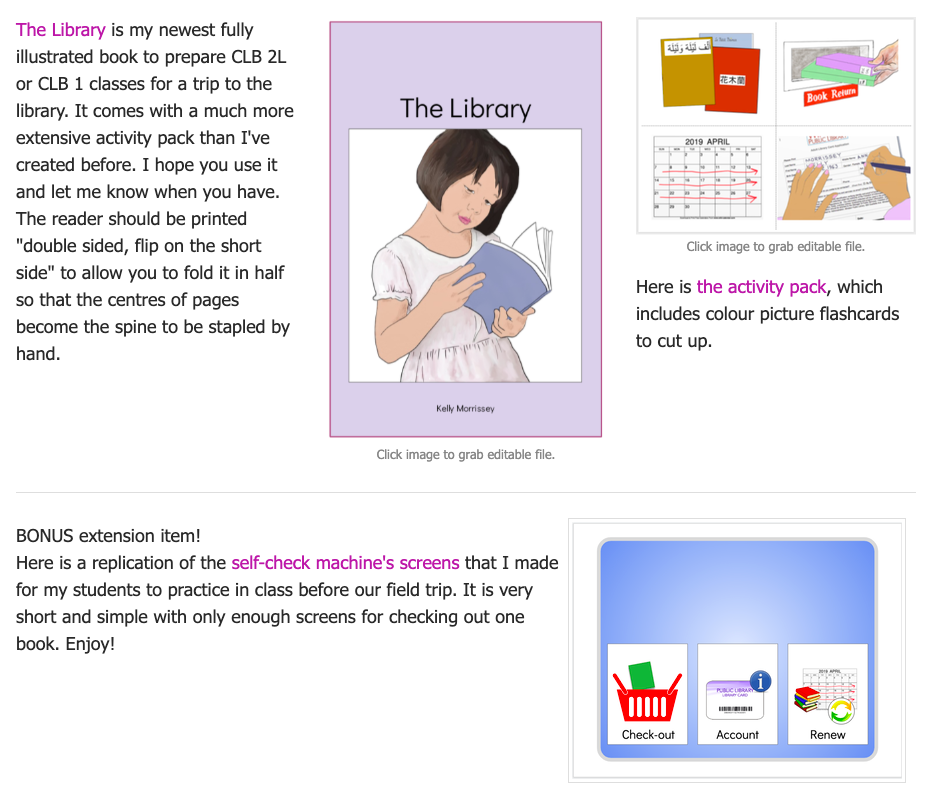
After using my own resources The Library and accompanying activity pack in my literacy classroom for a week, I ended up publishing a longer version of the activity pack with more matching words to pictures, more picture flashcards so that every text flashcard has an image to go with it, as well as two new dialogues for role plays. The librarian's role will have to be played by the teacher or a T.A. The following week, I published a resource that is a facsimile of my local library's self-check machine screens. I stuck the pages (screens) into the cello sleeves of my old classroom bank machine made from a cardboard box. That worked out great; everyone seemed excited to learn how to check out their own materials without going to the circulation desk. Whether that translates to an actual ability to do so during our field trip this Wednesday is yet to be seen! The bonus extension resource is on the website for free download.
That's it for me for this week. I'm enjoying the rest of my visit to Shaker Heights, Ohio today where the grand mature trees that shade the boulevards are beautifully blanketed in snow this afternoon.
How's life in your neck of the woods?
I don't have much else to say on that topic now, so I'll finish out this blog post with bits of news on other topics.
My Twitter feed is abuzz with colleagues' preparations to attend BC TEAL's annual conference. Yuliya has been presenting again, this time edging into the subject of student feedback on PBLA. I'll update you on that when I can, or you can follow her on Twitter https://twitter.com/YuliyaESL.
After using my own resources The Library and accompanying activity pack in my literacy classroom for a week, I ended up publishing a longer version of the activity pack with more matching words to pictures, more picture flashcards so that every text flashcard has an image to go with it, as well as two new dialogues for role plays. The librarian's role will have to be played by the teacher or a T.A. The following week, I published a resource that is a facsimile of my local library's self-check machine screens. I stuck the pages (screens) into the cello sleeves of my old classroom bank machine made from a cardboard box. That worked out great; everyone seemed excited to learn how to check out their own materials without going to the circulation desk. Whether that translates to an actual ability to do so during our field trip this Wednesday is yet to be seen! The bonus extension resource is on the website for free download.
That's it for me for this week. I'm enjoying the rest of my visit to Shaker Heights, Ohio today where the grand mature trees that shade the boulevards are beautifully blanketed in snow this afternoon.
How's life in your neck of the woods?
Sunday, March 17, 2019
Cool Hand Luke
This week I have a little of this and a little of that for discussion.
Lastly, I would like to address myself to those commenters whose comments have not made it past the new screening process in the past week or two--not that any of you would be back here to read another blog post! The rule as is stands, having been put to a vote by readers, is that the anonymous commenting feature is intended to be used only by those whose comments could get them fired or blacklisted. If you want to take potshots at the PBLA skeptics and critics, use your name. If you want to call us whiners and wallowers in negativity, do so under your own name. If you want to make the point that the issuing of new PBLA guidelines means we now have no excuse not to all jump back on the bandwagon, shut our traps and just put the damned pieces of paper in the binders, you may say that; just sign your real name.
I think that is where a lot of debate is going to centre now. What do the new guidelines mean for everyone? For some, it could mean an end to a lot of bullying and power grabbing by supervisors who had been using their twisted version of PBLA to make teachers' lives a living hell. That's yet to be seen. But for some of us, the new guidelines do little to change our stance. I don't have Claudie's gift for spelling things out; I'm fond of metaphors and allegories.
My PBLA lead teacher, after a round of inspecting binders in anticipation of a visit by an IRCC binder auditor, said to me: "I don't know why you have such issues with PBLA. You know how to do it. You're doing it fine." She said something to that effect. I responded, "Just because I can follow some steps doesn't mean I think it's in the best interest of stakeholders. You could set up a ladder and ask me to climb to the top and back down 17 times. I could execute that perfectly. It wouldn't mean I agreed with having to do it."
Suddenly a scene from an old movie came to mind.
First I want to share Yuliya's update on the state of PBLA research. Here is her recent missive.
Dear Colleagues,Secondly, I'm happy to announce to literacy and low-level ESL teachers that I've just published a new ESL literacy reader with activity pack. It's aimed at about a high CLB 1L to 2L or a CLB 1 class and is called The Library. You can download the PDFs of the book and activity pack from www.kellymorrissey.com - LITERACY - School and Library OR you can click either the book image or the activity pack image on that site to go directly into the Google file in order to edit it before use. The book itself is not city-specific, but the activity pack does have Windsor street names and our late fines. So the activity pack would need to be edited before use by teachers in other cities. Please email me if you find a typo or have any feedback.
Here is a very brief update on our PBLA implementation research and a new project invitation for literacy teachers, from a colleague at theUniversity of Birmingham.
I continue to present on the project that you participated in order to stimulate further discussion, more research, and, ultimately, policy changes.
Three major conferences are approaching: Metropolis National Conference in Halifax, BC TEAL, and ACLA/CAAL 2019 in Vancouver. Hoping to see you there if you are close to any of the conference sites.
Good news is that other research projects on PBLA are underway, and both are researching PBLA impact on beginner language learners: Dr. Marylin Abbot is working with learners of refugee background in Edmonton, and Esther Karasova is inviting literacy teachers to share their experiences with PBLA implementation at pre-CLB and lowest CLB levels.
If you could share the invitation below with your colleagues, it would be very much appreciated. Insightful and practice-relevant research can not be conducted without teachers' input. Esther’s survey is short, focused, and can be completed in about 10 minutes.
Thank you for your consideration!
Best regards,
Yuliya
I think that is where a lot of debate is going to centre now. What do the new guidelines mean for everyone? For some, it could mean an end to a lot of bullying and power grabbing by supervisors who had been using their twisted version of PBLA to make teachers' lives a living hell. That's yet to be seen. But for some of us, the new guidelines do little to change our stance. I don't have Claudie's gift for spelling things out; I'm fond of metaphors and allegories.
My PBLA lead teacher, after a round of inspecting binders in anticipation of a visit by an IRCC binder auditor, said to me: "I don't know why you have such issues with PBLA. You know how to do it. You're doing it fine." She said something to that effect. I responded, "Just because I can follow some steps doesn't mean I think it's in the best interest of stakeholders. You could set up a ladder and ask me to climb to the top and back down 17 times. I could execute that perfectly. It wouldn't mean I agreed with having to do it."
Suddenly a scene from an old movie came to mind.
Sunday, May 27, 2018
A Windsor Freebie and PBLA Update
Happy Sunday!
Before I get to the freebie, allow me to take a moment to give you an update on the results of my digging. Anytime you find information that could be helpful to others who are struggling in Orwellian work environments, feel free to email me with that info so I can add it to THIS PAGE.
Those who follow The Joy of ESL Facebook page have probably already seen this email I received:
Hello Kelly,
Thank you for raising your concerns with how the Portfolio-Based Language Assessment (PBLA) is being implemented. We will be sending new Operational Guidelines for PBLA to all language training providers in the coming weeks. These guidelines will clarify many of the issues raised in your email and we will encourage all language training providers to consult the guidelines regularly.The Centre for Canadian Language Benchmarks (CCLB) is responsible for coordinating the implementation of PBLA in Ontario. You are welcome to add pbla@language.ca to your website for instructors who have questions about PBLA or who require additional support. This is a more appropriate point of contact than MCI staff.
The CCLB is undertaking a Practice Review of PBLA to gather feedback from Administrators, Classroom Teachers, and Lead Teachers on how PBLA has been implemented and to ensure that PBLA is implemented in a consistent manner. If you would like more information you can visit http://pblaepg.language.ca/…/pbla-practice-review-framewo…/…
Daniel Lisi
Team Lead
Program Design Unit
Ministry of Citizenship and Immigration
The reason I was referred to MCI and not IRCC is presumably because it was my local MPP's office answering me. Anyway, I was hoping for a NAME that goes with a FACE to put on www.kellymorrissey.com on the PBLA support page, but I suppose pbla@language.ca will have to do. That email inbox is monitored by someone on the Centre for Canadian Language Benchmarks Board, I assume?
In any case, the advent of this document, "new Operational Guidelines" could be a good thing, no? When it comes out, we need to get our hands on a copy and read it cover to cover to see if it is of any help to us as we face drastic inconsistencies in expectations from school to school. Some employers are implementing PBLA in a way that does not create a hostile, toxic work environment with unreasonable after-hours workload expectations, while others... well, you know. (Don't even get me started on how PBLA is not resulting in consistent assessment around the country. That's another can of worms.)
At the same time, I've been in communication with someone who has advice for those of us in unions, but I am just waiting for that person to advise me whether he/she wants to be identified when I share that advice or not.
As for those of us who are NOT unionized, I did get a an interesting bit of information this past week when we had a speaker visit my morning class from Community Legal Aid. She spoke mostly about Community Legal Aid, but also a bit about Legal Assistance Windsor, whose offices are in the same building on Ouellette over the fitness centre next to the post office. She said that the law students at these two organizations can assist workers who are concerned that their employers may be violating labour standards. To be eligible for this help, you would need to a) not be a member of a union and b) qualify for their free services based on income. The threshold is somewhere around $25K per year for a family of two and around $21 K per year for a single person. She said that even if you don't meet the threshold, it is worthwhile to stop in or call them because oftentimes where they cannot help directly, they can make a referral.
This week I had two opportunities to talk to teachers at other SPOs around my city and both times I learned interesting things.
- Some employers do not give teachers any paid PBLA prep time. I think all teachers deserve to be aware of what is happening around the province and country when it comes to the PBLA roll-out.
- One teacher was overheard saying, 'if they hold up London as the gold standard, I'll quit my job tomorrow.' Watch out, Thames Valley. You have a reputation for how NOT to implement PBLA. 🙁
- Some SPOs do not require the collection of 32 artifacts between promotion periods. They recognize that as untenable, especially for those with very large classes.
- Some employers understand that worker wellbeing is more important than PBLA. Implementation needs to be done with a heavy dose of common sense and compassion for instructors, as well as by providing paid time for teachers to accomplish training and to meet expectations for the creation of lesson plans, materials, module plans and assessment tools.
Oh, and I've contacted Yuliya Desyatova about my need to update the status of her project on my website. She will update us as soon as she can. She has to do things in a certain order since this is her PhD research project.
=======
=======
As for the freebie, here is a 3-page list of free and low cost things students in Windsor's downtown core can do this summer. Feel free to edit.
Sunday, February 25, 2018
Talk to Me
Instead of talking to you this week, I'd like you to talk to me. How can I--with my website of free materials and my weekly blog posts--better meet your needs? I hope you will take a moment to answer six questions for me.
Click HERE to take the six-question survey.
Cheers!
Click HERE to take the six-question survey.
Cheers!
Sunday, February 4, 2018
One Week, One Handout (almost)
Anyone who knows me probably knows I have a keen interest in methods such as Dogme and other materials-light approaches. You might also know that I recently joined a Facebook group called Global Innovative Language Teachers, led by Dr. Gianfranco Conti. Well, the other day a member of the group posted a comment in which she expressed appreciation for a graphic organizer she had gotten from one of Dr. Conti's books and which had proven very useful for her language class. Others seemed interested, so (with his permission) I recreated it in Google Drawing--first in A4 for all the European teachers in the group, and then in 8.5" by 11" for those of us in the U.S. and Canada.
You can find it on the FREE - BLANK TEMPLATES page of my website. If you have a Google account, you can click the name of the worksheet to be taken to the master, copy it over to your own Google Drive, and edit for your purposes. If you like it as is, just click the image to download the PDF.
Anyway! I showed it to my morning (seniors) class and they were keen to take it for a test drive. I introduced the form this week, but didn't introduce it on Monday. First we talked about our recent student-teacher conferences that ended our fall/winter term on January 26th. Many people told me that seniors cannot learn the same way young people can. They want even MORE reviewing than I have been giving them. (I admit that over time, I tend to drift away from some good practices and have to be reminded.) They said that as seniors, they learn three new words Monday and forget two on Tuesday.
So I decided it was time for a trip back to our easel chart--where each page full of topical lexical items represents one module we've covered in the past. I flipped back to the very beginning of the pad of paper and asked the first student to choose one useful word* from the sheet. I asked a new student who was brand new to our class and whose English is more developed than most in the room, to be my secretary--writing each word on the white board as I flipped pages. She was great--a good speller with lovely large handwriting.
I flipped to the second page and had the student next to the first one choose a word. Thus we took turns and ended up with about 20 previously studied words on the white board.
"Now take out a piece of paper. You can do this with a partner or on your own, as you wish. I want you to write a short story and incorporate as many of these unrelated words as you can." As usual, I advised Ss with lower writing benchmarks to try to incorporate 4-5 words, while higher level writers could try to incorporate almost all of them. And then I sat down with my tablet and pen to work on the same task while they did it.
We ended up with some really wonderful stories, and I was amazed at my students' creativity. (They have asked me to focus on L/S, so I rarely get to find out if they are creative writers; some really are!) I came around to check papers and point out errors that needed correcting before they shared their stories aloud.
In a subsequent lesson that week, I introduced the Connectigram. I filled in one as an exemplar and projected it. After talking about the whys and wherefores of my use of these connectors, the students took turns trying to put together their sentences. Students discovered that "while" and "since" both have temporal connotations as well as definitions that refer to to causal or logical relationships.
Remembering Conti's admonition to provide students not only with practice on focused processing but also with thorough processing, and recalling that he considered "odd man out" activities to be helpful with this, I created a multiple choice worksheet to complement the Connectigram.
By this time we were at the end of Thursday, as we did some work on our beginning-of-term needs assessment along the way. Friday morning we took up the answers to the quiz, and debated the answers until everyone was satisfied. I then asked the students to take out their stories from earlier in the week and select a few sentences or passages to re-write using their new connector words. This was the point at which I really got to see who understood and who did not. One student had even used "whereas" in place of the temporal "while." See? This is why we have to go Back to the Well. They cannot finish the trial-and-error process without time to test out hypotheses and have them checked.
We finished by watching the three-minute film from the National Film Board's Canada Vignettes, The Log Driver's Waltz. We ran out of time, but Monday we will try to talk about the plot of the little film using some of our new words. Can you say something about the plot using "nevertheless?"
I ended the week feeling very good about how the class had gone. We had successfully (I hope) integrated two new and very different types of students into a class whose chemistry had been cemented for months if not years. We now have equal numbers of Mandarin speakers and students who speak another language, meaning I can now give my Mandarin speakers a partner every week with whom they cannot fall back on their L1 to communicate. The best part was that my prep was minimal. I hope you can make use of these resources--the way I created them or customized.
*I use the term word to mean unit of meaning, whether it be an idiom, phrasal verb or other lexical chunk.
You can find it on the FREE - BLANK TEMPLATES page of my website. If you have a Google account, you can click the name of the worksheet to be taken to the master, copy it over to your own Google Drive, and edit for your purposes. If you like it as is, just click the image to download the PDF.
Anyway! I showed it to my morning (seniors) class and they were keen to take it for a test drive. I introduced the form this week, but didn't introduce it on Monday. First we talked about our recent student-teacher conferences that ended our fall/winter term on January 26th. Many people told me that seniors cannot learn the same way young people can. They want even MORE reviewing than I have been giving them. (I admit that over time, I tend to drift away from some good practices and have to be reminded.) They said that as seniors, they learn three new words Monday and forget two on Tuesday.
So I decided it was time for a trip back to our easel chart--where each page full of topical lexical items represents one module we've covered in the past. I flipped back to the very beginning of the pad of paper and asked the first student to choose one useful word* from the sheet. I asked a new student who was brand new to our class and whose English is more developed than most in the room, to be my secretary--writing each word on the white board as I flipped pages. She was great--a good speller with lovely large handwriting.
I flipped to the second page and had the student next to the first one choose a word. Thus we took turns and ended up with about 20 previously studied words on the white board.
"Now take out a piece of paper. You can do this with a partner or on your own, as you wish. I want you to write a short story and incorporate as many of these unrelated words as you can." As usual, I advised Ss with lower writing benchmarks to try to incorporate 4-5 words, while higher level writers could try to incorporate almost all of them. And then I sat down with my tablet and pen to work on the same task while they did it.
We ended up with some really wonderful stories, and I was amazed at my students' creativity. (They have asked me to focus on L/S, so I rarely get to find out if they are creative writers; some really are!) I came around to check papers and point out errors that needed correcting before they shared their stories aloud.
In a subsequent lesson that week, I introduced the Connectigram. I filled in one as an exemplar and projected it. After talking about the whys and wherefores of my use of these connectors, the students took turns trying to put together their sentences. Students discovered that "while" and "since" both have temporal connotations as well as definitions that refer to to causal or logical relationships.
Remembering Conti's admonition to provide students not only with practice on focused processing but also with thorough processing, and recalling that he considered "odd man out" activities to be helpful with this, I created a multiple choice worksheet to complement the Connectigram.
By this time we were at the end of Thursday, as we did some work on our beginning-of-term needs assessment along the way. Friday morning we took up the answers to the quiz, and debated the answers until everyone was satisfied. I then asked the students to take out their stories from earlier in the week and select a few sentences or passages to re-write using their new connector words. This was the point at which I really got to see who understood and who did not. One student had even used "whereas" in place of the temporal "while." See? This is why we have to go Back to the Well. They cannot finish the trial-and-error process without time to test out hypotheses and have them checked.
We finished by watching the three-minute film from the National Film Board's Canada Vignettes, The Log Driver's Waltz. We ran out of time, but Monday we will try to talk about the plot of the little film using some of our new words. Can you say something about the plot using "nevertheless?"
*I use the term word to mean unit of meaning, whether it be an idiom, phrasal verb or other lexical chunk.
Sunday, December 17, 2017
FREEBIE! Winter Break Wordless Picture Book
It's nice to have the webinar behind me. I can go back to what I enjoy most: illustrating and making learning materials! I spent today revamping a little 8-page wordless book about winter break that prints two-sided and folds in the middle for stapling. The whole book requires just 2 sheets of 8.5 by 11" paper. It uses only a tiny bit of colour ink and also prints well in grey scale. Some images were intentionally left as line drawings so that students may add the colour if they see fit. I keep a box of coloured pencils in my cabinet for those days when we just need a short break from the cognitive heavy lifting. Colouring is also therapeutic for those experiencing PTSD. Margaret Margaritis and I have both observed students having better focus and lower affective filter during and after about 20 minutes of colouring.
As for the webinar, I suppose it went pretty well, but I have since thought of several things I'll do differently if we are invited to repeat somewhere. For one, I think we should have been more explicit in our directions. Teachers were to look at the graphic organizers and come up with specific ideas for how the initial collection activity could be a springboard to further study of one of the parts of speech. I've created a space on my Flipgrid where anyone curious about Back-to-the-Well or anyone who already believes in slowing down, turning fewer pages, and engaging learners more deeply can drop in with questions or ideas. Hey, if nothing else, just stop in to see how Flipgrid works! It's SO easy that even my seniors AND literacy learners can use it. There's nothing to register for, no email address required. Come on, you know you wanna. ;)
Sunday, October 15, 2017
Connection, Collaboration, Creation!
I don't believe that planetary alignment has any bearing on human activity, but if I DID believe that, then I would be asking myself right about now, "what is going on up there?"
Lately I'm feeling a lot of shifting, shedding of old, opening up to new, and lots of connecting.
In my personal life, I just finally--after 32 years--reconnected with the Japanese woman who was my best friend during the year I lived in Sapporo on the northern island of Hokkaido.
On the professional front, I'm feeling more connected each and every day to my peers in the field of language teaching--not just locally but also globally! For example:
- After hearing two of my morning students rave about a wonderful class they took at WWWWIW over the summer, I contacted the instructor to find out what sort of magic she is working in her classroom. She generously shared a detailed run-down of a typical lesson structure. I copied this structure on Thursday, and the lesson was more engaging than usual.
- Two new teachers at my agency are finding useful materials on my website and have thanked me for that.
- One teacher in another province who has found my materials helpful has reached out to me to see if our two classes--my literacy and her CLB 1--might become pen pals. I'm thinking Flipgrid!
- I have joined #LINCchat on Twitter two times in a row! It helps that the day and time has stabilized (every other Tuesday at 9:00 p.m. eastern), which is a time I'm usually free.
- The TESL Ontario Conference is right around the corner. I feel so grateful that my employer is sending every teacher who wishes to go. Conferences put new wind in my sail.
- Someone in a Facebook group I've just joined called Global Innovative Language Teachers shared a link to an article called "Principles for Resource Writing." It's good to share ideas with other language teachers around the world.
More and more teachers across Canada are letting me know that they use and appreciate the resources I share freely, the links I have curated, etc. Yay!
![]() |
| The verb TO BUY |
Speaking of sharing, today I published an activity pack to complement Bow Valley College's ESL literacy reader "Food from Home." It's under LITERACY - FOOD on my website. I am also one step closer to finishing my alphabet line customized for adult settlement English learners in Canada. I finished D today, which means four down and at least 22 to go since I hope to do one card for every letter, plus one for a few of the most common digraphs.
![]() |
| D is for DOCTOR |
How are YOU doing, dear reader? Surviving you-know-what?
Sunday, February 26, 2017
My Week (and Free Stuff for You)
Let's get to the good stuff first. I have added a new sub-section to the FREE - BLANK TEMPLATES page of my website for any PBLA templates I create for myself. You are free to download them, modify them (they are in MS Word), use them if they help you. Scroll down. They are at the bottom of that page. Feedback would be lovely. Is there a template out there you wish were tweaked in a certain way but you don't have the skills or time to do it yourself? Let me know!
Because I often find myself having forgotten in the heat of the moment to update my master inventory list as the students are recording assessments on theirs, I have moved mine to the inside cover of the folders I carry home for marking.
I hope my new system helps me stay on top of this chore.
The stress I feel, when I feel it, in beginning to fully implement PBLA with literacy and seniors, usually can be traced back to two causes:
Because I often find myself having forgotten in the heat of the moment to update my master inventory list as the students are recording assessments on theirs, I have moved mine to the inside cover of the folders I carry home for marking.
I hope my new system helps me stay on top of this chore.
The stress I feel, when I feel it, in beginning to fully implement PBLA with literacy and seniors, usually can be traced back to two causes:
- I'm often overwhelmed by the number of books, documents, training manuals, workshop handouts, etc., I have to keep up with. I would give a limb for a master index.
- In certain situations, I feel as if meeting contractual obligations and putting my students' best interest first are mutually exclusive. That's a crappy feeling.
In the first instance, it helps to have a supervisor who reminds me that many of us are overwhelmed by the same thing. She tells me to forget about certain trackers. My colleague next door commiserates. She also tells me when she finds the exact thing we've both been searching for.
This week I have examples of the second scenario. In seniors class, we just finished up a rich series of modules (or one long one?) on the Erie Saint Clair Community Care Access Centre, a topic the students begged me to cover in spite of the fact that we would have to create all our own materials to turn their website and patient guide into ESL lessons. Everything went well. The students came away with a very comprehensive grasp of that community agency's mandate, services, how they can access those services, how likely it is they will be eligible for the services given a variety of health crises, and so forth. They now have the language to talk to a PSW, request services, or rent a walker.
When it came time to represent their learning in the form of artefacts for the binders, some of it felt contrived to me. Since students, divided into teams, had spent a week parsing 2 pages each of the patient guide and reporting on their part to the class, we considered digesting the guide as a real world reading task. Their presentations are proof they understood the content. So the presentations can be used as both reading and speaking artefacts, in my mind. No issue there. But then the speaker came to visit us. Feeling pressured to squeeze in another artefact, I tried to get each student to ask one question OR ask the speaker for clarification on something. Epic fail. What should have been an enjoyable Q & A session became Kelly the ringmaster trying to make students jump through hoops just to get one more gosh-darned artefact into those bloody portfolios. One student flat out refused to ask a question. When I reminded him it was for the binder, he shrugged. He's no dummy. He knows those artefacts accumulating in the binders are meaningless for the seniors class. It's the language and knowledge they want, not the pieces of paper with checkmarks.
Lesson learned? Assess when it feels natural to assess, don't become an artefact collecting machine. The same lesson presented itself to me this week in literacy class. Because my group has been whizzing through material very quickly, I told them it was time to raise the bar a bit. Having just finished a week of Mursal on the Bus (all skill-building, no RWT), I chose Farid Takes the Bus as a reader that would recycle all the language they had just mastered and add several new terms. I also thought we could try basic concepts related to Transit Windsor maps and schedules, which I have successfully used with a CLB 1L class before.
It was a four-day week due to Family Day. While the students did well with the longer reader and were keen to learn the four directions and words like "weekdays, holiday, schedule," and "map," they were not ready for assessments by Friday. Before PBLA, this would not have been a source of stress for me. I would either have abandoned the objectives as too high (my bad), or decided to spend another week building toward successful assessment. I still have those choices, but there is always the black cloud hovering over me, the little voice reminding me that I only have so many weeks in which to collect eight to ten artefacts for each of four skills. Tick, tick, tick, tick.
My decision is to do what is right for the students. They should not pay for my having misjudged their level. They also should not pay for the fact that the powers that be sending us our PBLA obligations are out of touch. PBLA should not be viewed as a one-size-fits-all framework, equally applicable to CLB 4 and to students still trying to figure out which way the paper goes. So I breathe and say: I'll get them when I get them. If I make the quota, I make the quota.
Again I have to remind myself that I only have max 15 a.m. and max 12 p.m. My troubles are minor compared to others'.
Speaking of PBLA, I got a wonderfully candid anonymous comment on this blogpost last week. Thank you, whoever you are, for being so forthright, and for others who continue to be supportive of the questioning contingent.
Sunday, December 11, 2016
PBLA and Back to the Well
For those of you who only care about the practical stuff, you can scroll down to the CLASSROOM APPLICATION sub-heading. :) You're welcome.
All week I have been communicating with stakeholders at every level of this PBLA puzzle. The more I talk to other teachers and the more I listen to national and regional project leaders, the more I become convinced of three things:
And that brings us to...
To give others an idea of how I continue to go Back to the Well with my students, I have started using the #BackToTheWell hashtag on Twitter, and I invite you to do so, too! Also, I'm going to start providing links to the materials we used in class to revisit the same lexis in a gazillion (ha!) ways, leaving it up to the students as to when we move on to a new text. I assure you that students like to feel they have really come to own the new language.
Okay.
Having finished a series of modules covering the journey of a newly diagnosed diabetic patient from initial appointment to lab to follow-up visit to pharmacy, the seniors and I then extended the last module by examining those colourful auxiliary labels found on prescription bottles and boxes.
To see all the ways we worked with those labels, visit my website - FREE - Settlement Themes - Health. Scroll down to PHARMACY at the bottom. Within those free printable sheets, we do not even come close to exhausting all the meaningful linguistic encounters we can facilitate for the learners.
Finally, on lab day, seniors learned to use Spelling City (which I normally only use with my literacy class) to practice spelling of our week's words and syntax of our sentences. This provided them with yet more opportunities to gain mastery over that week's lexis.
So what's the bottom line? Since learning to implement PBLA is taking up some of my precious cognitive real estate, I now have even more incentive to utilize a 'do more with less' tactic in my classroom. As counterintuitive as it is, I find that students do not get bored with repeatedly revisiting the same text in myriad ways. Rather, they appreciate the opportunity to gain intimate familiarity with a given set of terms and phrases--from collocation to connotation, from prosody (sentence stress, intonation, word stress, linking) to parallel paragraph writing. It all adds to their sense of mastery and thus to their confidence levels. Over time, students are able to lead activities themselves--freeing up some of the teacher's time and energy for writing / adapting new assessment tools, marking, and other new duties under PBLA.
What do you think?
All week I have been communicating with stakeholders at every level of this PBLA puzzle. The more I talk to other teachers and the more I listen to national and regional project leaders, the more I become convinced of three things:
- Those of us who are more conscientious, tending toward perfectionism, are feeling an extra dose of stress as we attempt to learn to implement PBLA while continuing to be responsible for the day-to-day delivery of lessons. It's like asking a career quality control officer to design a plane while flying it. In addition to feeling overwhelmed by the multi-tasking challenge, we balk at the ethical conflict of subjecting our passengers to a risky flight aboard an unproven aircraft.
- Many teachers--whether they weren't 'ready to understand,' as Joanne Pettis has put it to me, or whether unintentionally misinformed by their trainers--have been operating under certain assumptions that are now being contradicted. I am talking about exactly which elements of PBLA are non-negotiable and which are flexible, as well as how flexible we can be.
- There has never been a better time for teachers who are struggling with PBLA to consider slowing down, turning fewer pages, and engaging learners more deeply, i.e., "Sending Them Back to the Well."
To those teachers for whom the first point above resonates loudly, I want to say to you that your mental health, your work-life balance, and the wellbeing of our clients come before the forms pushed on us by bureaucrats. We MUST speak up when we feel something is ethically wrong for our students, for ourselves, for our classrooms. Only by speaking up are we ever going to get answers, solutions, compromises, acknowledgement of our right to do what is best for our clients.
That brings me to point two. I am beginning to feel cautiously optimistic and believe that I as a classroom instructor am still free to use my judgement when it comes to assessing my students' skills and making promotion decisions. Yes, I will certainly strive to collect the quota of artefacts to support and back up my decisions, but I am going to make sure that the assessment timing and methods are compatible with cultivating a safe space where learners' confidence is built up, not eroded. I will do whatever it takes to shield my clients from unnecessary test anxiety. I will set them up for success, not failure. I will assess my seniors' competencies in a way that does not demoralize them or bring to their attention the fact that their benchmarks seldom change. I will design assessments in such a way that a literacy learner with a (suspected) learning disability is not made to feel stupid; rather, I will test in such a way as to bring out each student's strengths and acknowledge ways in which they learn to compensate for areas of cognitive difference and/or differences in which their brains process language. I will not create a classroom in which excessive focus on testing exacerbates existing levels of PTSD. I will first do no harm.
Thirdly, I want to recommend that everyone--whether you teach literacy or level eight--read John Sivell and Chirawibha Sivell's article, "Sending Them Back to the Well" in the summer 2012 issue of Contact Magazine. Additionally or alternatively, you could read "A Year of Slow: One Teacher's Implementation of 'Back to the Well,'" the article John and I wrote for the February 2015 issue.
Just today John wrote this about the subject:
"...in relation to respecting students’ right to receive intellectual and affective satisfaction – I’ve recently been thinking about a very old idea from S. Pit Corder (Introducing Applied Linguistics, 1973), which I learned about a long time ago: it stuck in my mind and, on reflection, it now dawns on me that it has a potentially useful connection with BTTW – viz. his idea (although since then I think others have claimed it) of ‘surrender value’. His analogy is to life insurance: if you buy a whole-life policy and then decide to cash it in early (before dying), how much is it worth? … i.e. what’s its surrender value? The idea is that we ought not to hold up the great benefits that will eventually result if a student continues studying until (say) CLB 8, because we know very well that nearly all of them will ‘cash in’ their studies much earlier, say at CLB 3-4. On the other hand, if we focus on making sure that students learn (cognitive) and feel good about (affective) something worthwhile right away, every single day, we take honest account of the reality that what learners really need is a reward now, not at some distant time. By going back to the well consistently, we can provide students with what they deserve (cognitively and affectively), which may well not only assure that they trust in the early surrender value of our lessons every day, but also that they might decide to hang in there and ‘cash in’ their studies later than they might otherwise have done.Thanks for that, John!
And that brings us to...
----- CLASSROOM APPLICATION -----
To give others an idea of how I continue to go Back to the Well with my students, I have started using the #BackToTheWell hashtag on Twitter, and I invite you to do so, too! Also, I'm going to start providing links to the materials we used in class to revisit the same lexis in a gazillion (ha!) ways, leaving it up to the students as to when we move on to a new text. I assure you that students like to feel they have really come to own the new language.
Okay.
Having finished a series of modules covering the journey of a newly diagnosed diabetic patient from initial appointment to lab to follow-up visit to pharmacy, the seniors and I then extended the last module by examining those colourful auxiliary labels found on prescription bottles and boxes.
To see all the ways we worked with those labels, visit my website - FREE - Settlement Themes - Health. Scroll down to PHARMACY at the bottom. Within those free printable sheets, we do not even come close to exhausting all the meaningful linguistic encounters we can facilitate for the learners.
Finally, on lab day, seniors learned to use Spelling City (which I normally only use with my literacy class) to practice spelling of our week's words and syntax of our sentences. This provided them with yet more opportunities to gain mastery over that week's lexis.
So what's the bottom line? Since learning to implement PBLA is taking up some of my precious cognitive real estate, I now have even more incentive to utilize a 'do more with less' tactic in my classroom. As counterintuitive as it is, I find that students do not get bored with repeatedly revisiting the same text in myriad ways. Rather, they appreciate the opportunity to gain intimate familiarity with a given set of terms and phrases--from collocation to connotation, from prosody (sentence stress, intonation, word stress, linking) to parallel paragraph writing. It all adds to their sense of mastery and thus to their confidence levels. Over time, students are able to lead activities themselves--freeing up some of the teacher's time and energy for writing / adapting new assessment tools, marking, and other new duties under PBLA.
What do you think?
Sunday, October 23, 2016
Halloween Story and Activity Pack for ESL Literacy
Welcome, ESL teachers!
I have just uploaded a new story and activity pack to www.kellymorrissey.com under LITERACY - Dates and Holidays. It is a very short little story about Sam and his Superman costume that can serve as the basis for a module this week as we get our newcomer clients ready for this Canadian cultural phenomenon that is Halloween and trick-or-treating.
I hope you like it!
As always, please leave a comment if you use the story and if you have any suggestions for making the activity pack better, especially if you find an error or typo in it! Because it's in MS Word, you are also free to edit it yourself before you use it.
By the way, I do actually have another class that is not literacy; I will eventually once again share resources for CLBs three and four. However, it seems that ESL literacy teachers are the ones facing the direst need for appropriate materials with Canadian content.
Cheers!
Kelly
I have just uploaded a new story and activity pack to www.kellymorrissey.com under LITERACY - Dates and Holidays. It is a very short little story about Sam and his Superman costume that can serve as the basis for a module this week as we get our newcomer clients ready for this Canadian cultural phenomenon that is Halloween and trick-or-treating.
I hope you like it!
![]() |
| page 1 of 2 of story |
As always, please leave a comment if you use the story and if you have any suggestions for making the activity pack better, especially if you find an error or typo in it! Because it's in MS Word, you are also free to edit it yourself before you use it.
By the way, I do actually have another class that is not literacy; I will eventually once again share resources for CLBs three and four. However, it seems that ESL literacy teachers are the ones facing the direst need for appropriate materials with Canadian content.
Cheers!
Kelly
Sunday, October 16, 2016
How I Use the Literacy Activity Packs
I apologize.
I was rushing on October 2nd and didn't do a good job. Let me try again to describe how I build a week-long module. This time I will get much more into specifics regarding how I use the activity packs that I have been uploading to the LITERACY area of the website.
Staying within a Theme
Though I don't always spend an entire month on the same theme, I do think it is beneficial to the literacy learner to stay within a theme for more than one week. Why? I say this because with literacy learners, it takes a lot longer to activate the schema and prime the brain for the topic(s). Once you've warmed them up for one set of linguistic terms and cultural concepts, why would you want to burden their cognitive load unnecessarily by jumping from topic to topic? Why not settle in a while and allow them to become really comfortable as they layer more and more skills and a richer vocabulary within the same theme week by week? The lower the stress, the more room there is for fun, and I would argue that retention of the new language increases.
Starting with a Needs Assessment
Since settlement English programs are student-centred, you will have consulted with the learners via a needs assessment to determine how to prioritize the topics. I have found over time that some topics cannot be optional. One example is learning about our PBLA binders; another is learning personal information and calling 9-1-1. I also weave lessons on phonics, decoding skills, and printing into the thematic modules without asking the learners if they want that.
Mapping Out the Modules
When planning a series of four interrelated modules within a month-long theme, I start with a couple of modules that are heavy on skill building and end with a module or two that take advantage of the learners' new abilities. Just as a lesson starts off with more scaffolding and more controlled activities, gradually reducing the need for 'training wheels,' so can a module or series of modules be constructed so that students are using language more independently by the end. They can also be reading about the topic at a higher literacy level or with more fluency by the end of a module or series of modules when you stay within a theme.
An Example of Layering Modules
Let's say the theme is housing and the house. My series of modules might look like this:
Week 1 - learn the names of the rooms and a few key furniture pieces for each room
Week 2 - learn to read a house-related story in Talk of the Block short vowel series, HOME volume
Week 3 - learn to read Perminder's Cleaning Day
Week 4 - learn to ask the landlord to address problems in the apartment
Key Resources
The resources I would use to execute the modules listed above could include: a picture dictionary; student-made reference materials from flyers and catalogs; HandsOn!; Talk of the Block, ESL Literacy Network's Readers and Read Aloud versions of the same readers; ESL activity kits from Community Legal Education Ontario (CLEO); my own activity packs.
My Activity Packs
The resources I've listed above almost never come complete with sufficient activities to give the learners the number of linguistic affordances (opportunities to encounter the new language in a variety of contexts and ways) that I believe are necessary for long-term retention of the language. I have therefore developed the habit of creating my own set of activities that I use week after week. I simply change the vocabulary while keeping the activities pretty much the same. To see a sample, check out my activity pack for Deng Starts School.
One huge benefit to this habit of staying with a limited number of activities is that it vastly reduces cognitive load that otherwise would be devoted to instructions for the task. Students become so familiar with our routines that their entire cognitive load belongs to the linguistic and cultural content of the lesson. This level of confidence on the part of the learners means that when a new student joins the class, a peer will always jump in and show the new student the ropes.
An activity pack will typically start with easier controlled activities such as:
Conclusion
So those are some routines I follow in order to reduce the cognitive load on me and on the learners! When the students are highly familiar with an activity, they do not rely on me to spend my time and energy explaining and re-explaining, wrangling and redirecting them. This frees me up to help struggling students, tick boxes on rubrics, or prepare for the next activity.
What do you think?
I was rushing on October 2nd and didn't do a good job. Let me try again to describe how I build a week-long module. This time I will get much more into specifics regarding how I use the activity packs that I have been uploading to the LITERACY area of the website.
Staying within a Theme
Though I don't always spend an entire month on the same theme, I do think it is beneficial to the literacy learner to stay within a theme for more than one week. Why? I say this because with literacy learners, it takes a lot longer to activate the schema and prime the brain for the topic(s). Once you've warmed them up for one set of linguistic terms and cultural concepts, why would you want to burden their cognitive load unnecessarily by jumping from topic to topic? Why not settle in a while and allow them to become really comfortable as they layer more and more skills and a richer vocabulary within the same theme week by week? The lower the stress, the more room there is for fun, and I would argue that retention of the new language increases.
Starting with a Needs Assessment
Since settlement English programs are student-centred, you will have consulted with the learners via a needs assessment to determine how to prioritize the topics. I have found over time that some topics cannot be optional. One example is learning about our PBLA binders; another is learning personal information and calling 9-1-1. I also weave lessons on phonics, decoding skills, and printing into the thematic modules without asking the learners if they want that.
Mapping Out the Modules
When planning a series of four interrelated modules within a month-long theme, I start with a couple of modules that are heavy on skill building and end with a module or two that take advantage of the learners' new abilities. Just as a lesson starts off with more scaffolding and more controlled activities, gradually reducing the need for 'training wheels,' so can a module or series of modules be constructed so that students are using language more independently by the end. They can also be reading about the topic at a higher literacy level or with more fluency by the end of a module or series of modules when you stay within a theme.
An Example of Layering Modules
Let's say the theme is housing and the house. My series of modules might look like this:
Week 1 - learn the names of the rooms and a few key furniture pieces for each room
Week 2 - learn to read a house-related story in Talk of the Block short vowel series, HOME volume
Week 3 - learn to read Perminder's Cleaning Day
Week 4 - learn to ask the landlord to address problems in the apartment
Key Resources
The resources I would use to execute the modules listed above could include: a picture dictionary; student-made reference materials from flyers and catalogs; HandsOn!; Talk of the Block, ESL Literacy Network's Readers and Read Aloud versions of the same readers; ESL activity kits from Community Legal Education Ontario (CLEO); my own activity packs.
My Activity Packs
The resources I've listed above almost never come complete with sufficient activities to give the learners the number of linguistic affordances (opportunities to encounter the new language in a variety of contexts and ways) that I believe are necessary for long-term retention of the language. I have therefore developed the habit of creating my own set of activities that I use week after week. I simply change the vocabulary while keeping the activities pretty much the same. To see a sample, check out my activity pack for Deng Starts School.
One huge benefit to this habit of staying with a limited number of activities is that it vastly reduces cognitive load that otherwise would be devoted to instructions for the task. Students become so familiar with our routines that their entire cognitive load belongs to the linguistic and cultural content of the lesson. This level of confidence on the part of the learners means that when a new student joins the class, a peer will always jump in and show the new student the ropes.
An activity pack will typically start with easier controlled activities such as:
- Match the word to the picture
- Word Shapes worksheet
- Listen and fill in the (first, middle, last) letter
- How many times can you find the word?
It will include guided and more difficult but still relatively controlled activities, such as:
- Unscramble the sentence
- Gap fill with no word bank (answers are in the reader)
- Crossword with no word bank (some schematic knowledge, some verbatim from reader)
I try always to include a peer survey. This can be used as a free activity, giving students an opportunity to use new questions and answers related to the real-world task or it can be used to help activate the schema and prior knowledge at the beginning of the unit.
Finally, I include two activities to be used at the end of the week to solidify rapid recognition of our new lexis:
- Flyswatter game (I often don't include this as a document in the pack because teachers can simply print the words across the board)
- BINGO grid with word bank
Incorporating the Activities into Lesson Plans
At the beginning of the week I remind students of our needs assessment so that they recognize the module as being an answer to their expressed need. This helps give them confidence to communicate to me any desire to slow down, repeat, add new material.
As I place activities into lesson plans, starting with a hook, I try to be mindful of how the student will be feeling after one activity. To keep a fast PERCEIVED pace, which has nothing to do with actual pace, I strive to give them a change in activity about every 20 minutes. I endeavour to go back and forth between work that focuses on meaning (e.g. T/F quiz) and work that focuses on form (e.g. printing). I also try to break up periods of sitting and concentrating with bursts of movement and interaction.
Of course all the while we are building toward one or more real world tasks such as asking, "Excuse me, where's the sugar," understanding, "On aisle six, with baking," and responding, "Thank you."
A Snapshot
So a typical day might unfold like this:
12:30 - announcements
12:35 - review the alphabet and sounds
12:40 - review the prior day's learning (if it's Monday, ask each other about our weekends)
12:45 - hook - activate the schema, brainstorm, elicit prior knowledge
12:55 - introduce the new lexis, reader, etc.; students predict from pictures, pass around picture flashcards, etc.
1:05 - matching words to picture (project onto board)
1:15 - take up the worksheet by projecting it on the board, students come up and draw the lines
1:25 - work with word flashcards - one set per partnership; teacher says, "Show me X, show me Y..."
1:35 - categorizing activity - students group the picture or word flashcards in some way, such as by part of speech, by type of object, by sound, etc.
--BREAK--
2:00 - Introduce a short dialogue, such as "Do you like _____?" "Yes, I do / No, I don't." Give students a chance to practice it verbally many, many times in various ways. These exact phrases will appear on the upcoming peer survey.
- Repeat after T
- Teacher plays role of A, students take turns taking role of B
- Chain drill around the room
- Write the dialogue on the board. Read and speak.
2:40 - Do a plenary activity with the results of the peer survey, such as forming 3rd person singular statements about others. Ali likes tomatoes. Jenna doesn't like tomatoes. (Note that you have now covered all forms of this grammar point: question, positive and negative answer, positive and negative statement in first and third person.)
2:50 - Written sentences summarizing our peer survey findings or start a puzzle. (Teacher is now free to start cleaning up the classroom.)
Extending with Online Games
There are times when I need a little ten-minute filler activity and the students need a change of pace. In that moment, I'll be so glad I loaded the week's words and sentences from their text into Spelling City. Our school pays about $74 CAD per year for up to 25 students at any given time to use the premium activities. If you only want spelling test and a few games, you can get a free account. Since I believe the Sentence Unscramble game has enormous value to the learners, I have the premium account. In a given week, I might use Hang Mouse once, Sentence Unscramble once, and then link to the word list on the classroom blog so that the learners themselves can opt to practice our week's lexis using these same games and quizzes.
The Week
I tend to stick to a rather predictable pattern through the week:
Monday - presentation, controlled activities, take pictures for LEA books
Tuesday - skill building, practice reading, paragraph unscramble in pairs, phonics
Wednesday - iPads, reading circles, gap fill, posters, practice reading
Thursday - comprehension quiz, peer survey, flyswatter game, role plays, assessments
Friday - learning logs, BINGO, computer lab
So those are some routines I follow in order to reduce the cognitive load on me and on the learners! When the students are highly familiar with an activity, they do not rely on me to spend my time and energy explaining and re-explaining, wrangling and redirecting them. This frees me up to help struggling students, tick boxes on rubrics, or prepare for the next activity.
What do you think?
Sunday, October 9, 2016
Fleshing Out a Module
Last week I told you I would upload the materials I developed for one of the weekly modules. Well, I've spent the afternoon over at the website uploading all the materials AND rubrics I used in the first week of our October FOOD theme.
The literacy learners did cook a squash (we borrowed a microwave from another department). We created a Language Experience Approach book and had a lot of fun all week. You can download the book, the activity pack in MS Word, and a puzzle by going to LITERACY - FOOD on my website. You are free to modify this to suit your needs. You can use some or all of it. As always, you will need KG Primary Penmanship Lined font installed on all machines on which you plan to open my literacy activity packs. It's free from Kimberly Geswein, though I'm sure she'd appreciate a donation.
Because many teachers are finding PBLA implementation to be a bit stressful and overwhelming, I have begun including in my free resources area any rubrics that I develop to go along with the activities. The images on them are in the public domain and I have licensed them under a Creative Commons attribution non-commercial share-alike international license. That means please attribute the work to me, please also share it with others, and do not make money from it.
For teachers of higher levels, I have also uploaded a level 4 or 5+ reading assessment for TD Canada Trust savings and chequing account schedules and the accompanying rubric. Look under FREE - Settlement Themes - Banking.
If you appreciate what I do, please leave me a comment. It's my only payment.
The literacy learners did cook a squash (we borrowed a microwave from another department). We created a Language Experience Approach book and had a lot of fun all week. You can download the book, the activity pack in MS Word, and a puzzle by going to LITERACY - FOOD on my website. You are free to modify this to suit your needs. You can use some or all of it. As always, you will need KG Primary Penmanship Lined font installed on all machines on which you plan to open my literacy activity packs. It's free from Kimberly Geswein, though I'm sure she'd appreciate a donation.
Because many teachers are finding PBLA implementation to be a bit stressful and overwhelming, I have begun including in my free resources area any rubrics that I develop to go along with the activities. The images on them are in the public domain and I have licensed them under a Creative Commons attribution non-commercial share-alike international license. That means please attribute the work to me, please also share it with others, and do not make money from it.
For teachers of higher levels, I have also uploaded a level 4 or 5+ reading assessment for TD Canada Trust savings and chequing account schedules and the accompanying rubric. Look under FREE - Settlement Themes - Banking.
If you appreciate what I do, please leave me a comment. It's my only payment.
Sunday, September 4, 2016
How Should I Organize My Free Literacy Materials?
With school starting back up and a new literacy teacher joining our team, I am feeling motivated to go through and edit / improve all the activity packs that I have created both for the ESL Literacy Network Readers and for the Talk of the Block short and long vowel series of books. I did have some of these activity kits housed on Bow Valley College's teacher showcase area, but they discontinued that feature in their transition from ESL Literacy Network to Centre of Excellence in Foundational Learning.
As I go through and ensure that my materials follow best practices for literacy materials and contain only images that can be freely shared without copyright infringement, I will be posting them on my website.
Here's my question for you.
Where / how should I organize these materials? Is there a teaching resource website whose layout and organization you find especially user friendly? Do you find the current layout of my website www.kellymorrissey.com easy to navigate? If not, why not? What would you have me do differently?
I am currently planning to put the activity kits in their own section at the top or bottom of the existing thematic pages. These pages follow the settlement themes (housing, commercial services, banking and money, etc.) Do you think this is a good plan?
Alternately, I suppose I could create separate page or pages containing ONLY literacy worksheets, links, ideas, etc.
Please let me know in the comments section below which plan appeals more to you as a user of my website.
Thank you so much!
As I go through and ensure that my materials follow best practices for literacy materials and contain only images that can be freely shared without copyright infringement, I will be posting them on my website.
Here's my question for you.
Where / how should I organize these materials? Is there a teaching resource website whose layout and organization you find especially user friendly? Do you find the current layout of my website www.kellymorrissey.com easy to navigate? If not, why not? What would you have me do differently?
I am currently planning to put the activity kits in their own section at the top or bottom of the existing thematic pages. These pages follow the settlement themes (housing, commercial services, banking and money, etc.) Do you think this is a good plan?
Alternately, I suppose I could create separate page or pages containing ONLY literacy worksheets, links, ideas, etc.
Please let me know in the comments section below which plan appeals more to you as a user of my website.
Thank you so much!
Monday, November 30, 2015
Teaching Small Talk
My multilevel class of a dozen or so Chinese and two Iraqis--all over the age of 60--has embarked upon the task of learning how to chat up strangers.
We began the unit by defining small talk and brainstorming together why we do it, when / where we do it, and HOW.
They correctly guessed that we use this superficial blather to break the ice, fill silence (with which we in this culture are not always terribly comfortable), and offer a bit of chatter to pass the time at the bus stop, train station, in line somewhere, in our apartment building or office building elevator, and so on.
We spent a couple of days learning these conversation starters, but in order not to be overwhelmed, decided to select no more than FIVE conversation starters, making sure we had at least one for a party, one that could be used to comment on any sort of weather, and one to use while strolling at the riverfront this summer when we encounter people with pets or babies in strollers. We noted that many of these could be used in multiple situations by substituting the word RAIN for SNOW, and so forth.
The next couple of classes were spent mastering TAG QUESTIONS, since they are so often incorporated in small talk. (Nice day, isn't it?) Our reference text for this was Azar's blue book.
It wasn't difficult for me to find some nice colour photographs on Google images for us to use as practice prompts. I found a woman walking her Golden Retriever, a well-dressed man standing alone at a cocktail party, a man with a stroller at the park, someone with an umbrella waiting on a train platform, a fellow shovelling the snow from his driveway, a woman waiting for a bus, and a young lady basking in the sun at a park. These I distributed to groups of 3-4 so they could practice starting conversations in each imagined encounter.
Another grammar point I tied into this unit is that of situational ellipsis.
"Do you think Canadians always use full sentences and full questions when engaging in small talk?" The learners let me know that they are completely aware that native speakers often communicate in one- and two-word phrases, but they don't know how to do it themselves.
This was a great time for us to delve into Scott Thornbury's little dialogue called "The Train to Oxford." The students had little trouble adding the punctuation and needed only a bit of help with intonation. (Up for Y/N questions such as "Married?" and down for wh- questions, such as "When?")
They took turns performing this role play for the class, then we spent about 20 minutes of paper and pencil time trying to reconstruct the elided elements. It was fun comparing the various versions of re-built grammar. Some turned "Oxford!" into "Oh, we've arrived at Oxford Station!" while others preferred, "This is the Oxford stop." It's all good.
For their next task, I chose to put together a dialogue between two strangers engaged in small talk at the park using artificially complete sentences and questions. If you would like a copy of this, just visit my website - Free Resources - Grammar and scroll down to Ellipsis (grammar points are arranged alphabetically). Their job is to strip it down as far as they think possible while remaining natural or NS plausible.
After taking up the worksheet, we went back again to the photo prompts. These seniors really like to take things slowly and revisit the same material in various ways. In order to change things up a bit, this time we moved the tables and chairs out of our way and stood in two rows of seven. I gave each A a photo prompt. We stood face-to-face, seven As and seven Bs. I explained that Bs had to initiate the conversation with this stranger, and that after about a minute, I would signal Bs to move up the row on person, with the last B coming around to talk to the first A. We did this until each B had visited every A. Tomorrow we'll repeat that, switching roles. Also to add a bit of variety, I threw two new photos into the mix: a woman with a child in a clinic waiting room and an older person with arms full of grocery bags.
I hope you can use these ideas with your group. Let me know if you do. :)
Sunday, November 8, 2015
Store Returns (Part II)
As our unit on store returns (see last week's post) has unfolded, I have developed some materials that you can use. It's all Canadian content, using slightly adapted versions of actual returns policies of Canadian stores (Canadian Tire, Zehrs Markets, etc.).
Just go to my website www.kellymorrissey.com and then from the drop-down menu at the top, FREE RESOURCES - SETTLEMENT THEMES. Click the "Commercial Services" panel and you will see a link to the worksheets and unit outline as a hyperlink under SHOPPING - RETURNS.
Would love to hear if you end up using this with your students.
Cheers!
Just go to my website www.kellymorrissey.com and then from the drop-down menu at the top, FREE RESOURCES - SETTLEMENT THEMES. Click the "Commercial Services" panel and you will see a link to the worksheets and unit outline as a hyperlink under SHOPPING - RETURNS.
Would love to hear if you end up using this with your students.
Cheers!
Monday, September 21, 2015
Martine's Rule Number One
Muffled inside my backpack, the ring of my cell phone was just barely audible as I walked from my parking spot to the building where I'd just been hired to teach for four hours a week--a lunch hour pronunciation class.
I grappled with the zipper pouch in the middle of the sidewalk and managed to answer before it went to voice mail. It could be one of my colleagues calling me to supply for them, I thought. Covering for absent teachers was another role for which I was hired at the same time. My third hat was that of teaching assistant, which was why I was headed into work hours before my class time.
"Hello?"
"Kelly?" A weak and raspy voice came through from the other end.
"Yes?"
"Can you cover for me today? I woke up with a migraine."
"Sure I can," I said, already starting to feel ill at ease with the notion of zero prep time. "What's the topic?"
"Oh, there's no particular topic. Do anything you want with them."
"Thanks a lot," I said, hoping my voice didn't betray any trace of sarcasm.
She had given me no advance notice nor had she prepared anything like the other instructors always did. There wasn't even a topic to inspire me. Fortunately, I had spent a recent weekend compiling a few emergency lesson ideas for just such a circumstance. I would try out "student-made tests."
Thank goodness I'ma nervous Nellie an early bird; I had time to grab a ruler and create a simple table-style graphic organizer and make twenty copies. (Grab the free template on my website.)
After introducing myself and explaining their teacher's absence, I polled the class to find out what grammar points they had been covering over the past week or two. As they all began to chime in, I scribbled quickly, capturing their answers on the board.
Next I asked them what topic they had covered. They told me they had just finished reading The Piano, a slender chapter book abridged for ESL learners. Great.
I explained that their task would be to think up six good questions to test their classmates on the material covered over the past week or two: three about grammar and three about the novel. I would come around, I said, to help them find any errors in their questions. I then would circle what I thought were the best four out of six, and they were to copy those onto the graphic organizer.
That took us to break time.
After break, we pulled half the chairs from outside the U of tables to the inside so that pairs were facing each other.
"Partner A has five minutes to ask partner B four questions. When you hear my beeper go off, it's time to switch roles: B then has five minutes to quiz A. Then I'll ring the bell and Bs will move clockwise while As stay put. Got it?"
They got it. With five pairs, this took exactly fifty minutes, leaving us ten minutes for a debriefing before the end of class. They were supposed to rank their classmates and report at the end who had done the best job answering each question. But during the plenary discussion, something serendipitous arose from this technique. The students all said they had come to understand the material so much better. Their classmates had elucidated formerly cryptic grammar points, helped them understand the book's plot twists, and had taught them new words or given them a fuller grasp of terms already touched on in class.
As the students filed out into the hall with smiles on their faces, still abuzz with the energy of the activity, I heard the voice of my TESL prof in my head. "RULE NUMBER ONE," she said so many times that it can never leave me, "Whenever possible, have the students do the work."
Yes, Martine. I think I see what you meant.
The next time Martine's rule echoed in my mind was when I was acting as teaching assistant, observing and helping the literacy teacher. The class was about to play BINGO. How many times had I toyed with the idea of using this game in class only to reject it as too time consuming for the teacher? After all, each BINGO card has to be different since you can't have every students shouting BINGO at the same time. But this teacher did something that had never occurred to me. He put the bank of twenty-four words at the bottom of the sheet and had the students COPY them one by one into the BINGO grid, reminding them not to copy them in order starting with the top left cell, but encouraging them to scatter the words around the grid in a random way. Not only did this save the teacher prep time, but these students got an opportunity to practice copying--a skill most of them were still developing. Value!
That was over five years ago. Now I have two classes and continue to remind myself several times a week of Martine's Rule Number One. Today in literacy class, for example, I decided to start our food unit in a way I never have before. Instead of warming them up, activating prior knowledge, yada yada, and then presenting twelve food staple words of my choosing, I passed out grocery store flyers and had the students cut out five items they buy every week. From posters each team of two created, I then told them they had to decide on the twelve terms we would learn and practice with this week. Well, we ended up with a list almost identical to the one I usually give them, but I noticed that the level of engagement seemed much higher than usual. These are the words THEY chose, the ones THEY say they need when shopping.
So, how about you? How do you feel about Martine's Rule Number One? Do you embrace a similar philosophy in your teaching? If so, how? And if not, why not?
I grappled with the zipper pouch in the middle of the sidewalk and managed to answer before it went to voice mail. It could be one of my colleagues calling me to supply for them, I thought. Covering for absent teachers was another role for which I was hired at the same time. My third hat was that of teaching assistant, which was why I was headed into work hours before my class time.
"Hello?"
"Kelly?" A weak and raspy voice came through from the other end.
"Yes?"
"Can you cover for me today? I woke up with a migraine."
"Sure I can," I said, already starting to feel ill at ease with the notion of zero prep time. "What's the topic?"
"Oh, there's no particular topic. Do anything you want with them."
"Thanks a lot," I said, hoping my voice didn't betray any trace of sarcasm.
She had given me no advance notice nor had she prepared anything like the other instructors always did. There wasn't even a topic to inspire me. Fortunately, I had spent a recent weekend compiling a few emergency lesson ideas for just such a circumstance. I would try out "student-made tests."
Thank goodness I'm
After introducing myself and explaining their teacher's absence, I polled the class to find out what grammar points they had been covering over the past week or two. As they all began to chime in, I scribbled quickly, capturing their answers on the board.
Next I asked them what topic they had covered. They told me they had just finished reading The Piano, a slender chapter book abridged for ESL learners. Great.
I explained that their task would be to think up six good questions to test their classmates on the material covered over the past week or two: three about grammar and three about the novel. I would come around, I said, to help them find any errors in their questions. I then would circle what I thought were the best four out of six, and they were to copy those onto the graphic organizer.
That took us to break time.
After break, we pulled half the chairs from outside the U of tables to the inside so that pairs were facing each other.
"Partner A has five minutes to ask partner B four questions. When you hear my beeper go off, it's time to switch roles: B then has five minutes to quiz A. Then I'll ring the bell and Bs will move clockwise while As stay put. Got it?"
They got it. With five pairs, this took exactly fifty minutes, leaving us ten minutes for a debriefing before the end of class. They were supposed to rank their classmates and report at the end who had done the best job answering each question. But during the plenary discussion, something serendipitous arose from this technique. The students all said they had come to understand the material so much better. Their classmates had elucidated formerly cryptic grammar points, helped them understand the book's plot twists, and had taught them new words or given them a fuller grasp of terms already touched on in class.
As the students filed out into the hall with smiles on their faces, still abuzz with the energy of the activity, I heard the voice of my TESL prof in my head. "RULE NUMBER ONE," she said so many times that it can never leave me, "Whenever possible, have the students do the work."
Yes, Martine. I think I see what you meant.
The next time Martine's rule echoed in my mind was when I was acting as teaching assistant, observing and helping the literacy teacher. The class was about to play BINGO. How many times had I toyed with the idea of using this game in class only to reject it as too time consuming for the teacher? After all, each BINGO card has to be different since you can't have every students shouting BINGO at the same time. But this teacher did something that had never occurred to me. He put the bank of twenty-four words at the bottom of the sheet and had the students COPY them one by one into the BINGO grid, reminding them not to copy them in order starting with the top left cell, but encouraging them to scatter the words around the grid in a random way. Not only did this save the teacher prep time, but these students got an opportunity to practice copying--a skill most of them were still developing. Value!
That was over five years ago. Now I have two classes and continue to remind myself several times a week of Martine's Rule Number One. Today in literacy class, for example, I decided to start our food unit in a way I never have before. Instead of warming them up, activating prior knowledge, yada yada, and then presenting twelve food staple words of my choosing, I passed out grocery store flyers and had the students cut out five items they buy every week. From posters each team of two created, I then told them they had to decide on the twelve terms we would learn and practice with this week. Well, we ended up with a list almost identical to the one I usually give them, but I noticed that the level of engagement seemed much higher than usual. These are the words THEY chose, the ones THEY say they need when shopping.
So, how about you? How do you feel about Martine's Rule Number One? Do you embrace a similar philosophy in your teaching? If so, how? And if not, why not?
Monday, September 14, 2015
Free Library Resource
When our newest teacher asked me the other day for a copy of the "Using the Public Library" worksheets, puzzle pieces, and unit plan that has been passed around among several of my colleagues since I developed it, I was surprised to find that I'd never posted it with other freebies on my website. That was probably because it included a transcript of an audio lesson I did not have permission to replicate or upload. So I've deleted that part, making the whole thing sharable under a Creative Commons license.
Now is a great time to plan a field trip with your students to the closest library branch. At my school, we're fortunate enough to be within easy walking distance to the main branch. I take my literacy class there each spring and fall, avoiding the walk during the broiling hot and bitterly cold months.
A unit plan and photocopiable materials for CLB 3 and up are under FREE RESOURCES - Settlement Themes - Community and Government Services. For literacy level, we spend a couple of weeks skill-building, then write a Language Experience Approach story around our trip, which we learn to read during the week following the field trip.
How about you? Do you take your class to the library to teach them how to access resources and get a free borrower's card? If you do, I really hope these materials are useful to you. Please leave a comment if they are.
| Literacy student using her new card |
| Literacy students comparing borrowed items |
A unit plan and photocopiable materials for CLB 3 and up are under FREE RESOURCES - Settlement Themes - Community and Government Services. For literacy level, we spend a couple of weeks skill-building, then write a Language Experience Approach story around our trip, which we learn to read during the week following the field trip.
How about you? Do you take your class to the library to teach them how to access resources and get a free borrower's card? If you do, I really hope these materials are useful to you. Please leave a comment if they are.
Subscribe to:
Posts (Atom)