Monday, February 23, 2015

Happy Year of the Wood Goat

When I ordered four lunar new year treats from a nearby restaurant, I wrongly assumed they would all be ready-to-eat. But the taro cake needed to be pan-fried. I was floored when a staff member of a different department offered her time and their kitchen to slice up and fry the taro cake then bring it up to us on a plate. Not a day goes by that I don't remember how fortunate I am to work with people like J in an environment where you'll never hear anyone say, "That's not my job."

Students brought dumplings, peanuts, sunflower seeds, sesame balls, glutinous rice balls rolled in something yummy, black bean cakes, fruit salad, sticky buns, and more. The koi cake you see in the picture was purchased.

The prior week we had guests from LINC One whose instructor was playing chaperone on a field trip for Black History Month. I was in need of material that would both appeal to the seniors and be comprehensible to the level one students. Once again, The Westcoast Reader came to my rescue. We used the lesson about Lunar New Year from the Special Days and Holidays book, including page ten from the Word Games and Puzzles book (see their sidebar) so we could all find out about our respective animals in the Chinese Zodiac.

After reading the text and working with the vocabulary, we played "Find Someone Who" with a BINGO card I created. This all took two days (four and a half hours of classroom time). I was thrilled when two of the LINC one students, given the option on day two of watching a movie with other students, chose instead to come back to our class!

Did you do anything for Valentine's Day, Family Day, Lunar New Year or Black History Month? I would love to hear about it if you did.

****************

Coming Next Week: Why and how I use Total Physical Response (TPR) and how you can, too.

Sunday, February 8, 2015

How to Make a Classroom Bank Machine


The wisest thing I've ever done to help my literacy learners become comfortable with an ATM--something they had indicated via our needs assessment was important to them--was build an ATM from a cardboard box. Fortunately for me, all our students use the same bank, making the resource hunting part of this unit easier for me.

To give students lots of scaffolding for this lesson, we spent a week working with Fatima Goes to the Bank and the following week building our skills with the vocabulary needed for just ONE type of transaction--a withdrawal. These are words such as savings, chequing, select, and receipt. You'd be surprised how manageable these screens can be if you help students learn to scan for the words they DO KNOW while ignoring the big ones they don't know. For example, out of "no more transactions," they can find and understand "no more."

After learning how to withdraw and getting lots of practice with the simulated screens in class, the learners requested that we repeat the entire process with the deposit transaction. So that took another week. We combined it with learning to write cheques. After writing each other $20 cheques, those cheques were what we put into our deposit envelopes.

I found this unit on using an ATM to be very successful. Students learned that they needn't be intimidated by all those options on the screen as long as they can scan and find the option they need. By working with TD Bank's online Green Machine tutorials* and the classroom ATM that had been modelled after those screens, students got to the point of knowing exactly which question was coming next. Not only that, but learners had a lot of fun taking turns standing behind the cardboard ATM to flip the screens and push the bank card, receipt and money out through the proper slots while the student customer stood facing the "machine," ready to receive each one in turn.

Of course we also talked about ATM safety points, such as protecting your PIN, not counting money until you're in a private and safe place, where and when NOT to use an ATM, and other safety concepts.

Finally, we took photos of ourselves using the classroom ATM and built a story book around the process. That was our reading material for the following week, providing lots of recycling of the same words and concepts.

What you will need for a classroom ATM:

  • a cardboard box from your local liquor or grocery store
  • a utility or exacto knife
  • card stock on which to draw the keypad (or my photo of it printed out in colour)
  • packing or duct tape
  • ruler
  • markers
  • a life-sized print-out of a bank card to paste below the card slot (direction must match ATM)
  • one presentation portfolio or lightweight binder with enough plastic sleeves to hold all your screens
  • one copy of my editable ATM screens (Literacy - Banking and Money)
  • classroom money (at least four twenties)
Steps:

  1. Insert 8.5 x 11" screens for a given transaction into the plastic sleeves in the same order in which they appear on the Green Machine.
  2. Use strong tape to affix one cover of the binder to the top of the box in such a way that the plastic sleeves hang down onto the face of the ATM and can be flipped back out of the way one at a time.
  3. Use a ruler to sketch out then a knife to cut four slots: one for the bank card, another for the receipt to come out, a slot for deposits, and a large bottom slot from which the money can emerge. (Study a real TD Bank ATM so you know where these slots really are.)
  4. Paste the picture of the keypad or draw a PIN pad on a separate piece of cardboard and place it in front of the machine or attach it like a fold-out flap.
Voila! You have a classroom bank machine.

Also very helpful in teaching ATM use at any level are TD Canada Trust's own screen-by-screen tutorials and GCF LearnFree.org's ATM, an interactive simulator. Or check out this Canadian ATM simulator.

Please do let me know if you end up using any of these ideas. I would be so happy to know it.

Sunday, February 1, 2015

Listening Boot Camp (Week Two)

This week was the real test of the students' understanding of and investment in the new ideas around putting aside L1 and electronic (bilingual) dictionaries in order to focus more completely on improving listening and speaking skills.

I felt we had spent enough time building the toolbox, but the question remained: would they use those tools? I felt more determined than ever not to let conversation time turn into the same disastrous scene as always--with me running around trying to police the violators of the NO DICTIONARIES and NO L1 rules.

Here are some things I did to ensure a better outcome:

  • Made the text as simple and short as possible given the students' objectives. (It's a multilevel class with some functioning at CLB 2/3 in listening.) 
  • Gave them the text the day before so the dictionary addicts could look up unknown words that night. 
  • Explained to them how it made me feel when they used their first language during conversation time. I compared myself to the coach of a bike race team who has planned a wonderful route through gorgeous hilly countryside for the team to practice for the Tour de France. How do you think the coach feels, I asked them, if one cyclist sneaks off and catches a ride to the finish line in a buddy's car? What's the goal--getting to the finish line first, or practicing cycling? They got it and nodded in agreement. 
  • Offered to let them spend ten minutes with dictionaries, L1 allowed, before the dedicated conversation time, during which the strict rules would come into force. They wanted that prep time. 
  • Reminded them of our tools, pointing to the little coloured posters hanging around the classroom with gambits such as, "How do you say _____ in our language?" and "What does X mean?" 
  • Told them that policing them is not fun for me. They are adults and policing them is not my job. They can police themselves and each other. They agreed. 
And? It worked. For the first time since assuming the role as their instructor, I witnessed not one single instance of a student reaching for the bilingual dictionary or speaking his or her first language. That lasted a good half hour. I don't dare hold my breath and think it will necessarily happen a second time without a repeat of almost all these reminders, but at least I know that problems of this type in the past were caused in great part by my failure to prepare the students to succeed.

*******

I welcome ALL respectful comments, suggestions, typo corrections, or reports on what you had for lunch. :)

Monday, January 26, 2015

Listening Boot Camp (Week One)


I'm happy to report that the first phase of Listening Boot Camp (the buy-in) has been a success, but not without a bit of head-banging along the way (my head against classroom door--to much laughter). Many grasped the concept of guessing a word from context after I read "The Shillybog" aloud to them while they shouted out possible meanings for the nonsense words. To satisfy their unavoidable demand to see all oral texts in writing, I let them spend an hour with a printed copy, delighting in the fact that dictionaries were of no use whatsoever.

I gave them some language for oral practice:

A: What do you think _____ means? 
B: I think it means ____. A: 
Why? B: Because... 

Example:

A: What do you think 'shillybog' means? 
B: I think a shillybog is a type of night club. 
A: Why? 
B: Because we know it's downtown, and we know people go there after work to drink and dance or sing. It could be a dance club or karaoke club. 

That worked well. The next day I wanted to give a lesson on the art of talking around an unknown word, so I brought in a package of little dinosaur figures from the evil dollar store. After explaining the point of the exercise and getting agreement that they would not use dictionaries or pencils during this part of the lesson, I put them in A/B pairs and slipped a plastic T-Rex, Pterodactyl, or Stegosaurus into the waiting hands of each A partner, who tucked it under the table and vowed not to show the toy to partner. I reminded the Bs that communication is a two-way street and that they could ask partner questions about the item hidden away between cupped hands.

Soon I was hearing things like, "Does it have a long neck and tail?" "Do children visit parks and see statues of it?" Feeling satisfied with how things were progressing, I slipped out to use the washroom. On my return minutes later, two students had bilingual dictionaries open, and I heard the word "dinosaur."

I will be honest with you. I was crushed. I love my senior students like my own grandparents, so becoming angry with them is almost beyond imagining. But my face flushed. I got their attention and asked them, "Do you know how long I searched for an item nobody would know? By looking up the word, you've ruined the lesson."

You have to realize that I would normally NEVER use such strong language with my students. But this sneakiness and not taking me seriously when I set rules for activities has been going on for well over a year now. They do as they please, thinking a sweet apology makes it all better. Enough is enough.

Since they rarely if ever see me upset, my visible disappointment got their attention. Having used the dinosaurs as a warm-up and practice, after the break we played a game to practice this new skill of talking around an unknown word. I divided the class into two teams and explained the charades-like activity to them. Taking turns, one student from each team would come into the hall with me to peek at an item from a bag I'd brought from home. The student would then return to the classroom and try to describe the item to his/her teammates. Speaking the L1 meant an end to that turn and no point for that team.

This actually went very well. Some items they had to describe included a corkscrew, sink strainer, zip-lock bag and tape measure. Only one student lost the turn for her team by lapsing into her first language.

Thursday was compromise day. As a reward for their great efforts to fully participate in the Listening Boot Camp activities, I let them see the names of all the mystery items from the day before in the form of a matching worksheet. Once they had worked with classmates to complete the gap-fill, I asked them to practice a short customer-clerk dialogue with the same household items in mind:

A: Can I help you? 
B: Yes. I'm looking for a... well, I don't know the name of it. 
A: Can you describe it for me? What's it used for? 
B: It's metal. You use it to break open the shell of a nut. 
A: Ah, a nutcracker! Yes, we have a few models to choose from. How much did you want to spend? ...etc. 

After pairs had practiced their shopper-clerk dialogues one time through with each item, I invited them to the front of the class to perform for each other.

At the end of class that day, three students came up to me as they were leaving in order to tell me, "We like this method. We like listening boot camp."

Friday's lab activities included links to videos meant to reinforce some of the concepts presented during the week.

Monday, January 19, 2015

The Listening Skills Dilemma

I am about to pull my hair out. Seriously, I'm at my wit's end. Today I did a needs assessment with my beloved morning class (90% Chinese, 100% over the age of 55). They are almost in tears, they so badly want to improve their listening skills. And yet, when I try to get them to set aside their electronic dictionaries and pencils for a block of listening / speaking time, I feel like I'm dealing with toddlers. They are sneaky. They apologize. They laugh. They look sheepish. But they do not comply.

The same thing happens when they repeatedly revert to their L1--a problem that comes with the fact that it is such a homogeneous group. We have voted on it. THEY decided they wanted to ban L1 from the class, except for occasional, brief and discreet whispers to a classmate: "How do you say X in our language?" But do they stick to that rule? Heck, no. The minute my back is turned... no, not even. Right in front of me they just babble away in the L1.

One source of this challenge is clear to me. Given the generation and culture of origin of the majority, I assume they have been inexorably steeped in the grammar-translation method of second language acquisition. We have talked about that. I've offered myself as an example since I've studied languages as diverse as ASL, Demotic Greek, Latin, Japanese and Farsi. They nod in agreement when I say the grammar-translation method was apt and sufficient for my Latin studies, given the goal of being able to translate Ovid. Do they think this method rendered me able to order a beer in Latin or ask where the bathroom is? Of course not. We laugh.

In summary, I've given sermons about forging neural pathways (they are educated enough for this level of analysis) until I'm blue in the face. I've offered cute quotes like, "Do the uncomfortable until it feels comfortable." I've given testimonials from my own history as a successful polyglot. Nothing ever works for long.

Today I am starting over. I have decided I will do whatever it takes to get buy-in. I will try to work with instead of against the barriers. We must solve this problem. Below will be my journal where I will keep an account of what works and what fails.

12 January Tricked groups into making oral presentations without looking down at paper by surprising them with the assignment and not allowing them to bring paper with them to the front of the class. Of course they did just fine, and it was much more engaging than when they know about a presentation ahead of time and spend all night MEMORIZING their parts (gah!) or read from paper (double gah).

13 January We are seeing eye-to-eye regarding over-dependence on dictionaries. We made a compromise: dictionaries were allowed for the first 20 minutes after I had passed out the text (the needs assessment itself). After break, no dictionaries were allowed, only conversation about the questionnaire. Almost everyone cooperated, and I gave violators a choice between tucking the machines away in a satchel or letting me put them on top of the file cabinet. At the end of class, they were smiling. They said they liked the tactic and want to continue down this road.

14 January I want to sell them on the notion of guessing the meaning of words from context, so I'm giving them this text, "The Shillybog." We'll see how it goes.

15 January The activity re guessing the meaning of words from context went over very well. They get the point of it. On Monday we start our new project called "Kelly's Listening Boot Camp." The idea is that I am their personal trainer whose goal it is to help them develop and exercise the listening "muscles." It's my job to inspire and motivate while providing ways for them to strengthen these underdeveloped faculties. It won't always be fun. It may often be uncomfortable. But hopefully the end will justify the means!

Here are the text and discussion questions I'm using to kick off Listening Boot Camp on Monday.

It is my hope that I can help the learners build a tool box of strategies for improving their listening, including improving prosody through practice with the stress-timed nature of English (making the stressed vowel in content words longer, stronger, clearer), and in turn listening for content words in others' speech and realizing that catching every word is unnecessary. We will have many gambits for restoring faltering communication posted around the classroom, such as "Can you speak more slowly?" and "Can you say that using different words?" Thus we emphasize that communication is a two-way street, always able to be repaired when both parties take ownership of it.

I'd love to hear your ideas for my dilemma. What else can I do? How can I help these students with their listening skills? (Click the purple # Comments: link below.)

Monday, January 12, 2015

Why We Play Sentence Unscramble

Over the weekend I was Skyping with John Sivell (TESL educator at Brock), and we were talking about how literacy instruction should vary depending on whether the target language has a shallow or deep orthography. 

With their lovely one-to-one grapheme-phoneme correspondence, languages like Spanish and German have been very easy for me to learn to read and pronounce. Learning to read English as a second language, on the other hand, must be quite a challenge for our literacy students. Our learners have to contend with so many spelling irregularities, homophones and homographs, don't they? One letter can make a number of sounds, and one sound can be represented in a host of ways.

Once we as a class have pretty much mastered short vowel sounds in CVC words, I enjoy teaching the two-vowel rule. But I wince every time we run into an exception. We put those in a special column. They are our English-spelling-is-sometimes-crazy-I'm-so-sorry words. How can we better equip ESL literacy learners to take on a language in which predicting the pronunciation of the word in front of you isn't so cut and dried?
From the week we made snack bars in class.
John pointed out that when you are teaching an orthographically shallow language, you can focus a lot on the phonetic building blocks of the language. That's often enough for the learners. But when the target language is one with an orthography as deep as that of English? You have to support the learners with lots of oral practice before reading, and especially with plenty of syntax practice. Knowledge of the S-V-O pattern of English helps learners predict what the next word in a sentence might be, which in turn helps with fluency in reading.

Every week my literacy class tackles a new story or task. If it's a story, it might be Mo Stays Warm from the ESL Literacy Network, A New Dress from Talk of the Block series, or a book we have written ourselves based on photos taken while engaged in an activity. Whatever the text, I always load the ten to twelve new vocabulary words of the week into Spelling City, which allows students to work with the words on computer lab day--spelling and playing various games with them.

One key game is Sentence Unscramble. I always edit the sample sentence for every word in my Spelling City word list so that when students play this game, they are unscrambling sentences taken directly from our text. If I am giving students a sentence scramble worksheet in class, we will first play the game together as a class, pulling up the website on the classroom projector board.

I have found that by making syntax activities a regular part of our weekly routine, students quickly internalize the S-V-O pattern of English sentences--without a bit of metalanguage! Higher levels enjoy this game, too.

Update: This game has been moved to the premium section, prompting me to ask my school for a subscription. We pay about $54 per year USD. Now each student has an account and their scores go into my grade book. I can also print certificates of achievement for them, which we put in their portfolios.

Monday, January 5, 2015

Student-made Rubrics

One of the most useful TESL Ontario Conference workshops I have ever attended was called Happiness is a Good Rubric. I was not the only participant who went into it thinking that the title meant that student happiness is a good indicator of teacher success. Actually, the presentation title was intended to mean that happiness can result from having and using a good rubric.

I was then (and am still) new to ESL teaching; I had not yet started using rubrics in my own classes. Excited by the ideas that had been presented in this session, I went back and immediately started using rubrics--not only at test time, but for almost every activity and assignment, as the presenters had suggested. Until discovering the power of rubrics, I had been feeling quite frustrated by my students' seeming inability to remember to do homework, as well as by their inability to consistently remember and follow the expectations for a task. It didn't seem to matter how many times I reminded them or whether I wrote it in the special HOMEWORK corner of the white board.

All of that changed when I started giving them rubrics. The biggest shift, however, came when the students themselves started writing the criteria for the tasks and filling in the rubrics themselves.

"What do YOU think we should be looking for when we mark these essays?" I would ask.

As the learners brainstormed and came up with the criteria, we copied them together into blank grids. (You can try this in your own classes by downloading an editable MS Word rubric template from the FREE RESOURCES area - Assessment page.)


I can summarize my experience working with rubrics as follows:

  • When students have the rubric in hand BEFORE executing a task, performance improves.
  • When students help write the criteria, they invest more in the assessment process.
  • Providing rubrics ahead of time for every assignment and allowing students to take them home for reference while doing homework virtually eliminates misunderstood instructions, failure to complete assignments, and so on.
  • Students rarely if ever find reason to complain about their mark when they collaborated in creating the rubric and coming up with the criteria against which they are to be assessed. 
I have to agree with Linda Schwebke and Larry Iveson on this much: Happiness IS a good rubric!

Saturday, December 20, 2014

End of Term

My teaching term has ended for the year. My morning class (seniors) threw a party for me and two others in our organization who work closely with them. In the photo, I had just lost a round of hot potato and had to recite a poem, tell a story, sing, or dance. I chose to search YouTube for an Irish reel and dance.

Just then it was break time; students from other classes began filing in to get their coffee and tea from my hospitality station. Soon the impromptu dance floor was filled with wriggling, writhing, hopping, clapping students from all the classes.

The six days of free time that I have before I take a trip down south will be spent:
a) uploading materials to this website and continuing to design and organize the pages, and
b) Skyping with Dr. Sivell as we co-write an article we hope will be published in the conference issue of Contact Magazine.

I'm glad that only one or two people have discovered this website at this early date. You see, I had no intention of unveiling it until January or February. It was just by happenstance that Jennifer Artan stumbled onto my nascent site cum weblog a day before giving a Tutela webinar on Blogging as a Reflective Writing Practice. Since I was late joining the webinar, I didn't even know until afterward that my new site had been included on a handout for participants! The next morning I got my first fan mail. Ha!

In any case, I will continue to build this site up over the next weeks before seeking readers. For those of you who are already following, please note that I have just uploaded a couple of my own handouts and a few links that I used while teaching the health/medical topic of being referred to the lab for blood work. The free editable worksheets can be downloaded from the FREE RESOURCES - Health, Medical and Safety page.

Monday, December 15, 2014

Using a Free Online Translator

cheat sheet with screen shots
On Friday, our computer lab day, I noticed that many of the students in my morning class were using their electronic dictionaries to look up one unknown word after another as they visited various internet sites to which I had provided links from our classroom blog. When I asked them if they ever considered copying and pasting whole pages of text into an online translator to save time, they asked me to show them how to do that. I tried walking them through the steps, projecting the process onto the big screen at the front of the lab as they followed along. There are only a few steps, ones that strike me as simple. But these students are far from digital natives. 

The oldest of them said, "I can't do it."

I told this gentleman--who has learned to unlock the computers using Ctrl-Alt-Del, put in the password, hit enter, open the internet and navigate to our classroom blog--that I believed he could indeed learn to do it.

"You have to give it to us slowly, step by step," he said.

And so I made up a little cheat sheet with screen shots that they can bring with them each lab day. We went through the steps again, very slowly, as they made notes on the handout in their L1. They informed me, when all was said and done, that Google Translate does not render a high quality translation--something you probably already know. I showed them how to shop around for a better free online translator. After comparing how several rendered the same paragraph, they let me know that WorldLingo had done the best job, so I've included a note to that effect at the end of the cheat sheet. You can download the 2-page handout with screen shots and bright arrows from the Tricks, Tips & Tutorials Page.

If this comes in handy for your class, I hope you'll leave a comment. Or if you have reasons to be opposed to such an idea because of the nature of your class, you can share that, too.

Monday, December 8, 2014

Why We Love BINGO (And How We Play It)


I must confess that the first time I saw an instructor playing BINGO with a class, I thought the teacher was just being lazy. But since trialling the activity with a literacy class, I have to say that I'm completely sold on its value to learners.

The first difference between many BINGO games supplied in ESL books and the one I use is that you are following what I call Martine's* Rule Number One: "Whenever possible, have the students do the work." Instead of passing out ten or more different BINGO cards to ensure everyone doesn't BINGO at once, pass out a blank grid with the bank of 24 words at the bottom and let the students place the words randomly (key word: RANDOMLY) in the BINGO grid. I print an extra copy for the caller and cut up the word bank so I can place one word per strip of paper in a bag or bowl to draw during the game. We use dots pressed out from coloured card stock as markers.

If there are true beginners in the group who need extra support, two things happen: 1) a stronger student will almost always move unbidden to the seat beside the weak student, and 2) I will project the word bank onto the board and point to each word as I call it. I love the fact that strong students don't look up / cheat while those whose skills are still developing get extra help in a discreet way.

Why do I feel this game has value to the learner?
  • It is giving learners' brains one more exposure to the week's words.
  • Students get practice copying / printing 
  • Students get practice listening and recognizing the word as it's pronounced, which is much harder than it has been throughout the week since the word is not in context.
  • Learners get practice reading.
  • Having to quickly find the correct word in the grid, students come to realize that good spelling and legible printing work in their favour.
  • Winners must call out five words and pronounce them well before they can come claim a prize.
After a few rounds, I usually ask one of the stronger students if s/he would like to come up to the front while I play his/her BINGO card. Often more than one student will volunteer, so they take turns. This is when the energy in the classroom really picks up. Students relax more, laugh, tease, correct the caller on his/her pronunciation, razz the caller if s/he goes too fast or slow, and in general have a lot of fun.

Colleagues tell me they play this game with higher levels by giving the definition of the word rather than the word itself. I'll bet there are lots of ways to play.


The BINGO template in Word is in my Free Resources - Blank Templates section. I have used Word's "columns" feature to align the word bank at the bottom, which can be found in the LAYOUT menu. To get this to behave for me, I type the 24 words in a single column, allowing them to flow onto the next page, and add a blank line at the end. I then highlight the words, making sure I don't highlight that last blank line. Then I click LAYOUT - Columns - three columns. If this fights you, just use the tab key to arrange your words in three columns at the bottom of the BINGO grid. Depending on which font you choose, you may have to adjust the font size. I use Comic Sans 18 point.


Happy teaching! Oh, and DO let me know if you use this resource. Or share your ideas on this topic. It would make my day.

*I feel so fortunate to have had Martine Johnson as my main TESL educator at CCLCS in Toronto. She has since retired.

Monday, December 1, 2014

L'Anse aux Meadows

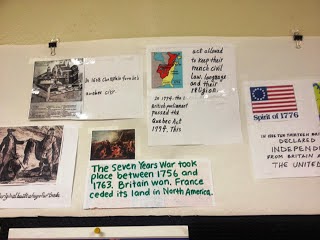
When the students making up my multi-level seniors' class asked that I teach Canadian history, it surprised some of my colleagues to learn that I wasn't limiting our studies to preparedness for citizenship test questions. Rather, we hung a long piece of butcher paper along the wall near the ceiling and, week by week, created a collage depicting all the major and some minor Canadian historical events and explorations--starting with the two (hypothesized) major migrations across what is now the Bering Strait and ending with Confederation.

One of the most interesting illustrations on the timeline, which a student found and printed on computer lab day, shows the Norse explorers meeting and trading with the native Beothuk.

If you ever get a group of students as knowledge-hungry as my seniors and want to share with them the wonders of the internationally renown historic site L'Anse aux Meadows in Newfoundland, I highly recommend this 29-minute documentary entitled The Vinland Mystery.


In my Free Resources for Settlement Themes - Canada and Citizenship section, you can download a worksheet that gets students to pay attention to a few key points of the film. Because the language is very high, I did three things to scaffold the task:
  • Provided students with the exact time markers at which they should start listening for the answer to each question.
  • Made the answers multiple choice.
  • Supplied illustrations with some of the multiple choice options. 

FAVOURITE TECHNIQUE ALERT!

Another activity students seemed to really enjoy was the "two article technique," which I employed using two of the three articles on Vikings free for download from Bogglesworld.

How:

Divide the class into two groups, A and B. Each group is given a different graded article on the same topic and 10-15 minutes in which to digest it. Each A student is then paired with a B; they teach each other the content of their respective articles (paraphrasing, no paper). Warn students that they will be tested on the peer taught material and remind them that communication is the shared responsibility of speaker and listener. Don't forget to supply them with any needed language to accomplish this, such as, "Did you say....?" "How do you spell that?" "Can you explain that in different words?" If you're worried that one student might get shorted by being paired with a classmate who isn't able to teach the material very well, you could set up queues facing each other whereby the As are stationary and, after 3-5 minutes, the Bs move one seat to their right. Depending on how much time you have, you can thus allow each student to be taught the same article a few times--each time by a different peer. Or you could set it up in teaching teams. Oh, my...the possibilities are endless, aren't they?

If you like any of these ideas or end up using anything here, I would love to hear about it.

Thursday, November 27, 2014

Our Milagro Tree

Do you decorate your classroom door or a bulletin board for the holidays? For a few years running, the organization for which I work held a door decorating contest. Now I'll admit to being just a weeeeee bit competitive. I wanted our project to win. Well, it didn't win, but the experience left an impression on me so lasting that I want to share it now, two years later.

I will admit that were I to do this again, I would bring the learners on board earlier and facilitate a more collaborative and democratic process from the very start, including the decision making process re how to decorate the door. But sometimes I am little miss instant gratification. Must do it NOW. The Friday night I decided to do this was one of those impulsive moments.

After much browsing through Google images using every keyword combination I could think of to render pictures of award-worthy decorations on classroom doors, I gave up. Later the same night, while drooling over yummy material possessions I neither need nor will ever actually purchase, I found this image.

That Monday morning I arrived at school with $3 worth of wooden dowels, a roll of aluminum foil, some red tissue paper, a sheet of silver bristol board, a package of 50 ornament hangers, and several pieces of thick cardboard dug out of my recycling bin.

The LINC 2/3 students who had been left in my care while their instructor attended a wedding on another continent joined me in cutting out symbols of peace and of our respective religions. With crinkled up red paper as a backdrop, we wrapped the "bones" of the tree and each little ornament in tin foil.

I wish I could share photos of the students of different faiths working together on our Milagro Tree.

Wednesday, November 26, 2014

The Power of Realia

realia in the classroom photos
I can remember starting a collection of realia before I'd landed my first teaching job. No longer did my junk mail go into the recycling bin. Solicitations from credit card firms, flyers from rent-to-own companies with their usurious interest rates, forms in clinic waiting rooms--they all went into my "might need that someday" realia file. I'm sure glad we have ample cabinets at work since my big bag of flattened food wrappers and containers takes up quite a bit of space.

In ESL literacy, I continually ask myself how I can incorporate realia into the week's lessons. If we're doing a unit on shopping, you'll find me running around town collecting grocery store flyers, discarded receipts, and bags.

Though paper and plastic classroom money comes in handy, during our unit on money, I passed out ziplock baggies with actual coins in them. While studying shopping, learners found and circled the HST and totals on real store receipts. When we studied food and used Eye On Literacy's set of wordless picture books called "Pancakes," I brought in measuring spoons, flour, oil, sugar, baking soda and powder, a measuring cup, eggs, and buttermilk. We made pancakes.

Today in my multi-level seniors' class, realia truly brought the lesson to life. The students have unanimously voted to return to the topic of health/medical and talking to medical professionals. They want to dig in deeper, this time learning how to communicate with specialists, with technicians during a variety of diagnostic tests, etc. So today we extended a lesson about diabetes using an actual Ontario lab requisition form. When I asked a coworker in another department if she could spare a few cotton balls to make our role plays more realistic, she not only came up with those, but also offered band-aids and gloves. One student turned a retractable pen into a convincing syringe.

Do you use a lot of realia in your teaching? What is your favourite lesson involving a lot of realia? Do you feel a lesson that incorporates realia is more effective?

Monday, November 17, 2014

Animated Short Film Illustrates the Flu Vaccine

You and the Flu - hatchstudios.com
This short animated video (click to go to page then scroll down to view) is, I think, an amazing tool to help our newcomer students understand what the flu vaccine is, how it is made, how safe it is, and why those who opt to get it must get a new shot annually. The film doesn't just debunk common myths (such as that the shot can give you the flu), but provides the science behind that--illustrated with charming and captivating cartoon images.

In my multi-level seniors' class, we first used a lesson plan and materials from LINC 1-4 Classroom Activities before viewing the video. One fun activity involved turning down the sound and having students attempt to reconstruct the language. Next time I'll probably have them do this in groups, or perhaps as a dicto-gloss.

On computer lab day, I offered a link to an audio text and quiz from Queen's University's "English for Your Health" series.

What do you use to teach this topic?

Monday, November 10, 2014

Transit Windsor Worksheets

Yay! I've just uploaded my first set of worksheets for levels above literacy. You can find the set under the Free Resources for Settlement Themes--Travel and Transportation

When I teach this topic, I first visit the central terminal downtown to pick up enough transit maps and reader's guides for my class. I have also created a bus stop sign and a timetable of the sort you find inside the bus shelter. At the end of the week, the students use these props to create a simulated bus stop in one corner of our room. Three chairs side by side make a great bench for waiting for the bus. 

It takes me at least a week to teach this topic, and more if the task analysis with the group indicates they need more skill building or revision of vocabulary, such as for telling time, days of the week, etc.

On computer lab day, I offer students this ESL Podcast about reading a bus schedule and links to SpellingCity.com, where I had pre-loaded our vocabulary words and sentences. Here are the links I provided to another class for the same topic. If you use these materials, I would love to see a photo of your students at their bus stop!

Monday, November 3, 2014

Excellent (Free) Health Literacy Materials

For a couple of years now, I've been relying heavily on a resource I stumbled upon during one of my frequent evening Google marathons. This week I had the opportunity to share the URL with two colleagues, and their enthusiastic thanks prompted me to post the link here, as well. 

Are you aware of Queen's Library's Health Literacy Curriculum for ESOL Learners, available in two versions: for beginner and for intermediate level students? Although the site can be a bit daunting to find your way around if you forget to bookmark it, I have found the materials themselves to be so very helpful and appropriate for a settlement English classroom. 

Not only are there complete lesson plans with answer sheets and student worksheets as a separate PDF, but there are also high quality audio recordings for listening practice or assessment. For example, in the unit on filling out a health history form and discussing one's health history with a medical professional, you can play an audio of a number of different patients, each participating in a very brief exchange with a practitioner. The worksheets include a graphic organizer for checking off which disease each patient mentions, which family member has/had it, and so on. This is only one of many topics covered, some of which include audio files and all of which include the lesson plan and worksheets.

I hope you will explore Queen's Library's materials and let me know if they are helpful to you and, if so, how you use them. Happy teaching!

UPDATE: fall of 2019, the website is found to have been reorganized with our beloved resources nowhere to be found. Years ago I downloaded the PDFs and audio files, so I am going to try to make those available as a zipped folder you can download from https://www.kellymorrissey.com/health-and-medical.html.  Please let me know if it works or does not work.

Monday, October 27, 2014

Can a Classroom Blog Save Your Sanity?

students in the lab photo
When I landed my first LINC position just a few years ago, I learned that most instructors took their students to the computer lab once a week. My morning class was a special demographic--all over the age of fifty. They wanted to gain computer skills, too! They told me of their desire to see grandchildren's pictures on Facebook, set up email accounts so they could send and receive pictures, and even look for volunteer or paying jobs.

In my early capacity as teaching assistant, I had the opportunity to see how other instructors used the lab. One teacher would hand out a piece of paper with the URLs of sites her students were to visit during the class period. Each URL looked to be about a mile long with lots of dots, dashes, slashes and non-words. There was no way my seniors were going to be able to type those in without making errors. I knew I would spend the whole period responding to their pleas for help, hurrying from one station to the next, barely getting one person on the right website before another was once again staring at a flashing advertisement luring him to come play a free round of Slay the Dragon. Then it hit me. Why not use a blog? I could post a little message for them on the evening before lab day along with clickable links of quizzes, pages from talking picture dictionaries, and videos tied to the week's learning. It would be a buffet system whereby students would decide which activities they felt would be most helpful to them.

Well, it worked! A few had to learn to use a mouse, but after that, the only web navigation skills they needed were: clicking hyperlinks and using the back arrow to return to the list of links. With just a little time invested in familiarizing themselves with this routine, they were soon self-sufficient in the lab. No more running around for me! Not only that, but the blog has proven to be a place to showcase our achievements.

Not long after this, I happily inherited a LINC literacy class in the afternoon. These students had never visited the computer lab. Would a blogging platform also work to enable them to enjoy self-paced, self-directed learning? There was one way to find out. First, though, I had to create another web log just for them. There was no way that they could have made heads or tails of my other classroom blog. It was far too cluttered, the font too small.

Following "best practices" guidelines for creating literacy materials (no font smaller than 18 point, lots of white space, few choices), I created Kelly's Literacy Class. I replicated a practice that works very well for me in the literacy classroom: by establishing a somewhat predictable weekly routine, I enable learners' entire cognitive burden to be dedicated to the content to be learned while the directions for the task can go on autopilot. Thus students choose between Starfall and SpellingCity. Within SpellingCity, a student might opt to spend the entire hour trying to ace the spelling test on our week's words (which I loaded the night before). Or she might choose to explore a few of the games, such as hangman or Sentence Unscramble. I will have edited the sentences so that they are ones we have been working with all week.

I'm happy to report that this way of using a blogging platform to make computer lab day stress-free for the instructor has been so successful that my colleagues have almost all followed suit. The one teacher who used to avoid the lab at all cost now takes her class to the lab and has her own blog that is cleaner, more beautiful, and better organized than mine.

In spring of 2013, I was invited by TESL Windsor to present "A Classroom Blog for Beginners." Even though technology failed us that day when we overwhelmed the server, many participants have since approached me to let me know they are using their new blogs in the lab or classroom. I really appreciate that feedback! I also shared this idea during a literacy webinar and was thrilled to learn that one fellow ESL literacy educator was inspired to create her own literacy blog--and has since won an award, I might add!

This May I will facilitate a webinar on the same topic, this time aimed specifically at teachers of ESL literacy learners. I'll be sure to announce it on my website under WORKSHOPS as soon as the publicity comes out.

 Do you use a blog with students? If so, how? If not, why not?