Tuesday, October 30, 2018

Outdated

I'm still mulling over the five questions Geoff Jordan put to teacher trainers via Twitter about a month ago. After I wrote this blog post, he commented expressing an interest in hearing how my beliefs play out in my classroom practice. So I then spent two more blog posts writing about the rather special demographic that I teach each weekday morning for 2.5 hours and how I try to address their needs.

While my teaching style can seem a little loosey goosey, there are principles that guide me. Two of these concepts are closely related: comprehensible input (which obviously is followed by lots of output) and the idea that less is more, which has been a topic on which I've presented or co-presented six times.

Regarding Comprehensible Input (CI)
In my TESL course, we did spend a lot of time on what our prof called grading our language. Vygotsky's Zone of Proximal Development (ZPD) was mentioned only briefly, but without using the i +1 terminology, we were still dwelling a lot on this notion of not speaking over students' heads, of making ourselves understood, and of not giving our learners material for which they were not yet ready. When I walked into the LINC 2/3 class where I was to do my first practicum and addressed Tanya's learners for the first time, my mentor said I'd got it bang on. She said it was very unusual for a teacher in training to nail that from the very first utterance. Maybe I get this right because I've tried to learn ten languages and have traveled through areas of the world where it was a struggle for me to communicate my needs. Or maybe teacher-speak is one of my languages; slipping into it is akin to code switching, as I did Saturday when I received a phone call from a political candidate's father back in my home state of Arkansas. Without any conscious effort on my part, I found myself parroting the elderly man's deep southern drawl.

As long as I'm on this topic, I want to say that I believe there is a helpful way and a wrong way for us to grade our language, especially with literacy learners. Leaving out the function words, as if speaking to a dog or toddler, is not--in my opinion--a good idea. Examples: Bad dog. or Stove hot! That isn't natural language. For nine years I've been speaking in full, grammatical sentences with my literacy learners without any puzzled looks on their faces. When I make the content words long, slow and clear, the listener's brain filters out the (relatively) quickly uttered function words until they, the learners, are ready for them. I can say "My NAME is KELLY," where the words my and is are barely discernible. This maintains the natural rhythm of English while allowing the listener to easily focus attention on the words NAME and KELLY as I point to my name tag. By the end of a term in a program with continuous intake, that same learner will have heard me utter this sentence hundreds of times. Don't program unnatural language; that's what I'm saying.

But I do not feel we got a lot of explicit training in creating what Martina Bex calls the comprehensible classroom. That is to say, HOW exactly do we provide lots of aural and written CI and how do we then push the output? That's an area where I'm floundering and searching on my own.

Tangent over.

Called into Question
My blog post of October 15th left off with a note about pedagogical ideas that I'm still toying with but am not yet ready to write about. That's where I want to pick up today. Which principles or ideas am I leaving behind because their validity is being challenged in the literature, and which ideas are catching my attention these days?

Let's talk about the things we were taught that are being called into question. A few come to mind right away:

  • TTT-STT ratio (Teacher Talk Time / Student Talk Time)
  • No L1 in the classroom / how much value is placed on translation
  • The banning of devices
  • learning styles (visual learner, auditory learner, kinesthetic learner)
  • Everything we know about teaching listening
Although I have not yet arrived at firm beliefs regarding what's valid, I do feel it's important not to swallow what I was taught hook, line, and sinker. My responses to each point above are:
  • As long as it's for the right reasons, perhaps there are times when it's okay for me to talk for more than 20% of the class period. 
  • As for first language use, I have come to believe that it has a place in our classes and is a very valuable resource. Lately I've been paying attention to the TPRS movement that is getting a lot of traction in American K-12 language classrooms; translation to the L1 is an essential part of the method. 
  • I no longer ask students to put away their devices unless I see that they are texting friends or checking every Facebook like. If their device use is enhancing learning, I want to work WITH that, not against it.
  • I'm glad the notion of learning styles has been debunked lately. That being said, as far as I know, it is still true that learners do better retaining newly learned material or language in multisensory environments.
  • I'm questioning everything I was ever taught about the teaching of listening. Gianfranco Conti has made me aware of the need to stop giving short shrift to the bottom-up skills, such as the ability to recognize word boundaries.
I can't yet write about these things beyond saying that I'm discarding old notions and exploring new ones. When I feel more confident about my grasp on these ideas, I'll surely let you know.

How about you? What ideas from your TESL training have you come to question or outright reject? Why? How has such a realization informed your practice?

Monday, October 22, 2018

Limbo

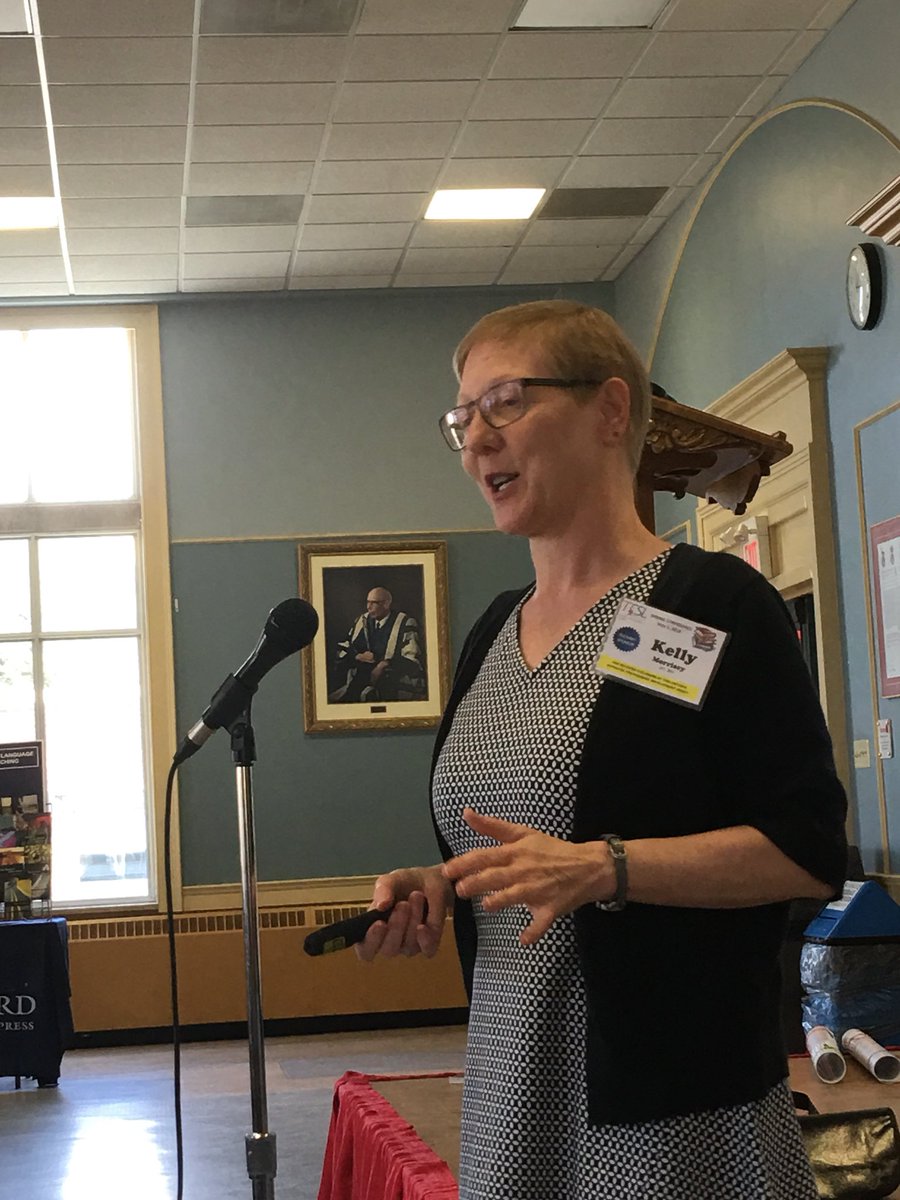
I was very pleased to be asked by my local TESL affiliate to present at their fall PD event this past Saturday. It was fun, and I got a bit more mileage out of some slides that I had put A LOT of time and energy into creating--slides that had only been shown twice before.
TESL Windsor Fall PD Event
As happens at so many of our PD events these days, the subject of PBLA came up. "Cover Less, Uncover More: the Transformative Power of Slowing Down" was the title of my talk. (I offer apologies to the late great Leo van Lier, whose words I've borrowed.) How can I possibly slow down, one attendee wanted to know, when my manager is breathing down my neck to do one module after another and get those artifacts into the students' binders? Had I not got us back on topic, might the entire 90 minutes have been swallowed up by venting and commiserating among frustrated and disillusioned educators?

The annual TESL Ontario Conference is right around the corner, and for the first time in nine years, I'm not going. I'll miss breakfast at The Senator and hopping on the subway to get to whichever restaurant I've decided to try that year. I'll miss wandering up and down Queen Street West, stopping to smell the Johnny Fluevogs. But when I look at the conference program and see workshop after workshop after workshop on PBLA, my heart sinks. I miss the field as it once was and wonder what is to come for our profession.

It's absolutely wonderful that Yuliya Desyatova is doing her PhD research on the impact of PBLA, but what will become of that? Will anyone listen? Will they care? Is there a light at the end of this tunnel? Speaking of that, I hope those who are attending the conference will attend her presentation. I certainly would support her in that way if I could go.
Seen on Queen St. West
In more ways than one, I feel I'm in limbo. Even my presentation felt a bit stale to me. I'm ready for something different. The conference used to offer that. Ken Lackman was always there with something to get my gears turning, like his C.A.T.: a Framework for Dogme. There were so many good workshops that I would lament not being able to clone myself in order to be in three places at once! I would return from Toronto on fire to try new things with my learners.

I'm sorry this isn't much of a blog post today, but I'm not feeling it.

How about you? Where are you at now?

Monday, October 15, 2018

My 'Principled Eclecticism'

My afternoon class is literacy--refugees either learning to read and write for the first time in any language or learning the Roman alphabet for the first time WHILE learning to speak and understand English. That is a whole other can of worms. I'm hoping to do an online class soon on what works for me with that group of learners. So let's not talk about them today.

Let's talk about an average week with the seniors, the group I blogged about here last week. In that blog post I mentioned some things that have not worked very well.

No more fighting the translators
Because so many of them have set-in-stone study habits when they emerge from forty years of grammar-translation style second language education, I have abandoned all attempts to pry the translators from their hands. I have read and heard a lot lately about the value of those electronic dictionaries, so now I am working with instead of against them. By compromising and allowing a lot of prep before activities designated as 'no pencils, no dictionaries,' I'm seeing much better levels of cooperation when I ask students to put the machines away just for a little while.

What Happened to PPP?
In response to this post, Geoff Jordan said he was happy to hear about some aspects of how we teach settlement English in Canada, but was "not so pleased to hear that [we] were given the PPP lesson plan as a model." You know what? I am feeling vindicated right about now because within about six months of landing my first teaching job, I was starting to feel like either PPP was unrealistic or I was a defective teacher. I remember trying to get students to the 'free practice' part of the lesson by the end of the class period, and in the case of my lunchtime pronunciation class, that meant get there in under an hour! I did it in the beginning, but it never felt quite right. When I landed the job as teacher of a class full of senior citizens who were always begging me to slow down, I made an executive decision to stray from that model.

So if I am not following Presentation Practice Production or Controlled practice, semi-controlled practice, free practice, then what am I doing every day? That's a good question. I'm not sure I really know or can articulate it well. I know that I am continually listening in on what other teachers do (such as by participating in #CdnELTchat on Twitter, being an active member of Global Innovative Language Teachers on Facebook, attending webinars, reading books, and listening to podcasts by people like Joe Barcroft and Scott Thornbury. I bring all sorts of ideas to the classroom and try them out. Some become part of our routine and others don't withstand the test of time. Following are some of the ideas and practices that have stuck, at least for now.

The Structure of a Module
Everything begins with a needs assessment. Not only do I conduct formal ones at the beginning of each five-month semester, but we often do impromptu votes to help me with minor decisions all through the module.

Secondly, I plan out a module on a particular topic that satisfies one of the needs expressed by the students. For example, students voted to study health. Topics voted for included talking to medical professionals, making appointments, etc. When I mentioned meeting a naturopathic doctor over the weekend at a How to Fair, students perked up. "Would you like me to invite him to speak to you?" They were keen. So we are now doing a module on naturopathic medicine as we gear up for his visit.

I decide what the objective of the module is: have the background knowledge and vocabulary to understand Dr. Oake's talk, to ask him a question or two, and to make an informed decision on whether to seek a consultation from an ND. From there I do task analysis: what skills do we need to build up between now and the presentation? That's what I try to give them over a period of one to two weeks. This particular group has requested no writing and grammar only as the need arises. So I plan some listening, speaking, and reading lessons.

For every module, we make a vocabulary acquisition plan. We keep an easel chart at the front of the class where that module's vocabulary is recorded--often colour coded and grouped by part of speech. We are mindful of which terms promise good 'surrender value,' as Gianfranco Conti calls it. We may quickly turn to COCA to check frequency of use and pencil a number next to the term.

A Lesson
Every lesson begins with a warm-up. Cognitive science tells us that it's helpful to prime the brain for the topic. I use a variety of activities to accomplish this. It could be a brainstorming session where I'm secretary with marker standing at white board, or it could be "think, pair, share" or a KWL chart. I like to activate prior knowledge. My class is made up of engineers, doctors, scientists, pharmacists, etc. They have a lot of knowledge to share with me and with each other.

I would say that from there, things get a little intuitive on my part. I have my very rough plan scribbled out in front of me, but it's not unlike me to completely scrap the plan if I start to feel that it's not going over well. I try to tune into the learners and get a feel for what they need next.

As for that old PPP model, I haven't forgotten it altogether. I loosely follow the idea behind PPP if you consider that early in the week I am asking students to do something with that week's text (audio or written) that is more 'controlled.' I'm trying always to be mindful of the cognitive load of a given activity. In his book Input-Based Incremental Vocabulary Instruction, Joe Barcroft points out that if we cognitively overload students during the initial phase of new lexis exposure, we can actually inhibit uptake / long-term retention of new language! Sometimes I just let students have a block of quiet time with translators. Often I give examples of usage; I pantomime, draw pictures, and pull up Google Images.

Activities
I would say that my teaching style is very activities-based. Once I know what is to be achieved in a particular stage of the module, I reach into my grab bag of activities and choose one that I think fits the need while matching the current mood and interest of the class. If we just did a Dictogloss last week, I probably won't repeat that one this week. Some of my go-to activities are:

  • Each one teach one (Divvy up new vocab two terms per partnership. Each pair produces a small poster with definition, pronunciation, example sentence, illustration. Partner A stays with poster while partner B circulates around room as a student, then As and Bs switch roles.)
  • Jigsaw
  • Dictogloss
  • Conversation groups with photo prompts
  • Extemporaneous speaking (E.g., Students line up As across from Bs; I give each A or perhaps both sides an index card with a topical question and they begin to chat. I ring the bell and Bs move clockwise.)
  • Read aloud with focus on good prosody (linking, phrasing, sentence stress, intonation), remembering that English is a stress-timed language a la Cows Eat Grass.
  • Back to the Well with graphic organizers I developed with John Sivell, Professor Emeritus, AppLing, Brock University.
  • Read or tell a short interesting story then do 'circling,' i.e., yes questions, no questions, which/binary questions, wh- questions
  • projects, presentations, posters
  • role plays
  • pair work
  • group work
  • guest speaker
  • one hour of computer lab per week (buffet-style choices, self-directed)
  • field trips
Team 3 - Teaching us how to fish
Principles
While I'm stitching together this patchwork of activities with more scaffolding at the beginning of a module, there are certain principles I'm attempting to adhere to. The whole thing might appear to an observer to be heavily influenced by dogme.  Even though it was just my undergrad minor, I feel confident when it comes to applied linguistics. Having studied ten languages and having aced advanced English grammar courses, I feel able to respond in the moment to intriguing questions about a grammar point or even a trivia question. I try not to let these raised hands hijack an entire 2.5 hour class, of course! I check in with the students to see if the majority want the tangent. If not, we may put it in the parking lot for a dedicated lesson. But if it's desired by the majority, I often give 'pop-up' grammar or pronunciation lessons.
field trip
Within the last year I've become aware of The Learning Scientists' website and materials. I've shared them with my students and together we've made it a goal to incorporate the six strategies for effective learning in my teaching and their practice. So for example, instead of three solid weeks of health, we did a week on reviewing parts of the body and organs followed by a week of their second chosen topic, Canadian culture (Thanksgiving), then a return to health. That's interleaving. We also have two fun games we play for big review, a way to revisit past pages of that big easel chart. Supposedly this is going to help us get new language into long-term memory!

You will notice that not once have I had to mention Portfolio-based Language Assessment. That's because I wrote a proposal asking for the seniors to be exempted, and this was granted. :) We still have the big white useless binders that I force the seniors to lug home over the summer break. We maintain the About Me section and sometimes even create artifacts--not an easy task since their abilities span CLB 2 to 8.

Materials
In putting together modules for my learners, I tend to create or find one simple audio or written text and use it in a gazillion different ways throughout the week. I long ago learned to, as Leo van Lier once said, "cover less, uncover more." That one text could be from the LINC 1-4 Classroom Activities binder/pdfs or from the Citizenship Resource. It might be a true story about me or a set of pharmaceutical labels. Sometimes, though not often, I do give an explicit grammar lesson, but it is always driven by a need that has arisen while we were using the language, and I always allow students to vote on whether or not to pursue the grammar formally with rules and exercises and all of that. I'd say we agree to that about twice a year. Otherwise, we focus on grammar in context.

Edited to add: I wrote this quickly without much revision or proofreading. Please point out my typos or errors. Also, I notice I didn't say anything under PRINCIPLES about comprehensible input or bottom-up listening activities. These concepts have made it onto my radar but are not yet a fully-formed conscious part of my teaching approach. I'm still studying. I will attempt to blog about emerging practices and principles very soon.

Tuesday, October 9, 2018

This Teacher, These Students, What Hasn't Worked

Last week I said I would write about how principled eclecticism plays out in my classrooms. The more I thought about what to write, the more I realized that there is SO MUCH a reader has to first understand about my very special group of students. I think it's too much to try to talk about both of my classes since they are so different from one another. So for now I'll just talk about the morning class of seniors, not the literacy class.

Much of the reasoning behind what I do is based upon my discoveries of what did not work with my groups when I tried it. I suppose that while I'm at it, we should also look at the experience, perspective and biases I bring to the table. My beliefs about language learning and their way of approaching language learning both come heavily to bear on what my classroom practice ends up looking like on a given week.

First let's talk about me. When I was in high school, I discovered a facility for language learning. After raking in top prizes and awards in German, I decided to see if I had the same ability to master Spanish. Yes, I won blue ribbons in poetry declamation and extemporaneous reading in both languages at an annual state-wide foreign languages festival in the same year. I became a ravenous student of languages--studying French at university during the day and classical Latin, Demotic Greek, Italian for Business and Travel as continuing education courses at night. Portuguese I studied on my own using Berlitz records. Yes, vinyl LPs!

In each case, I did my best to find a friend who was a native speaker and then offered this person something in exchange for just hanging out with me speaking his/her mother tongue. In some cases I traveled to a country where I could practice. At the age of 21, I went to Japan where I lived for a year with a Spaniard. I insisted we have a completely traditional Japanese household without chairs or forks. In keeping with "when in Rome, do as the Romans," I offered my subway seat to any male I saw standing. I was all in, as they say. I wanted the experience of full immersion. Because Xavier was a graduate fellow at the University of Hokkaido, I qualified for free Japanese classes every week day. I was a student of the same sort of classes I teach today. The Japanese we learned was intended to help us learn to navigate life on campus. We learned to say things like, "Where is the cafeteria?" and "Go past the engineering building and turn right. It's just past the library." The text book was excellent. It came with a set of cassette tapes that I listened to over and over at night in the small apartment we rented on the low-income side of town.

In case you haven't guessed yet, my approach to language learning is obsessive. I want to listen to target language (TL) radio, watch TL television, and learn the lyrics to TL songs. If I run into compatriots in public, I refuse to speak our common mother tongue. That's me. I wonder what biases spring from this perspective and how those inform my approach!

And what about my students?

The LINC Seniors' class was mandated by the government to be one of the specialty niche classes warranting a lower student-teacher ratio--about ten students maximum per class instead of the 20-25 found in mainstream classes. In that way it's not unlike my afternoon literacy class.
Getting library cards
For the past four years, the class has been comprised of at least half immigrants from China with the rest being refugees from Iraq. The Iraqis tend to be risk takers with solid listening skills and good strategic competence; their weak area is often the mechanics of writing. The Chinese students arrive with set-in-stone study habits (such as a compulsive need to copy into their notebooks EVERY SINGLE WORD I write on the board and EVERY SINGLE IMAGE that I doodle next to any word). I suspect their English is the product of forty years of grammar-translation method. They can write well punctuated sentences with lovely spelling, though I note more than a little L1 interference--such as dropping of the copula or subject pronoun, or a sentence like, "The goes-everyday-to-Tim-Horton's man is my friend." They know their metalanguage inside and out and sometimes challenge me as they peer into their electronic translators. I'll say, "Yes, beyond can be a preposition, but in this sentence it's an adverb. Do you want me to explain why?"

Through a series of needs assessments, I have learned which settlement themes and topics they want us to explore. I've also discovered that the Chinese students do not want me to spend any class time on writing. "We don't need to know how to write a composition anymore," they tell me. "We don't need to write resumes," they add. It's why they've migrated here from another school where they were integrated with younger students.

What DO they need me for? The Chinese students want me to help them improve their listening skills and pronunciation. And the Iraqis? They seem content to build their vocabulary and gain the knowledge imparted during a typical semester of settlement English: how to use a bank machine, what is considered polite and rude in this culture, that sort of thing. The entire class enjoys daily opportunities for oral practice. Neither the Asian nor the Middle Eastern seniors want me to spend much time on explicit grammar lessons. About once or twice in a semester we do a sort of on-demand week of grammar. Last term it was a four-week course on the English article system woven in among topical lessons. This semester it was causative verbs and passive causative after one Dictogloss team had written on their chart paper, "M's uncle took his prostate out."

So my big challenge is helping the Chinese students improve their listening skills. Now before I tell you next week what I am doing in class these days, let me tell you what hasn't worked. My attempt at a "Listening Boot Camp" pretty much failed in every way. You can read about that using the following links:

The Listening Skills Dilemma
Listening Boot Camp - Week One
Listening Boot Camp - Week Two

Okay, well that's enough from me for one week! Next week I hope to share not which practices and approaches I've abandoned, but which techniques I'm now employing and how that's going.

Monday, October 1, 2018

Our Teacher Training

This morning my attention was drawn to a tweet by @GeoffreyJordan asking teacher trainers to read and respond to five questions at the bottom of this blog post.

The problem, Jordan says, is that the most prominent teacher trainers seem to be paying too little attention to the questions "what are we doing?" and "is what we're doing effective?"

He goes on to cite research supporting the importance of implicit as opposed to explicit learning. I'm thinking he means language being taken up as a result of buckets of comprehensible input as opposed to months of grammar lessons from a coursebook.

It's always interesting to me to follow these debates in global and British circles of English as a second (or additional) language teachers since almost all of these educators do teach from a coursebook. We settlement English teachers in Canada do not, as a rule--though many of us find useful coursebooks on Amazon Marketplace or at conferences when we steal away to browse the publishers' displays. Pages from those squirreled away books might end up being useful on occasion, but our mandate is to sculpt a syllabus where topics are drawn from regular needs assessments, objectives are task-based, and the approach is communicative.

Let's fast forward to the five questions at the end of Jordan's blog post and see if we can answer them from the perspective of teachers reflecting on our own training. How were we taught to teach? How might our trainers answer the five questions?

Q1. How did our trainers transmit their views of the English language to us?
Q2. How do we think people learn a second language? How was language learning explained to us?
Q3. What types of syllabus did our trainers discuss with us? Which type was recommended to us?
Q4. What materials did our trainers recommend?
Q5. What methodological principles did our trainers discuss with us? Recommend to us?

Okay, so I'll get the ball rolling and others can chime in using the comment box below.

A1. My principle trainer went to great lengths to maintain a poker face and not reveal her biases, if any, as we undertook a survey of the most prominent SLA theories. I got a distinct feeling, however, that she agreed with Chomsky on the existence of a universal grammar and looked down on Krashen and the Krashenites. It was made clear, however, that I was to survey the literature and draw my own conclusions. One of the essay questions on our final exam dealt with this very thing. Which theory did I believe and how would that inform my teaching? I remember responding that I didn't feel able to conclude that one theory was 100% valid and the others rubbish. I said I would use an eclectic approach and hope that something might hit the mark.

A2. It was explained to me that L1 acquisition is different from L2 acquisition in that there is a window of plasticity that ends at around the age of puberty. If you don't get to the child with the L2 exposure by that age, then the child will never achieve native fluency. That's what I was taught. I do NOT recall getting a lot of information about any of the comprehensible input streams. That I've had to find out about on my own.

A3. We read a book about syllabus design and discussed it in class then took a quiz on it, I think. I remember it was a slender little green and black book, but that is all I remember. I kept the book and referred back to it after landing my teaching job, but I could not tell you right now any of the contents. We were taught how to build a unit / module backward from the objectives by doing task analysis. That's what I've had to know how to do. Everything in LINC (Language Instruction for Newcomers to Canada) starts with the needs assessment. Every semester is different.

A4. My trainer brought in a variety of books for us to examine and discuss--some more communicative in their approach than others. I remember seeing the Azar grammar books at one end of the spectrum, Grammar Dimensions, and a few others. We were tasked with choosing one to use in a class and defend our answer. With our trainer's heavy emphasis on communicative methods, most of us concluded that Azar made a nice supplement for assigning grammar homework, but that it wasn't appropriate for daily use. In the end, we all knew we would have to make each lesson and the materials from scratch.

A5. My trainer really drove home the obsolescence of the grammar-translation method while ensuring we understood the Canadian Language Benchmarks. My training (beyond the bachelor's degree) consisted of around 360 classroom hours. Half of those were theory and half practical. We learned how to create a PPP lesson plan and how to divide the allotted time among the three stages: presentation, practice, production. We learned how to let students learn inductively or deductively--what each of those lessons might look like. We learned how to create and conduct listening, speaking, reading and writing lessons that follow one another and how to assess using a rubric. When it comes to assessment, I learned some principles that are very important in assessment creation, such as face value.

I'm so glad that Geoff Jordan has raised these questions because the area where I feel my training and teaching has been most lacking is the area of effectiveness and the link between current / emerging SLA research and my practice. I feel as if I've sort of been thrown to the wolves. It's up to me to sift through all the journals, books, and articles and figure out what is likely to give my students the biggest SLA bang for their buck (time spent in class).

I have purchased MANY books with my own money and have read them with highlighter in hand and tried then to apply some of the ideas in my practice. These include but are not limited to:

  • Teaching Unplugged by Luke Meddings and Scott Thornbury
  • Uncovering Grammar by Scott Thornbury
  • Teaching Lexically by Hugh Dellar and Andrew Walkley
  • The Language Teacher Toolkit by Steve Smith and Gianfranco Conti
  • Input-Based Incremental Vocabulary Instruction by Joe Barcroft
  • Fluency through TPR Storytelling by Blaine Ray

Yes, blog readers, I owe you a lot of book reviews!

In all of my reading of both the books above and countless scholarly articles, I have one question in mind: what really works? What is the most effective way for my students to acquire second language in the time we have together, and how can I help them?

I also spend a lot of time reading about and listening to podcasts about cognitive theory in general and how it informs teaching of any subject. For example, I'm following the Learning Scientists and have begun to share their principles with my morning class as well as employ such things as spaced practice and interleaving in my teaching.

Thanks, Geoff Jordan, for bringing this up!

NB: This is blog post #2 of 2 today. Scroll down for the first one.

Leading Research on PBLA Addendum

This is blog post one of two today.

Last week I gave an update on the work of Yuliya Desyatova, but I left out an important date. That's an upcoming webinar on Tutela open to members of TESL Ontario, I assume.

Here is the text of an email Yuliya sent out this week to update us all on her activities:

Dear Colleagues,
I hope you are enjoying what September has to bring.

Here is a brief update on the research project you contributed to.

New season of conference presentations is ahead, and I hope some of you will be able to join one of the events:
  1. Oct 3, 2018 – TESL London Annual Wine & Cheese, where I will be the invited guest speaker this year – PBLA Implementation: Did we achieve what was intended? Thank you TESL London for your interest in current PBLA research!
  2. Oct 24, 2018 – TESL Ontario Tutela Webinar on a similar topic
  3. Nov 2, 2018 – TESL Ontario Annual Conference, where I will be presenting on Teacher Learning in PBLA: a critical analysis.
The last paper is currently being peer-reviewed by an open-access Canadian academic journal, and I am optimistic about being able to share the link to the published article with you by the end of the year. More papers and conference proposals are in progress with the goal to ensure that all your voices are present in both the academic and policy-making circles.
I will also be sending an invitation to join me in submitting a proposal to present on whatever issue you find pertinent to language learning and teaching in Canada for the Metropolis Conference in Halifax in March 2019. The goal of this conference is to facilitate dialogue and exchange between researchers, government, and non-government (community and private) sector partners”, which might be a very good place for the conversation on PBLA and LINC/ESL in general. If you think you might be interested in presenting there, please let me know.
Last, but not least, the significance of this research project has been acknowledged by the Ontario Graduate Scholarship, which means that this year I will be able to extend my invitation to your learners to participate and share their perception of PBLA. More details to follow.


Best regards,

Yuliya
In addition to my bringing you this update from Yuliya, a commenter on last week's post wants everyone to be aware of a Q and A on Tutela for cohort two administrators. It's on October 4th at 11:00 a.m., ensuring that teachers cannot listen in.

Ciao --KM

Monday, September 24, 2018

Leading Research on PBLA’s Impact

As many of you already know, Yuliya Desyatova is taking one for the team by devoting her PhD studies to researching the impact of Portfolio-based Language Assessment (PBLA) on our lives, our classrooms, our morale, our job satisfaction, our ability to be effective, and on our students' learning experience.

She has completed some analysis of the first tier of data gathered and has begun writing articles and giving presentations. In May of 2018, she was at the BC TEAL conference. The title of her presentation was Constraining Learning Spaces. Yuliya did a great job explaining the breakdown of responses from teachers, administrators and leads to her survey. She had a good data pool with 322 participants. Of these respondents, 72% had a somewhat unfavourable or very unfavourable view of PBLA.

Some emerging recommendations at that time included:
  • suspending mandatory implementation
  • engaging all stakeholders in an open and constructive dialogue under non-threatening conditions

In June of 2018, Yuliya spoke to the International Society for Language Studies at their conference at Wilfrid Laurier University in Waterloo, Ontario. The title of this talk was When Inquiry is seen as Resistance to Change. Yuliya included the original document "The Change Cycle," which was used in early training at the top of the PBLA implementation chain and which includes the suggestion that those who do not get on board with the new way are "laggards" who "may need to be fired." She quoted many of the surveyed teachers, bringing light to the "dramatic increase in teacher stress" and "unpaid teacher workload."


Yuliya is not yet ready to make slides from these talks public, as she is still strengthening parts of her study and the recommendations that flow from it. There are still opportunities to hear Yuliya speak about her findings, though.

On October 3, 2018, Yuliya will be the keynote speaker at TESL London's annual wine and cheese event. She will be sharing results of her research.


Yuliya will be presenting a paper at the upcoming TESL Ontario Conference on Friday, November 2, 2018 from 11:20 to 12:20. If I am able to be at the conference this year, I will absolutely be one of the first in line to hear more about her findings and analysis of same.
F3J Teacher Learning in PBLA: a critical analysis Yuliya Desyatova - University of Toronto: Drawing on policy documents and empirical data from a larger project, the paper analyses how teacher learning is conceptualized and enacted in PBLA implementation. As suggested by the data, PBLA teacher training demonstrates a strong reliance on behaviourist and cognitive understandings while neglecting the sociocultural complexity of teacher learning. Category: Paper Level: Adult ESL/LINC,College/University, Elementary, ELT/SLT, Secondary Focus: Research Audience: All Participants

Yuliya's contact information is:

Yuliya Desyatova
PhD Student
Centre for Educational Research on Languages and Literacies
Department of Curriculum, Teaching and Learning | OISE
RM 10-229, 252 Bloor St W | Toronto, ON | M5S 1V6
yuliya.desyatova@mail.utoronto.ca

Twitter: @YuliyaESL

Sunday, September 16, 2018

A Season

For everything there is a season,.... Ecclesiastes 3:1


The blogger is IN.

Ok, I don’t mean to get all heavy by starting with a Biblical quote. In fact, I’m feeling lighter than ever after a sweet, very relaxing summer. It was the most restorative break I’ve had in my eight years of teaching English. I didn’t participate in any PD. I didn’t go up to my workplace with jugs of vinegar to clean the water boiler that’s the centre of my hospitality station. I can do that next week.

Everything work-related went on hold. Self-nurturing came to the fore.

But now I’m back and believe that such a complete vacation is to thank for my current fresh attitude and excitement about the blank canvas before me.

I’ve always been a fan of summer. It’s not that I love muggy days more than crisp fall days. I think it’s because summer reminds me of childhood summers—the only time of year when I was permitted and it was socially acceptable to give myself long blocks of time away from other humans. At the age of nine I would hide up in a tree. Today my apartment is hidden among the boughs of two tall maples.

But fall has it’s own deliciousness, doesn’t it? This is a season of transition, nicely symbolized by the transitional wardrobe drying on my clothesline on this warm late summer day.

As a teacher, I appreciate this time of year for the opportunity it offers us to reinvent our classroom practice. The freedom from stress I experienced over the summer has made me realize that I can do so much better in the area of self-care, mental well-being, and work-life balance. I am even starting to believe that I can be a more effective teacher without devoting such an insane amount of time to planning and prep.

What does this mean for me as the administrator of www.kellymorrissey.com and this blog? I’m not certain yet where I’m headed with it, but I can tell you what is calling to me and what isn’t.

For one, I have returned to my job feeling that life is too short for me to spend a lot of psychic energy on the BS. I want to continue to make time for my hobbies, such as linoblock printing and sewing.

I am still committed to supporting Yuliya Desyatova and anyone else who strives to bring more critical thinking and common sense to this whole national fiasco known as PBLA. You can expect me to post updates and summaries from her field work, publications, and conference circuit. My goal is to begin that next weekend.

But mostly I would like to corral and contain my advocacy work in order to make room once again for the things in ESL teaching that bring me joy, such as discovering a promising language teaching approach or reading a pedagogical book or article that makes me look forward to Monday when I get to share the ideas with colleagues and try them with students.
I have recently found such a teaching approach and received a nice thick book to read about it, so watch this space.

It’s good to be back.

Sunday, June 17, 2018

The Summer Project

Blogger is still not behaving for me. Things seemed to go out of kilter during that whole GDPR compliance frenzy a couple of weeks ago. I'm not sure there's a connection. In any case, I no longer receive an email when someone comments on the blog. I've gone back into settings twice to ensure the right boxes are ticked, but I don't think it's working still. That means I have to remember to log in and check the comments section of the dashboard to know if any comments are pending approval or require a response. I will try to do that ever few days.

I don't have a blog post today and am not planning to blog weekly over the summer. I feel a need to do self care in the form of purposefully not thinking about lesson plans, professional development, or PBLA.

That being said, there are some projects still the works, goals left over from this school term, ones that I have not yet met. Because their completion affects all of you, I want to come back here and to the website to get them finished. Also there are a couple of guest blog posts pending from others. I'm just waiting to receive them. As soon as I do, I'll post them.

The main project is basically to work on the "Canadian Experiment" page of www.kellymorrissey.com. Lately several people have either shared something very valuable to us all in the comments or have told me something during back channel conversations that I think should be shared publicly with all of you. So I need to gather up all these bits and pieces and put them over on that page of the website.  I'm also hoping soon to be able to include an update from Yuliya on her PhD-level research project.


My mom, who is 87, is visiting me now from Little Rock, Arkansas. She arrived today; we spent the whole day getting caught up on each other's news. We have a lot of fun together. She's only here for ten days, so we will be packing a lot into each day. As soon as I have a breather, though, I will be working on the objective mentioned above.

How about you? Are you off for the summer? Working? Going to use some of your summer for PD or PBLA or lesson planning? Or the contrary? I would love to know what is happening with you.

Sunday, June 10, 2018

Looking Back

Our spring term is coming to a close this week, and I've been reflecting on which techniques and activities worked well this time around and what did not work well.

For my morning students, all over the age of 60, jigsaw activities seemed especially useful and engaging. This is the technique I used to help students become familiar with a select few of the sculptures we would see on our field trip to Windsor Sculpture Park. I used it again to help them get ready to visit The François Baby House and Museum, and again when we learned about staying safer in hospital. For the 'safer in hospital' module, one group became experts on VRE, one on MRSA, and one on C. diff.

Expert groups will later split up into colour groups.

What didn't work? Rushing. I have to remember that I cannot just tell these students what I expect. I need to produce an exemplar for them to model their work on and I need to provide the rubric ahead of time so that they really understand which criteria I'll be using to judge their work. Also, the next time we do reports or posters, I need to impose a maximum word limit. Although I stressed many times the importance of brevity for a poster to grab the attention of students passing by it in the hall, we still ended up with posters drowning in text. So I definitely learned my lesson and will provide both an exemplar and rubric next time. That being said, they are proud of the "my hero" posters that were part of preparing for a trip to Jackson Park.

In the afternoon class, a high level (CLB 1L-2L) literacy class, the techniques and activities that worked the best were Language Experience Approach books and multi-sensory lessons. In some cases, we had a multi-sensory experience that we then turned into an LEA book.
Tasting our way through the regions of Canada
Sometimes we cannot go out and take pictures of ourselves having an experience. In those cases, we can still make the new language and concepts personal by giving our opinions and expressing preference, which is how I turned the topic of "summer in Windsor" into an LEA book. Instead of going to Summerfest, the beach, fireworks night, etc., we talked about which ones we planned to enjoy this summer and then built a true story around that. This book becomes the basis of a week's worth of activities. We spend some time each day practicing reading it until we reach fluency, starting with choral repetition and ending with being able to read it individually by Friday. I love being able to load up our sentences into SpellingCity, which then gives us myriad games and worksheets using the same terms and sentences.
F. wants to eat cotton candy at Summerfest.

M wants to take her children to Sandpoint Beach via bus #2.

After helping compose sentences, students copy text into blank versions of LEA book.
And what didn't work? Well, they are a very agreeable group. I find that most anything helps them improve their language skills and helps them learn how to learn so long as I follow a few basic principles. Language must be taught orally first and must be personally relevant. Also, I need to change things up a lot--both week to week and also about every twenty minutes--while also maintaining certain predictable routines.

So if we use a reader from Bow Valley College, School of Global Access one week, we will write our own LEA book the next week, and follow that up with a chapter from the Talk of the Block series the third week. Within a given class period, I try to go back and forth between activities that focus on meaning (questions about the story, relating the story to our lives) and activities that focus on the building blocks of language (copy, pronounce, spot the intruder). I also try to switch every twenty minutes or so between a sedentary activity (writing) and one that gets us up and moving around (peer survey, flyswatter game, coming to the board).

To be honest, I think the ideal lesson is a multi-sensory one or a lesson that is based around a field trip. I have to admit, however, that I don't find myself having the energy to manage such lessons every single week. It takes a lot out of me when I cart 20 pounds of kitchen equipment up to the school so that we can make gingerbread cookies while learning fractions. But if I could snap my fingers and have a host of helpful elves appear every time I needed them, I probably would take students out into the world or into a kitchen or maker space almost every week.

How about you? Is your term coming to an end soon? How are you feeling about it? Which activities will you bring back again because they were successful? What might you abandon because it fell flat?

Sunday, May 27, 2018

A Windsor Freebie and PBLA Update

Happy Sunday!

Before I get to the freebie, allow me to take a moment to give you an update on the results of my digging. Anytime you find information that could be helpful to others who are struggling in Orwellian work environments, feel free to email me with that info so I can add it to THIS PAGE.

Those who follow The Joy of ESL Facebook page have probably already seen this email I received:

Hello Kelly,
Thank you for raising your concerns with how the Portfolio-Based Language Assessment (PBLA) is being implemented. We will be sending new Operational Guidelines for PBLA to all language training providers in the coming weeks. These guidelines will clarify many of the issues raised in your email and we will encourage all language training providers to consult the guidelines regularly.The Centre for Canadian Language Benchmarks (CCLB) is responsible for coordinating the implementation of PBLA in Ontario. You are welcome to add pbla@language.ca to your website for instructors who have questions about PBLA or who require additional support. This is a more appropriate point of contact than MCI staff.
The CCLB is undertaking a Practice Review of PBLA to gather feedback from Administrators, Classroom Teachers, and Lead Teachers on how PBLA has been implemented and to ensure that PBLA is implemented in a consistent manner. If you would like more information you can visit http://pblaepg.language.ca/…/pbla-practice-review-framewo…/…
Daniel Lisi
Team Lead
Program Design Unit
Ministry of Citizenship and Immigration

The reason I was referred to MCI and not IRCC is presumably because it was my local MPP's office answering me. Anyway, I was hoping for a NAME that goes with a FACE to put on www.kellymorrissey.com on the PBLA support page, but I suppose pbla@language.ca will have to do. That email inbox is monitored by someone on the Centre for Canadian Language Benchmarks Board, I assume?

In any case, the advent of this document, "new Operational Guidelines" could be a good thing, no? When it comes out, we need to get our hands on a copy and read it cover to cover to see if it is of any help to us as we face drastic inconsistencies in expectations from school to school. Some employers are implementing PBLA in a way that does not create a hostile, toxic work environment with unreasonable after-hours workload expectations, while others... well, you know. (Don't even get me started on how PBLA is not resulting in consistent assessment around the country. That's another can of worms.)

At the same time, I've been in communication with someone who has advice for those of us in unions, but I am just waiting for that person to advise me whether he/she wants to be identified when I share that advice or not.

As for those of us who are NOT unionized, I did get a an interesting bit of information this past week when we had a speaker visit my morning class from Community Legal Aid. She spoke mostly about Community Legal Aid, but also a bit about Legal Assistance Windsor, whose offices are in the same building on Ouellette over the fitness centre next to the post office. She said that the law students at these two organizations can assist workers who are concerned that their employers may be violating labour standards. To be eligible for this help, you would need to a) not be a member of a union and b) qualify for their free services based on income. The threshold is somewhere around $25K per year for a family of two and around $21 K per year for a single person. She said that even if you don't meet the threshold,  it is worthwhile to stop in or call them because oftentimes where they cannot help directly, they can make a referral.

This week I had two opportunities to talk to teachers at other SPOs around my city and both times I learned interesting things.

  • Some employers do not give teachers any paid PBLA prep time. I think all teachers deserve to be aware of what is happening around the province and country when it comes to the PBLA roll-out.
  • One teacher was overheard saying, 'if they hold up London as the gold standard, I'll quit my job tomorrow.' Watch out, Thames Valley. You have a reputation for how NOT to implement PBLA. 🙁
  • Some SPOs do not require the collection of 32 artifacts between promotion periods. They recognize that as untenable, especially for those with very large classes.
  • Some employers understand that worker wellbeing is more important than PBLA. Implementation needs to be done with a heavy dose of common sense and compassion for instructors, as well as by providing paid time for teachers to accomplish training and to meet expectations for the creation of lesson plans, materials, module plans and assessment tools.
Oh, and I've contacted Yuliya Desyatova about my need to update the status of her project on my website. She will update us as soon as she can. She has to do things in a certain order since this is her PhD research project.
=======
=======
As for the freebie, here is a 3-page list of free and low cost things students in Windsor's downtown core can do this summer. Feel free to edit.

Sunday, May 20, 2018

Let's Fix PBLA!

This is the video response to those who say we teachers who have problems with PBLA should step up and make it better.

What would you add that I forgot to say?

An Open Letter to IRCC

Just now an interesting comment came in on the post I wrote two weeks ago, Dave Has an Idea.
I hereby invite every reader and visitor to this blog to leave his or her response to this comment in the comments below THIS, today's post.

Here is my own personal response. I represent nobody but myself in saying what follows.

First of all, who am I speaking to? The IRCC people or person reading this blog knows my name and face, where I work and my every thought and feeling on this subject going back at least two years. Could I please know your name(s) and see your face(s)? We would very much like some transparency around this pan-Canadian mandate.

ONE: My first request is to have the entire misstep retracted. Please watch professor Norm Friesen's video, listen to Yuliya Desyatova's findings, compare this project with the Belgian roll-out of task-based learning, and do some investigating into how a broad imposition of AfL models have worked out (or not) in the UK.

TWO: If you are not willing to entertain recalling this edict, then I beg of you: at least put a moratorium on making it a requirement for SPOs' funding and teachers' employment until such a time that all supports, resources and materials are in place. By making PBLA optional, those few teachers I've encountered who actually like doing it can fill their boots. Those of us who were more effective as teachers before being hobbled by this paint-by-numbers formula can go back to what we were doing before.

THREE: Apologize for the damage already done. Seriously. An apology would go a very long way toward reuniting us as one big team so that we can go forward together once more. Apologize not only for the hours we have donated shoring up a half-baked initiative, but also for the way employers contracted by you and under directions from you have, in not just a few locations, weaponized PBLA and abused employees. You must not only apologize but also take steps to put an immediate stop to all the ways that misinterpretation of the guidelines is resulting in miserable work conditions, divisiveness among team members, and violation of labour standards.

FOUR: Replace the train-the-trainer model. If you want to know what works better, talk to Yuliya Desyatova. She has studied the Belgian model in great depth.

FIVE: Forget about those bulky, heavy two-inch binders. They are a complete waste of taxpayer money, especially the Language Companion. If you must issue binders for portfolios, give our students one-inch binders with the portfolio dividers only. If you must continue to publish the Language Companion, bind it separately. But really? Ditch it. That money could be so much better spent.

Okay, dear readers, I hand it over to you. If someone with any power at IRCC really is reading this, what do you want them to do? Can you encapsulate it in five points? Please give yourself a nickname so that we don't end up with twenty people all named anonymous. How about the way Google handles it? Anonymous Aardvark, Anonymous Marmot, ...

Have a good Sunday. NB: Teachers are writing to officials at MCI and IRCC, pointing them to this post. For that reason, I have changed the publication date to a future date, which is the workaround in Blogger to pin a post to the top. Scroll down if you want to read other weekly posts.

Monday, May 14, 2018

Dreaming

A few weeks ago I had occasion to drive from Windsor through Kitchener-Waterloo on my way to the U.S. Whenever I pass through the area, I always stop in the Canadian city I first called home after immigrating in 1999: Waterloo. I don't have friends in the area anymore, but I still like to have a vegetarian meal at the Jane Bond and take in an art house film at my old haunt, the Princess Cinema.

It was dark when I arrived in Waterloo, but I recognized my old workplace: the Equitable Life Insurance Company of Canada. For five years I was a systems specialist. In that role, I wore many hats--from being a one-woman software support hotline to quality control of data files. I taught myself to code in VBA and created custom solutions for my team. I really enjoyed creating GUIs (Graphic User Interfaces) that were dummy-proof. Using my little apps, it was impossible to make a mistake or wrong decision. The programs I wrote shoehorned the user into right decisions. I didn't have any formal I.T. education, yet they allowed me to do that.

Driving past the unassuming headquarters of the life insurance company with its darkened windows late that night, I could almost not believe that the memories flooding into my mind were MINE, memories of my own life just twelve years ago. This English teacher used to write code. I used to joke that I could make MS Excel do just about anything shy of going to the corner and bringing back coffee.

The next day I rose and drove the rest of the way into New York state, passing turn-off signs for Niagara-on-the-Lake. Once again, the memories astounded me. Could it be that I had once stayed overnight at the Pillar and Post because our clients there needed a custom solution to a data upload problem? Yes, my employer had sent me (a lowly liaison to the I.T. team, not even a member of I.T.) to figure out a way to get data out of their payroll system and modify it in all the ways necessary for upload to our system. It took me an afternoon, but I found a way. I made the impossible possible.
The Pillar and Post, Niagara-on-the-Lake
Another memory came after that, a memory of the day that Scott, an actuary and my boss' boss, came to my desk in frustration over the months and months that it was taking I.T. to develop our company website. He almost never emerged from his office, so I was surprised to see him standing over me. He said, "Kelly, if we paid for it, would you be willing to go learn ASP?" I said I didn't know what ASP was. He said it was a web programming language. I told him I wasn't sure, maybe I would be willing, and why did he ask. He said, "Because if you were working on the website, it would be done by now."

He was (still is, I'm sure) a man of few words, so his vote of confidence has stuck with me all these years. I call those words to mind when my self-esteem needs a boost. Yes, damnit, I'm smart and very capable. I'm a hard worker. I study on my own time to be the best I can possibly be at what I do.

Why am I reminiscing tonight? You can probably guess.

When I first arrived on the Language Instruction for Newcomers to Canada (LINC) scene, I had a lot of the same feelings as I have at all the jobs before this one. I felt my superiors--from my boss and her director all the way up to the folks at IRCC who pay them to employ me--trusted me and believed in me. I felt seen, my gifts recognized and put to good use. Have you heard about Google's 'genius hour?' I have been blessed to almost always land in jobs where I'm given leeway to use at least some of my on-the-clock time to experiment. No employer has ever regretted giving me that play time. It has been during that time that I've solved long-standing problems for my employer. I believe that every language teacher also needs time and room for 'principled eclecticism' and action research.

The cheerleaders of PBLA who leave comments on this blog have more than once accused us of just whining or being negative. I have a whole video percolating in my mind to answer that accusation, but meanwhile I would like to suggest we do something here and/or over on my The Joy of ESL Facebook page. I'm not normally one to dwell on the past or live in the future, but just as an exercise, I'd like to ask if anyone wants to talk about joy on the job. Do you find your job to be a source of joy in your life now? If not, was it before? Or could it one day be--even hypothetically?

If you feel like it, tell me about a time you were happier in your job than you are now and what it is that made the job fulfilling at that time. OR tell me what you dream of as the ideal classroom space or SPO. If you could wave a magic wand and have MCI and IRCC direct the taxpayers' money the way YOU ask them to, what would that look like? I have some ideas of my own, but I'd like to hear from you first.

Sunday, May 6, 2018

Welcome, Conference Attendees!

Whether you received one of my MOO cards at the annual TESL London conference or from my friend at BC TEAL's annual conference, welcome to this blog, which doubles as the de facto national PBLA forum and the only one where teachers can share their thoughts and feelings or organize advocacy with the option of remaining anonymous.

I thought that parts of my plenary presentation went well while other parts bombed. My theoretical overview seemed well received, but the free graphic organizers did not trigger very much discussion or many questions. I didn't quite know how to recover from that, so I simply went on with my example of how even the simplest of resources--a set of pharmacy labels--can be the well that you go back to again and again in order to explore vocabulary, syntax and discourse. I think I should have brought up each handout onto the screen to give teachers an explanation of what happens with them in the classroom and why they are so engaging.

I heard a lot of talk during the materials slam of "contextualized grammar" or "grammar in context." Yet when it came my turn to take the mic, I forgot to tie 'Back to the Well' to this very concept. Of course these graphic organizers--which facilitate activities that you can do with just pencils and notebook paper, for that matter--are about just that! Instead of (or in addition to) getting out the old Azar book to teach about clauses or verb-direct object chains or discourse markers, you can take students back into a familiar text to FIND and exploit the examples that are right there waiting for them.

It was very gratifying to be approached and thanked by teachers who appreciate being able to use this blog as a place to connect with others who are extremely upset by what PBLA is doing to our professional and personal lives. The board member who issued the invitation to me told me more than once how much she appreciates the literacy activity packs that I give away on my website. I really enjoyed the entire conference, including both sessions I attended and the materials slam, which left me wanting the game 'Apples to Apples.' Special thanks to Jen Artan for being on top of all things tech and for getting me and my slides up and running.

If you were holding onto a door prize ticket at the end of the day hoping to get one of the posters I brought and did not win one, you can still grab the PDF from my Google Drive and print it yourself if you have 11" x 17" (preferably glossy) paper and a good colour printer.

Here are the links. When you click one, you will be able to copy the poster over to your own Google Drive where you can either edit first then go to FILE - Download as PDF or just download.

Before You Say, "I'm finished"...

The Seven Cs of an Effective Teacher

Cheers!

Sunday, April 29, 2018

Five Tips for New ESL Teachers in Asia

a guest post by Fazreen Razeek
It can be quite challenging as an ESL teacher in Asia. It can be difficult to teach your class an additional language, especially if they don’t have experience in learning a new one. As a new teacher, you will spend most of your time in a new country and begin your ESL teaching career. You will need to commit to a new life. The first time is always the hardest, as you don’t know which strategies to use. As you go through your first experience as a language teacher, expect some form of a learning curve once you step into your new role. Don’t let the challenge overwhelm you. Here are some tips for new ESL teachers to ace their first experience in teaching an additional language.

1. Give visual cues Printing off pictures of what you need to explain is a great technique if they’re completely clueless about what you’re trying to say. You can use flash cards to help bridge the language barrier.

2. Network with Local & ESL Teachers Most likely, you will be working with local co-teachers and teaching assistants. You will be surrounded by other English speakers who are also your co-teachers in the faculty room. Don’t be afraid to ask for their help and talk to them about your class. They can be very helpful and give you some useful advice in handling students and insights on lesson plans and teaching strategies.

3. Make lessons exciting with games Classroom games never get old, especially in Asia, where gaming culture is a huge hit. You can integrate games into your lessons. You can find plenty of ESL Teacher games online that you can use. PRO TIP: Try to do a quick survey and see what your students love doing - their hobbies, pastime. Then, you can create and recycle games according to those.

4. Always Be Consistent Once you develop a classroom routine, try to stick to it and do not be afraid to test out some new things as well. You can start and end each class in a similar way that students can expect from you. You can try having weekly snacks or picnics, movie days, and other activities that give your students something to look forward to. You’ll be surprised how routine can motivate and excite your students.

5. Maintain a Classroom Chart Be organized and document your student’s performance by having a chart on the wall. This can serve as a source of motivation for your students. You can include your student’s performance in homework, oral recitation, and projects. This chart can also help your students track their own progress and motivate them to do better. Thanks to the technology, there are a lot of teaching hacks available online. Try until you find the strategies that work for you and your students. Use them and share with other teachers you know. Once you get the hang of efficiently managing your classroom, you will find yourself more and more at ease with your ESL teaching career.

About the Author:
Fazreen Razeek from Edarabia.com has served the education industry for over 5 years. He collaborates and works alongside education-marketing agencies, event organizers, and educational Institutions ranging from nurseries, schools, and universities to develop and execute their marketing strategies. He is extremely passionate about education technology and also writes for various local and international publications. A graduate with High Distinction from the Edith Cowan University, Perth, Australia, Fazreen holds a Bachelor’s Degree with a double major in Marketing & Management.

Saturday, April 7, 2018

The Sky is the Limit with Google Drawing

Ever since I made the astoundingly wise decision to join Tony Vincent's online course "Classy Graphics with Google Drawing," I have all but abandoned the Microsoft Office suite for creation of classroom materials. Learning how to use Google Draw also opened the door for me to investigate Google Docs, Google Forms, and Google Slides. I love the fact that I no longer need to worry about saving work done at home to a flash drive that I carry to work since everything I create in the Google suite is saved in the cloud. Sorry if the way I talk about this magic gives me away as someone who did not grow up with the terminology. Is that even how digital natives say it? Saved in the cloud? Whatever! I am happy to be a digital transplant, non-native accent be damned.

A couple of weeks ago, I was standing at the copy machine, my hands outstretched as I eagerly collected a print job before heading off to class. "I made that," I bragged to a colleague who was next in the queue for the copier. She indicated that she would like for me to show her how to do it.  You don't have to ask me twice to show you how to do something; teaching is my passion.

And so about a week later I had six or seven colleagues from three different departments gathered in our computer lab after hours to get the quick and dirty introduction to Google Drawing. Since I cannot possibly teach all the concepts and applications of this great tool in an hour (nor do the sort of job Tony does in breaking it down and making it fun), I passed out flyers inviting those who wished to go further to Tony's only offering of Classy Graphics to take place in 2018. The deadline for joining is April 9th, 2018. Although the first class was this past Tuesday, that is not a big deal since all instruction is recorded and posted for viewing at each student's leisure. A lot of peer support takes place via Flipgrid among fellow educators located around the world. Homework assignments are always optional. It is very cool.

Anyway, everyone was pretty excited to receive an introduction to the platform. In just an hour of playing around, these coworkers of mine were already starting to get the hang of the various tools.


I had pinned to a bulletin board in the class a sampling of worksheets, graphic organizers, and posters I've made using Google Drawing as well as some magazine advertisements that could easily be reproduced using nothing but Google Drawing and an attractive photo. We analyzed how some of these were created.

I continue to be fascinated by graphic design and constantly view every bit of visual marketing in my environment with the question, "How did they do that? Could I do that?" With the exception of text that curves around a circle or semi-circle, I find there is just about nothing I cannot reproduce.

While flipping through a free magazine picked up this morning at a health food store, I spotted a lovely layout that I wanted to try to replicate just for the fun of it...just to see if I could. Here is my mock-up.


This took me about 20 minutes, including obsessively searching for the perfect fonts and similar photo of a rosemary plant. Not bad for free software, eh?

The thing I like most about Google docs, slides and drawings compared with Microsoft Word is that elements stay where I put them. With Word, I find myself very often frustrated and wasting time fighting the software to get it to do exactly what I want it to do and then not mess up what I had arranged when I go to add something else to the mix. The columns of words in my word bank below the bingo grid need to stay put and not bleed over onto the next page every time I sneeze. Why must I turn on REVEAL CODES to find out where the 3-column formatting ends? I should not have to first insert a table before using images just to ensure images will not get a life of their own and fly away to another part of the page when my back is turned. It's not like I don't know my way around the FORMAT IMAGE menus. I've been enrolling in MS Office suite workshops since the late 1990s. When I tick "different first page" in Headers and Footers, it should be intuitive and not make me guess whether the first page or every page thereafter is now going to keep the header I just created. Things like that drive me batty. Teaching is hard enough without having to duke it out with materials creation tools. These are some of the reasons I am abandoning Microsoft and embracing the Google suite of tools.

Monday, April 2, 2018

Dave Has an Idea

I hope everyone had a nice relaxing long weekend. This is one week late and still not what I had envisioned, but I hope it helps.

Part 1 - Dave has an idea.


Part 2 - The idea (click link to watch) https://youtu.be/dNZFgqiysiI

We Have a Winner

This is not my main post for this week. That I hope to have up by the end of today, Easter Monday, which I am spending at home.

Meanwhile, congratulations to the winner of the $100 draw.